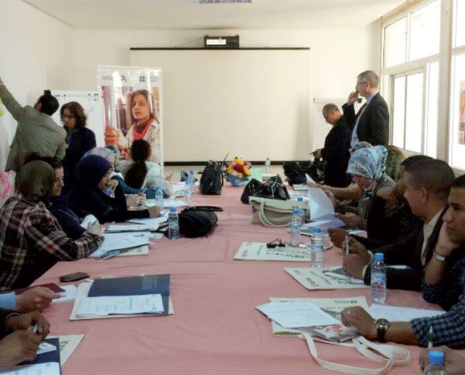
The Prefectural Committee for Human Development (CPDH) of the Agadir Ida Outanane prefecture held a meeting at the headquarters of the Agadir wilaya on Wednesday, September 7, 2011, under the chairmanship of the wali of the Souss Massa Drâa region, governor of the Agadir Ida Outanane prefecture, and president of the Committee.
The purpose of this meeting was to identify four (04) urban neighbourhoods to be targeted by the programme to fight against social exclusion in urban areas, and the presentation of the six (06) rural communes targeted by the programme to fight against poverty in rural areas within the framework of the INDH programme for the 2011-2015 period.
The six (6) rural communes in question were chosen on the basis of the 14% threshold as the poverty rate instead of the 30% adopted for the first phase 2006-2010. These six (06) target rural communes are: Aziar, Tadrart, Tiqqi, Imouzzer, Tamri, and Aqesri.
The members of the Prefectural Committee also chose four (04) new neighbourhoods on the basis of local consultations conducted jointly by the CPDH and the High Commission for Planning while taking into account the criteria set in ministerial message no. 15040 of August 10, 2011, and the classification of the neighbourhoods of the city of Agadir in accordance with poverty indices and the insufficiency of access to basic infrastructure (connection to drinking water, sanitation, housing condition, poverty rate, roads, etc.)
The four (04) new neighbourhoods chosen by the CPDH at the level of the city of Agadir are as follows: Ahlaka Imouanssisse Takoute N’aït Abderrahmane, Hay Mohammadi, Lakhyam Lagouira, Assaka in Tikiouine.
It should be recalled that the six (06) old target neighbourhoods at the level of the city of Agadir, which have experienced extensions including new agglomerations, are maintained. These are Taddart, Anza; El Hajeb, douar Laârab in Tikiouine; Bir Anzarane, douar Souiri in Tikiouine; Bensergao centre; Aghroud in Bensergao; the foothills zone neighbourhood (Aït Taoukt, Aït El Moudden, Ighil Oudardour), with in addition two peri-urban neighbourhoods: Drarga centre and Aourir centre, for a total of twelve neighbourhoods.
At the end of this CPDH meeting, Ms. Saloua Benkirane, head of the Social Action Division at the Agadir Ida Outanane prefecture (DAS), made the following statement to us: "For the first period 2006-2010, we had three programmes within the framework of the INDH: the programme to fight against precariousness, the programme to fight against social exclusion in urban areas, and the transversal programme. For the second period 2011-2015, we have four programmes: the three I have just mentioned to which we have added the programme to fight against poverty in rural areas where the poverty threshold of rural communes exceeds 14%. So, we have six target rural communes and twelve urban and peri-urban neighbourhoods, for a total of eighteen targets in all". And Ms. Benkirane added: "So now, we are going to start working with the local human development committees, then the animation teams who will carry out the participatory diagnosis with the help of the Social Action Division. And after that, the local committees will work on the initiatives to be submitted to the CPDH for study and validation. So, we are now in the participatory diagnosis phase".
And the Head of the DAS concluded: "The priority for this second phase of the INDH is AGRs (income-generating activities). We must work especially with young graduates, and women too. Education and health are also among the priorities. But AGRs constitute the great priority. And of course, we will call on the concerned external services so that they work with them".
News 12 Sep 2011 3 min read
Agadir Ida Outanane Prefecture: Twelve neighbourhoods and six rural communes targeted by the INDH