Organised in collaboration with the Scientific Institute of Rabat, the Society for the Protection of Birds in Morocco (GREPOM), the Society for the Protection of Animals and Nature (SPANA), the Moroccan-German cooperation project PRONALCD/GTZ and Birdlife International, this Awareness Day scheduled at the Al Akhawayn University campus will debate more than one subject relating to wetlands in Morocco, their interest and the need for their preservation from degradation, including the conservation and management of wetlands (problematic, achievements and perspectives), the presentation of the practical guide for the development of environmental education and awareness programmes in protected areas, the presentation of the guide for conducting a diagnosis for the development and management of a wetland and information, awareness and education tools and materials at the level of the Bas Loukkos wetland complex.
In this context and while waiting to see clearly the results of such an awareness day and the recommendations that will be adopted there for better conservation and management of the dozens of wetlands that our country enjoys in general and the Middle Atlas region and the Ifrane National Park in particular, we would like to point out that the city of Ifrane experiences significant tourist influx every year with thousands of national and foreign holidaymakers who opt for this destination as a holiday and resort station to live in the green, if only for the time of a weekend in the various green tourist sites that this floristic crossroads of undeniable diversity and complexity that Morocco in general and the Moroccan mountain in particular possesses, far from the stress of large urban areas and metropolises.
Indeed, due to its climatic and ecological conditions and its position between European, Saharan and Macaronesian flora, Morocco is known for the richness of its biological diversity, its ecosystems, and above all, for its wetlands which record a considerable flow of visitors each year. Areas threatened, more and more, by over-visitation which harms the natural environment.
Among these most threatened wetlands, which incite reflection and the mobilisation of all nature lovers, we can cite the Val d'Ifrane which is crossed by Oued Tizguite which, by itself, expresses very well the natural richness. This area, one of the most sought after in the Kingdom, records nearly 150,100 visitors per year with visitation rates varying between 103,569 visitors in summer 2003 and nearly 10,506 visitors in spring 2004, passing through 34,523 visitors in the month of September of autumn 2003 and a little less than 1,500 visitors in winter 2004.
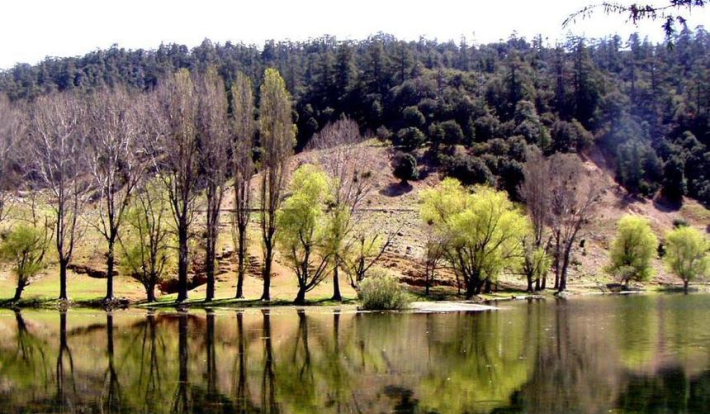
The Val d'Ifrane, well known for having housed its beautiful cascade of virgins and that of the valley, its beautiful site of the Source Vittel, its green prairie of the city centre and its memorable lake with crested coots and its island of love, among others, expresses well the richness of the area.
Indeed, in addition to the main forest species that cover its watershed and which are essentially constituted of cedar, holm oak, oxycedrus juniper, maritime pine and Arizona cypress, the Val d'Ifrane is probably the site where the most beautiful ash formation (Fraxinus angustifolia) of Morocco exists. It is also a valley crossed by Oued Tizguite, which is one of the watercourses where the vegetation is the most varied with more than thirty species listed so far. Likewise, several species of vertebrates rare or localised in Morocco have been reported in the watercourse of Oued Tizguite such as the otter, the Fario trout, the gudgeon, the red-clawed crayfish in danger of extinction, the pond turtle, the natrix natrix, the dipper and the grey wagtail. The artificial water body of Ifrane located in the heart of the valley, just at the exit of the city towards the city of Fez, has allowed the installation of the crested coot as well as a colony of cattle egrets. Subject to permanent disturbance, this beautiful lake houses in winter some 200 birds with especially mallard ducks and dozens of shovelers and common coots and crested coots.
Oued Tizguite is a watercourse classified by annual fishing decree as water classified for salmonids from the sources to the wooden bridge of Sidi Brahim. The section from the sources to the footbridge at the level of the Source Vittel is considered a permanent reserve, while the rest of the wadi is open to fishing. The ichthyofauna livestock of this watercourse is essentially constituted of Fario Trutta, Barbus nasus, Corhynchus mykiss, Barbus callensis, Astacus astacus and Scadinis erytrophtalmus.
This livestock, according to specialists, represents one of the best bio-indicators of pollution and allows a sustainable valorisation of this ecosystem by the rational practice of sports fishing. Regarding this sport which is an activity that is practised with a line in certain rivers and bodies of water, it essentially concerns noble species highly sought after by fishermen such as trout, pike, black-bass, perch and zander.
This sport unfortunately is in regression in the Val d'Ifrane as evoked by the low number of fishermen met as well as the number and the small size of the pieces of fish caught. This state is due to several factors which have strongly contributed to the degradation of the biotopes of this ecosystem. Indeed, according to a study carried out very recently, there are no more than a hundred fishermen today in the Val d'Ifrane during the fishing season while the development booklet of this watercourse testifies, by way of indication, to 700 fishermen having captured 3,500 trout only on the day of its opening to fishing for the year 1956.
That said, it is necessary to signal to all this beautiful world, which is in the city of Ifrane and which goes by thousands per day on the Val d'Ifrane for a cure of oxygen and a good relaxation in the beneficial shade of its foliage, that the site is not only the famous Source Vittel or the cascade, so well known, of the virgins, but also and above all one of the most precious wetland ecosystems of Ifrane and the Middle Atlas very monitored until the end of the last century because it housed plants, insects and unique, remarkable animals, for the most part endemic to Morocco and which deserves our protection and our attention to preserve it against any degradation.
On this occasion, we launch a solemn appeal to all good consciences to say that the Val d'Ifrane is very threatened and that with simple gestures of civic-mindedness and good conduct, we will arrive together to save what remains so beautiful to preserve. In this perspective, we deemed it good to prescribe some rules of conduct to respect: - do not introduce your vehicle into the deepest part of the forest and the prairies of the valley located between Vittel and the Zaouia of Sidi Abdeslam; do not wash with non-degradable detergents in the soiled waters of the Oued Tizguite; - if you have carpets, do not bring them to clean them on the spot, in the watercourse of Tizguite as is the tradition at the beginning of the 21st century which has dropped the municipal decree of yesteryear prohibiting such a practice; - if you have a sheep to fatten, it will no longer be part of the party and it will never be able to mow the surroundings again, because this other tradition of the 2000s prohibited by the said municipal decree of yesteryear is excluded nowadays still thanks to the distress calls launched in 2005 by the Association of Friends of the Val d'Ifrane by press among other means; teach your children good conduct such as not shouting too much so as not to disturb the silence of nature, not trampling on flowers and breaking branches, not massacring birds with a slingshot; do not give them a hand to decapitate the last little innocent snake, to trample the "abominable" toad and finish with creation, in the name of old demons; - do not wallow in numbers on the soft grass and avoid happy ball games which transform, little by little, the ground into galvanised earth! All this to the thunderous sound of your car radio, in order to cover the futile singing of birds, to cause the brood to abort; do not abandon your waste, your greasy papers, your various packaging in the prairies, on the banks and in the water of the wadi! Do not forget also to pick up this "little extra" that represents your child's diaper, or even the sanitary napkin. do not accept a horse ride in single file even in the prairies of the valley, it will please the many kids who offer it to you, but the lawns, the paths and their berms will only be better compacted if you accepted it.
President of the Association of Friends of the Val d'Ifrane for the protection of the environment and the promotion of ecotourism
News 31 Jan 2011 8 min read
World Wetlands Day: Together to succeed in the PAG of the Val d'Ifrane
The High Commissioner for Water and Forests and the Fight against Desertification, Abdeladim Lhafi will preside, Tuesday 1 February 2010, in Ifrane, the commemoration ceremony of World Wetlands Day (Editor's note: celebrated on 2 February each year), placed this year under the theme "Forests: vital for water and wetlands".