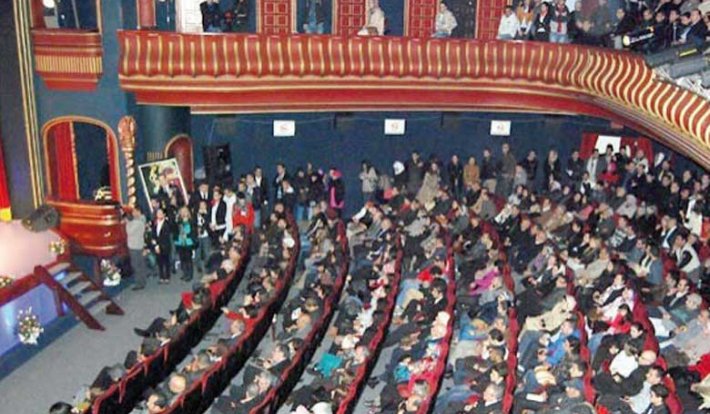
The twenty-second edition of the International Mediterranean Film Festival will take place from 26 March to 2 April 2016 in Tetouan. Luis Minarro will chair the feature film jury and Amir Emry the short film jury, while the Belgian Karine de Villers will head the documentary competition jury. A fourth jury, created this year in tribute to the late Mostapha Mesnaoui, will be chaired by Mohamed Noureddine Affaya.
Mediterranean cinema professionals will head the juries of the twenty-second edition of the International Mediterranean Film Festival from 26 March to 2 April 2016 in Tetouan. Thus, director and producer Luis Minarro will chair the feature film jury. Amir Emry, an Egyptian critic, will be in charge of carrying out his mission as president of the short film jury. The documentary competition jury will, for its part, be chaired by the Belgian director Karine de Villers. A fourth jury was created this year in tribute to the late Mostapha Mesnaoui, one of the great figures of literature and film criticism in Morocco and the Arab world.
Luis Minarro, president of the feature film jury, is one of the leading figures of contemporary Iberian cinema. He has to his credit more than 23 films that he has produced in 15 years, films that have represented Spanish cinema in the most famous international festivals such as Venice, Cannes, Toronto, Locarno, New York, Buenos Aires, Shanghai… He has worked, among others, with Manuel de Oliveira, José Luis Guérin, Marc Recha, Albert Serra, Lisandro Alonso, and José Maria de Orbe. In 2010, he won the Palme d'Or at the Cannes Film Festival, ex aequo with other producers, for the film "Uncle Boonmee Who Can Recall His Past Lives". As for Amir Emry, an Egyptian critic residing in London, who will chair the short film jury, he is known for his numerous writings and research on cinema and for his interventions in major universities and cultural institutes in Cairo, Tehran, Rome, and London. He has also collaborated with Arab TV channels and the Arabic section of the BBC. He is the author of a dozen books on cinema.
He has been a jury member several times in numerous Arab and international festivals. He was a member of the Egyptian Association of Film Critics between 2001-2003 and director of the Ismailia International Film Festival for Documentaries and Shorts (2001 to 2012). He is the founder of the site "Eye on Cinema", of which he was editor-in-chief until 2011. The Belgian filmmaker Karine de Villers will chair the documentary film jury for this twenty-second edition. She studied History of Art in non-European civilisations, archaeology, and anthropology at the Free University of Brussels. In the early 90s, Karine made her way into the world of cinema by directing her first documentary "Je suis votre voisin" in 1990, which tells the daily life of the inhabitants of a small neighbourhood where she lived herself. The film was well received, which encouraged her to take an interest, in her subsequent films, in the details of daily life. She subsequently directed several other documentaries such as: "Comme je la vois", "Le petit château", which won the Grand Prix of the Scam in Paris in 2003, and "Luc de Heusch, une pensée sauvage" in 2007.
In its desire to pay tribute to the late Mostapha Mesnaoui, writer and critic, the festival has created the Prize that will bear his name and whose jury president for this edition is none other than the writer and researcher Mohamed Noureddine Affaya, a close friend of the deceased, and one of the most illustrious writers and researchers in the Arab world, a respected academic in Morocco, currently president of the Association for Research in Intercultural Communication. He has published several works in Arabic and French, including, but not limited to, "Identity and Difference...", "Modernity and Communication, Questions of Renaissance in Morocco", "The Other in Arab-Muslim Thought", "About Contemporary Philosophical Criticism, its Western Sources and its Arab Manifestations..." He has several publications in the field of film theory and criticism, the most well-known work being "Cinematic Discourse between Writing and Interpretation".