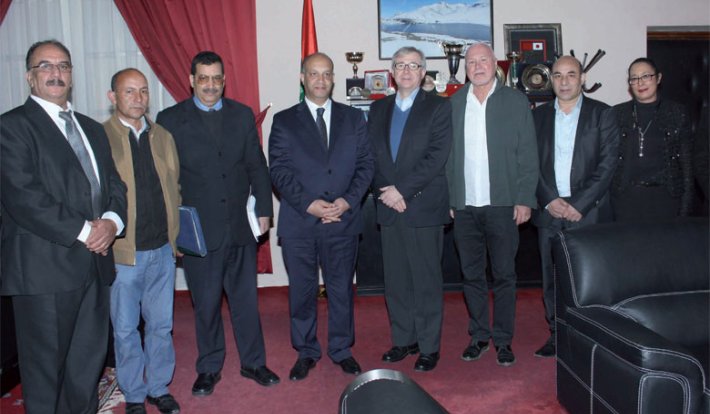
All eyes were on the douar Aït Abdi, in the Al-Haouz province, on Saturday 28 February, which received a visit from the Norwegian ambassador to Morocco, Are-Jostein Norheim, on the occasion of the presentation ceremony of a Norwegian book about this small, isolated locality in the rural commune of Tazart.
The book, entitled “Sensations of a Berber village, scenes of life in Aït Abdi”, the fruit of a collaboration between the Norwegian University of Lillehammer and the Moroccan Cadi Ayyad University of Marrakech (UCAM), retraces the different facets of the daily life of the local population and highlights the cultural and socio-economic particularities of the village. The publication of this 160-page book, whose texts are the work of Pierre Nygren, professor of psychology and sociology at the University of Lillehammer, and the images of Anne
Lee Ensgtrom, an independent photographer based in Denmark, tend to reflect, through
testimonies and photos, the sensations felt while following the daily life of the inhabitants
of the locality.
This book, the proceeds from the sale of which are intended for socio-economic projects in the village, has already been presented in Oslo, in the presence notably of Saadia El-Alaoui, ambassador of the Kingdom to Norway, and members of the Moroccan community established in this Scandinavian country.
The Norwegian diplomat took this opportunity to congratulate the University of Lillehammer which, with its various projects, including that of the production of this book, contributes to establishing a bridge between the two cultures, just as he stressed the need to “strengthen the intercultural dialogue which is essentially universal and based on the equality of the partners involved”.
This initiative is indeed part of a long series of research and development projects piloted by the Norwegian university in the Al-Haouz province, the latest of which was the equipping, last September, of an Aït Abdi primary school with new information and communication technologies (NICT) through familiarising pupils with the use of digital tablets. Called the “iPad Project” and considered a pilot experiment, said project aims in particular to stimulate the learning of algebra using the “DragonBox” programme and to encourage children to use NICT and other “DragonBox” programmes in disciplines such as geography, biology, Islamic education and language learning.