

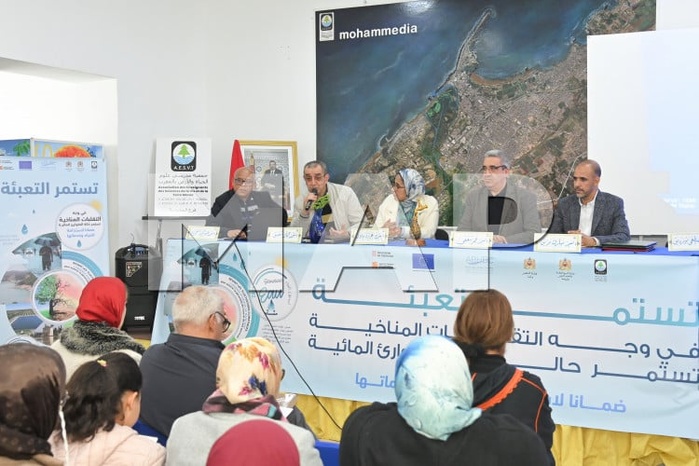
Organised at the Centre for Environmental Education and Sustainable Development by the Association of Life and Earth Sciences Teachers in Morocco (AESVT), in collaboration with the Ministry of National Education, Preschool and Sports, as well as several hydraulic basin agencies and partners, this meeting aimed to exchange ideas and innovative solutions for the sustainable management of this vital resource.
Speaking on this occasion, the Director of the Bouregreg and Chaouia Hydraulic Basin Agency (ABHBC), Omar Chafki, indicated that thanks to the enlightened vision of His Majesty King Mohammed VI, Morocco has adopted a proactive, participatory, and innovative water policy that has enabled the country to overcome numerous challenges related to water management, particularly by mitigating the effects of successive years of drought.
This approach is based on concrete and effective measures, ensuring sustainable management of the Kingdom's water resources, he noted, pointing out that the main pillars of the strategy implemented by the Ministry of Equipment and Water include the valorisation of non-conventional water through seawater desalination and wastewater reuse, optimised water demand management, long-term planning, and the crucial importance given to raising citizen awareness for the rational use of water.
For his part, the President of the AESVT-Mohammedia Section, Abdelmajid Sahraoui, emphasised that this symposium, organised on the occasion of World Water Day, constitutes a platform for exchange between researchers, experts, and institutional actors regarding innovations in water management.
He recalled the urgency of acting in the face of growing climate challenges, advocating for education and scientific research as fundamental pillars for preserving natural resources.
“Faced with the societal challenge that water management represents today, it is crucial to mobilise all actors, beyond mere technical measures,” stressed, for his part, the Director General of School Life Organisation at the Ministry of National Education, Preschool and Sports, Abdelmoumen Talib.
In a speech read on his behalf, Mr. Talib affirmed that awareness and education are essential to instil a culture of preserving this resource, noting that the Ministry of National Education is acting in this direction through two major axes: integrating the theme of water into school curricula and implementing educational activities aimed at raising awareness and encouraging students to adopt responsible behaviours.
It should be noted that this symposium was marked by the signing of a partnership agreement between the AESVT and the ABHBC. According to the AESVT President, Abderrahim Ksiri, this agreement aims to strengthen awareness and environmental education actions by incorporating them into a continuous approach throughout the year.
This convention will allow for the deployment of educational and awareness programmes on water resource management, relying on innovative models developed in Mohammedia, he specified in a statement to the press, noting that these initiatives will be extended to the 40 branches of the AESVT across Morocco.
Held under the theme “Faced with climate fluctuations, the water emergency persists to ensure the sustainability of water and its services”, the National Water Week is organised until March 29th.
In addition to the national symposium held in Mohammedia, regional meetings are planned in Tetouan, Marrakech, Fez, Agadir, and Guelmim, accompanied by local and national mobilisation activities.
Speaking on this occasion, the Director of the Bouregreg and Chaouia Hydraulic Basin Agency (ABHBC), Omar Chafki, indicated that thanks to the enlightened vision of His Majesty King Mohammed VI, Morocco has adopted a proactive, participatory, and innovative water policy that has enabled the country to overcome numerous challenges related to water management, particularly by mitigating the effects of successive years of drought.
This approach is based on concrete and effective measures, ensuring sustainable management of the Kingdom's water resources, he noted, pointing out that the main pillars of the strategy implemented by the Ministry of Equipment and Water include the valorisation of non-conventional water through seawater desalination and wastewater reuse, optimised water demand management, long-term planning, and the crucial importance given to raising citizen awareness for the rational use of water.
For his part, the President of the AESVT-Mohammedia Section, Abdelmajid Sahraoui, emphasised that this symposium, organised on the occasion of World Water Day, constitutes a platform for exchange between researchers, experts, and institutional actors regarding innovations in water management.
He recalled the urgency of acting in the face of growing climate challenges, advocating for education and scientific research as fundamental pillars for preserving natural resources.
“Faced with the societal challenge that water management represents today, it is crucial to mobilise all actors, beyond mere technical measures,” stressed, for his part, the Director General of School Life Organisation at the Ministry of National Education, Preschool and Sports, Abdelmoumen Talib.
In a speech read on his behalf, Mr. Talib affirmed that awareness and education are essential to instil a culture of preserving this resource, noting that the Ministry of National Education is acting in this direction through two major axes: integrating the theme of water into school curricula and implementing educational activities aimed at raising awareness and encouraging students to adopt responsible behaviours.
It should be noted that this symposium was marked by the signing of a partnership agreement between the AESVT and the ABHBC. According to the AESVT President, Abderrahim Ksiri, this agreement aims to strengthen awareness and environmental education actions by incorporating them into a continuous approach throughout the year.
This convention will allow for the deployment of educational and awareness programmes on water resource management, relying on innovative models developed in Mohammedia, he specified in a statement to the press, noting that these initiatives will be extended to the 40 branches of the AESVT across Morocco.
Held under the theme “Faced with climate fluctuations, the water emergency persists to ensure the sustainability of water and its services”, the National Water Week is organised until March 29th.
In addition to the national symposium held in Mohammedia, regional meetings are planned in Tetouan, Marrakech, Fez, Agadir, and Guelmim, accompanied by local and national mobilisation activities.
