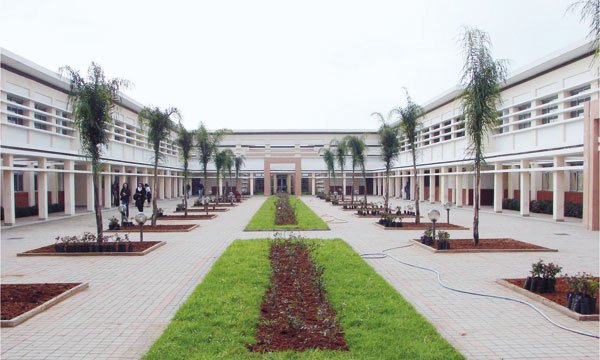
An annual report relating to achievements for the year 2011. This is one of the latest publications of the Hassan II Mohammedia-Casablanca University (UH2MC). The achievements in question are inherent to the objectives contained in the University's development project, in compliance with the 2009-2012 Emergency Plan, which had charted the path to follow to allow universities to meet the major challenges they must face, notably to increase their reception capacities and raise the quality of training with a view to accompanying the projects in which Morocco has engaged. The UH2MC development project concerns governance, training, and scientific research and is articulated around the quantified objectives of the Emergency Programme. This includes the development of the training offer, the fight against repetition and dropping out, the improvement of the employability of graduates, the promotion of scientific research, and the strengthening of the skills of university staff, as well as the improvement of the governance of the university establishment and the strengthening of its autonomy. "To consolidate the good governance of the university and prepare it for the autonomy stipulated by Law 01.00, the UH2MC oriented its actions during the year 2011 towards the strengthening and modernisation of its bodies, which are supposed to offer it the opportunity to self-manage and give it the possibility to act and innovate while taking into account the requirements of the socio-economic environment," reports the MAP agency. For the record, the expectations of the development project concern initial and continuing training programmes, research policy, administrative organisation, as well as the development of institutional partnerships with a view to optimising human and material resources. Regarding training, it is indicated that the UH2MC has offered a range of training courses meeting the needs of its socio-economic environment, with a pedagogical supervision rate higher than the national average. The report in question also mentions the strengthening of the University's national and international relations. "The field of application of national conventions in 2011 focused on the promotion of cooperation in terms of scientific research, continuing training for the benefit of staff, internships for the benefit of students, and the organisation of scientific and technical events of common interest".
The objectives set through the development of cooperation and partnership relations consist, among other things, of the exchange of students in initial training, favouring the reception of students in doctoral training and for internships in university laboratories or partner companies, as well as providing mutual participation in congresses, colloquia, and courses organised by one or the other of the universities. "Within the framework of international partnership, the UH2MC has intensified the exchanges of teacher-researchers, academic and technical staff, and students and has facilitated mutual participation in research projects and the development of joint training," underlines the same source. Finally, given the rapid evolution that characterises it, the UH2MC has recorded an increase in teaching staff, administrative and technical staff, student numbers, the number of courses and modules, as well as the necessary equipment and premises.
Responding to decentralisation
The Hassan II Mohammedia-Casablanca University (UH2MC), the first nucleus of which was created in 1984 to respond to the decentralisation of university institutions, occupies an important place within Moroccan universities due to its particular geographical position, located between the economic capital and the administrative one. This institution has been able to build its reputation thanks to the efforts made by the teacher-researcher body and the administrative staff who have set themselves a clear objective: To adapt training and research at the UH2MC to the requirements of integrated development at the local, regional, national, and international levels. The University has 77 accredited research laboratories, as well as 7 research units associated with the CNRST (National Centre for Scientific and Technical Research) and 5 Doctoral Studies Centres. In short, the economic and social environment of the Hassan II Mohammedia-Casablanca University offers it a space favourable to the development of knowledge. It also allows it to establish partnerships and relations with companies in the region through cooperation agreements and research programmes.