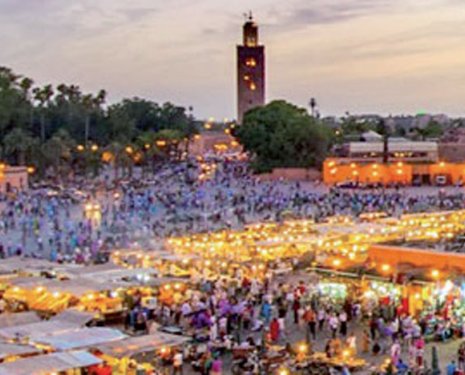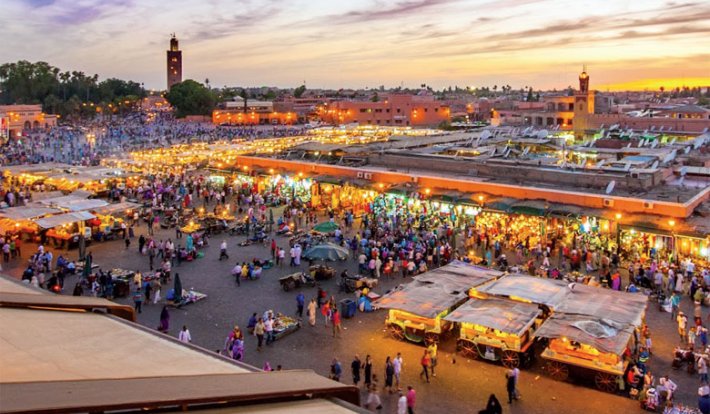
"Memory of Marrakech: Portraits in the history of the art of Halqa at Jemaa El-Fna Square" is the title of the latest work dedicated to the mythical square of the Ochre City.
The history of Marrakech remains intimately linked to its emblematic Jemaa El-Fna Square, a true open-air theatre classified in 2001 as a Masterpiece of the Oral and Intangible Heritage of Humanity by UNESCO. The beating heart of the city, this space for the performance of shows par excellence continues to be a source of inspiration and creation for generations of writers, artists, and researchers, as evidenced by the multitude of works that have been dedicated to it.
The latest to join this anthology of authors is none other than the researcher Abderrahmane El-Malhouni, who has just published a book as voluminous as it is fascinating, entitled "Memory of Marrakech: Portraits in the history of the art of Halqa at Jemaa El-Fna Square". In this 528-page large-format work in two volumes, the author offers precious information on this mythical square, its various actors, and its popular traditions, which allow the reader to learn about the hidden secrets of this "Court of Miracles", considered a cultural space steeped in history.
Composed of 22 chapters, this work is intended as a scientific guide for any amateur and critic of the Square. The work constitutes an essential reference that clearly and exhaustively answers various questions relating, in particular, to the history of the city of Marrakech and the different facets of its popular culture.
The Halqa, as a place of oral transmission of culture and as a guarantor of artistic memory, occupies a place of choice in this book. As a connoisseur, Abderrahmane El-Malhouni plunges us into this sphere created between the storyteller and his audience around stories centuries old, including tales from the "One Thousand and One Nights" and great Arab epics. The author has, in fact, dwelt on the preponderant role that storytellers have always played on the famous Jemaa El-Fna Square, whose number, unfortunately, continues to decrease without a new generation being ensured.
The names of certain narrators who have taken turns on this open-air theatre for decades are imperishable and will remain forever engraved in the memory of the Marrakchis, according to the researcher who cites, among others, Cheikh Barghout, Cheikh Mrika, Haj Ben Ba Ahmed, Sidhoum Moulay Mehdi, Moulay Ahmed El-Gazi, Cheikh Jilali, Cheikh Ba Abbes, Oulad Kharkhar Zemmouri, Cheikh Flifla, Moulay Abdeslem Assaroukh, and Houcine Bakchich.
With the skyrocketing of commercial activities on the Square, the art of storytellers and other actors has, alas, been relegated to the background. Confined to the periphery, they find themselves obliged to perform in increasingly precarious conditions and feel like strangers in their own universe, dispossessed of this magical place of which they were once masters.
It is truly time to save this age-old art that made the reputation of Jemaa El-Fna from disappearance. The two or three "hlayqiya" (performers) who are still alive experience many difficulties in transmitting their know-how, and the young, for their part, are not really ready to take up the torch from their parents. To perpetuate these popular traditions, it is more than urgent to create a school to train young storytellers.