
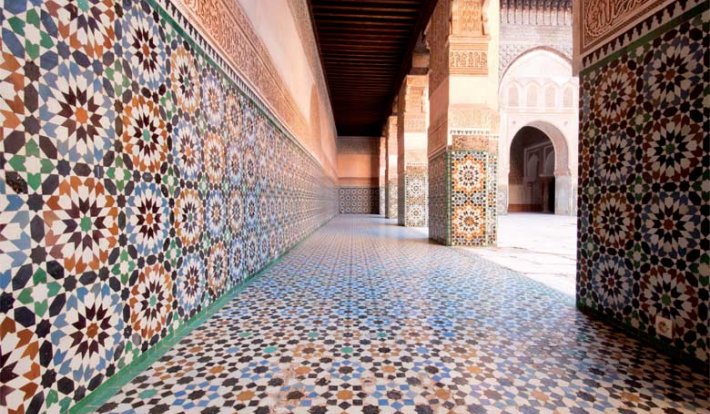
The celebration of the thirtieth anniversary of the declaration of Marrakech as a World Heritage site of humanity took on a particular character, insofar as the city succeeded in registering itself, from 18 to 20 December, at the heart of its environment and its heritage and to mobilise at its bedside three ministers of the Benkirane government.
In an atmosphere of celebration and a great moment of reunions and conviviality, numerous guests responded to the invitation to commemorate with pomp the thirtieth anniversary of the declaration of Marrakech as a World Heritage site of humanity and to share festive moments with the Ochre City. The highlight of this great cultural, scientific and artistic event was undoubtedly the impressive opening ceremony in the Ben Youssef Medersa, which offered its splendour as an Arab-Andalusian architectural jewel, during which praise rained down from all sides for Marrakech. The first to set the tone was none other than the Minister of Culture, Mohamed Amine Sbihi, who considered that the inscription of the Ochre City on the Unesco list constitutes at once a pride for all Moroccans, an invaluable enhancement of the authentic cultural heritage of Marrakech and a date to remember to recall the key moments of the city's history. The same sentiment was shared by his colleague of Communication, Mustapha El Khalfi, who observed that the Ochre City, land of knowledge, cohabitation and tolerance, possesses a heritage of exceptional universal value that requires effective protection and conservation and active enhancement. In his turn, the Minister Delegate in charge of General Affairs and Governance, Mohamed El Ouafa, of pure Marrakchi stock, underlined that the city holds a cultural and historical heritage of great value that must at all costs be safeguarded and preserved so that Marrakech continues to shine beyond the borders. The Minister of Habous and Islamic Affairs, Ahmed Toufiq, who could not make the trip, held, however, in a speech read in his name, to signal that Marrakech, a city depository of a rich historical legacy, has always shaped the Moroccan identity and rhymed with peace.
The inscription of the Ochre City on the Unesco list perfectly embodies its abundance as a cultural crossroads, a city that dreams and imagines itself, permeates with its legends, hypnotises with its spicy scents and certainly translates the history of a country rich at once by its culture, its heritage and its magic. This ceremony was also an opportunity for some observers to sound the alarm on the degradation of heritage. Some of its fierce defenders even believe that if Unesco undertakes today an objective evaluation of the classified sites, one will not be surprised to see a certain number among them declassified. What is worrying for the future of the medinas is the forgetting of their destiny in urban planning and the privilege granted to the real estate bubble to the detriment of the enhancement of cultural heritage. Hence the imperative need to redouble efforts so that this heritage continues to exist, to be transmitted and to be celebrated.
We note, however, some positive developments that give rise to a glimmer of hope. In this sense, this heritage meeting was an opportunity for the organisers to lay the foundations for a long-term safeguard plan which has the ambition of integrating all the interventions of architectural revival and restoration of the medina and the protection of its buildings against deterioration due to human action or environmental factors.
