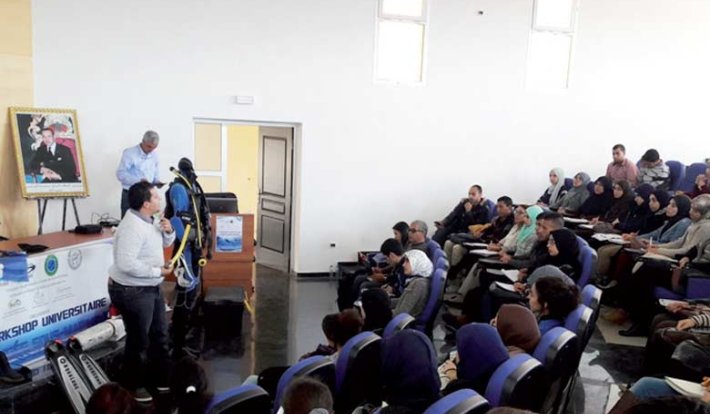
The Faculty of Sciences of El Jadida, the El Jadida Diving Association (APJ), and the Royal Moroccan Federation of Diving and Underwater Activities recently organised the first university Workshop on the theme "Scuba diving: A tool for research in marine biology".
This workshop, in which 75 young researchers (master's students, doctoral students...) participated, offered theoretical and practical lessons on scuba diving with a particular look at its various uses for scientific research in the field of underwater life exploration. The speakers thus addressed the fundamental notions of physical and biological oceanography, scuba diving between sport, leisure, and professionalism, the physical laws and the great constraints to the discovery of the underwater world, scuba diving as a tool for scientific research and protection of the marine environment.
Practical thematic workshops allowed participants to touch the material and equipment for scuba diving closely with detailed explanations on their utility and use. The second day was devoted to diving baptisms for the benefit of the participants.
The student researchers were able to beat their first fins underwater, equipped with diving suits and putting their theoretical knowledge to the test under the attentive eye of the APJ trainers, who initiated them to the discovery of the big blue. According to the organisers, this workshop is the first in Morocco to offer an integrated programme linking the learning of scuba diving to the diversity of applications for scientific research on underwater environments.
In addition to the theoretical and technical training in scuba diving essential for pleasure or scientific exploration, it will allow future divers to become professional actors operating in the fields of protection of aquatic ecosystems (marine, lacustrine, artificial), in archaeological studies, the handling of wrecks as well as in various civil engineering sectors operating in various types of hydro-systems. It is therefore understood that the mastery of the diving activity could correspond to an important source of income, provide jobs, and diversify the tourist offer in several marine or lacustrine sites in Morocco.