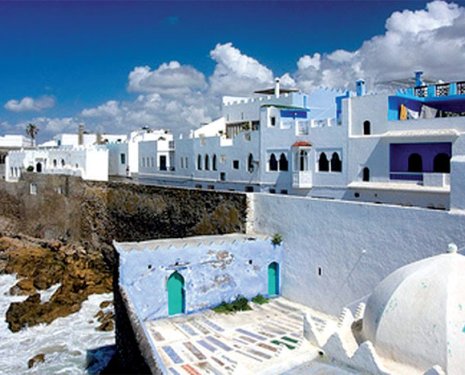
Like every year, the white city, known for its seaside vocation, records the lowest visitor numbers in January and February. With a capacity of nearly 1,000 classified beds, Asilah's hotel and tourist accommodation establishments do not all manage to make ends meet, particularly during this low season period. "Hotels in the city can generally only reach an average occupancy rate of 15% during this period," says Badr Loudiyi, director of a tourist establishment in Asilah.
Furthermore, the tourist season in Asilah has not exceeded the two months of July and August for more than thirty years. "Due to the coincidence, in recent years, of Ramadan with the high season, the sector does not benefit from the entire summer holiday. Hotel and tourism operators must therefore do their best to hold on throughout the year," stresses Mr. Loudiyi.
It should be noted that the Spanish market has long remained the destination's primary client, representing 80% of the city's visitors. "However, Spanish tourists have reduced the length of their stay because of the crisis that Europe has been experiencing in recent years," says Mr. Loudiyi, noting that "the majority of Spaniards limit the number of their stays to twice a year, particularly on the occasion of Christmas and Easter (Semana Santa) holidays."
To de-seasonalise this destination, local professionals are calling for it to be equipped with a real animation plan. The city also needs a promotional strategy, particularly in the Spanish source market.
Especially since Asilah has the most beautiful beaches, both sandy and rocky, as well as a significant number of historical and tourist sites. Local professionals are banking on another type of visitor to reduce the seasonality from which the destination suffers.
This is done by encouraging the organisation of congresses and seminars, particularly in the spaces of the Hassan II Centre for International Meetings and the Prince Bandar Ben Sultan Grand Library. It is also a matter of highlighting the richness and diversity of Asilah's hinterland, by equipping them with a series of tourist circuits.
It is recommended in this same context to favour visitor access to a certain number of historical sites such as Ksar Raissouni (Palace of Culture), the Al Kamra tower, etc., which remain closed almost all year round.