

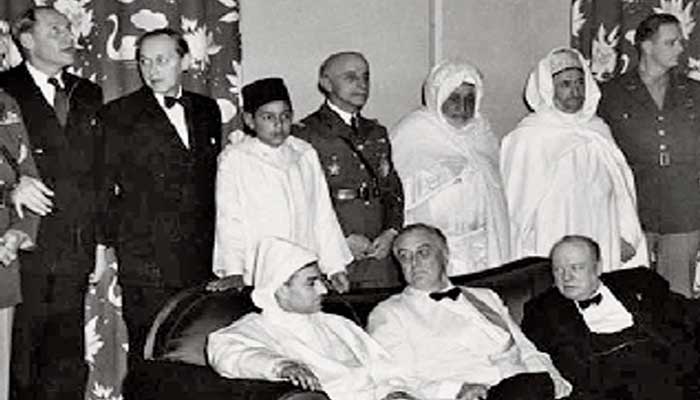
The commemoration of the anniversary of the Anfa Conference (14-24 January 1943 in Casablanca) is an opportunity to celebrate the leading role played by Morocco in finding a resolution to the Second World War. The Kingdom, while securing international recognition for its aspirations for independence, emerged as a strategic actor for peace and international diplomacy.
This historic event indeed paved the way for the Kingdom's independence, while consolidating its strategic geopolitical position in the world. Through the decisive intervention of the late HM Mohammed V, who appointed the eminent judge and scholar Sidi Mohammed Bendriss Alaoui, the Cadi Bendriss, to head the organizing committee, and thanks to the support of the United States, the Anfa Conference embodied a turning point for Morocco, but also for the post-war world order.
The Anfa Conference was held in the context of a world war at its peak. A consultation meeting of the Allies supported by figures such as US President Franklin D. Roosevelt, British Prime Minister Winston Churchill, and French Generals Charles de Gaulle and Henri Giraud.
Beyond strategic military issues, this event had a major impact on Moroccan diplomacy and served as a springboard for the Kingdom's independence. The choice of Casablanca for this meeting was not trivial. Strategically located between Europe, Africa, and the Americas, Morocco offered an ideal platform to coordinate Allied efforts against the Axis countries, particularly after the landing of Allied forces in North Africa during Operation Torch in November 1942.
The late Sultan Mohammed V seized the opportunity of this meeting to express the Moroccan people's aspirations for independence. On 22 January 1943, during his meeting with President Roosevelt, he pleaded for the liberation of Morocco from the colonial yoke, while proposing that the Kingdom adhere to the Atlantic Charter, a fundamental document in the building of the post-war world order.
This initiative by the late HM Mohammed V also marked a key moment in relations between Morocco and the United States. Roosevelt, by providing his support to Morocco's national cause, not only strengthened the legitimacy of the independence claims but also paved the way for a lasting strategic relationship between Morocco and one of the great world powers of the time.
For the expert in geostrategy and security, Cherkaoui Roudani, the historical importance of the Casablanca Conference stems from the fact that it strengthened the unity of the Allies and marked a crucial step in shaping global geopolitics.
In a statement to the MAP, he emphasizes that the choice of Morocco to host this meeting is explained by its strategic geographical position, at the crossroads of Europe, Africa, and the Americas. "Morocco proved to be a key platform for Allied military efforts, particularly after the success of Operation Torch, which had opened a front in North Africa and allowed for the securing of vital ports for Allied logistics," he said.
The decisions taken in the wake of the Anfa Conference, notably Operation Husky (landing in Sicily), were, according to Mr. Roudani, decisive steps in the defeat of the Axis and the liberation of Western Europe.
On the diplomatic front, he continues, the Anfa Conference undeniably strengthened the role of the late Sultan Mohammed V as a visionary leader capable of making Morocco's voice heard on the international stage.
"By advocating for the Kingdom's independence, he not only expressed the aspirations of the Moroccan people but also established the foundations of a flourishing relationship with the United States and other world powers," the expert notes.
From this historic moment, Morocco positioned itself as a key geopolitical actor in Allied strategies during the war, but also as an essential partner in the post-war world. Roosevelt's support laid the foundations for long-term cooperation with the United States, thus strengthening the Kingdom's international stature.
An international aura of Morocco majestically maintained by the Alaouite Sovereigns until the reign of His Majesty King Mohammed VI, whose enlightened leadership has allowed the Kingdom to enjoy a place of choice in international forums, commensurate with its historic role in the preservation of peace and dialogue between peoples and civilizations.
By Karima El Otmani (MAP)
This historic event indeed paved the way for the Kingdom's independence, while consolidating its strategic geopolitical position in the world. Through the decisive intervention of the late HM Mohammed V, who appointed the eminent judge and scholar Sidi Mohammed Bendriss Alaoui, the Cadi Bendriss, to head the organizing committee, and thanks to the support of the United States, the Anfa Conference embodied a turning point for Morocco, but also for the post-war world order.
The Anfa Conference was held in the context of a world war at its peak. A consultation meeting of the Allies supported by figures such as US President Franklin D. Roosevelt, British Prime Minister Winston Churchill, and French Generals Charles de Gaulle and Henri Giraud.
Beyond strategic military issues, this event had a major impact on Moroccan diplomacy and served as a springboard for the Kingdom's independence. The choice of Casablanca for this meeting was not trivial. Strategically located between Europe, Africa, and the Americas, Morocco offered an ideal platform to coordinate Allied efforts against the Axis countries, particularly after the landing of Allied forces in North Africa during Operation Torch in November 1942.
The late Sultan Mohammed V seized the opportunity of this meeting to express the Moroccan people's aspirations for independence. On 22 January 1943, during his meeting with President Roosevelt, he pleaded for the liberation of Morocco from the colonial yoke, while proposing that the Kingdom adhere to the Atlantic Charter, a fundamental document in the building of the post-war world order.
This initiative by the late HM Mohammed V also marked a key moment in relations between Morocco and the United States. Roosevelt, by providing his support to Morocco's national cause, not only strengthened the legitimacy of the independence claims but also paved the way for a lasting strategic relationship between Morocco and one of the great world powers of the time.
For the expert in geostrategy and security, Cherkaoui Roudani, the historical importance of the Casablanca Conference stems from the fact that it strengthened the unity of the Allies and marked a crucial step in shaping global geopolitics.
In a statement to the MAP, he emphasizes that the choice of Morocco to host this meeting is explained by its strategic geographical position, at the crossroads of Europe, Africa, and the Americas. "Morocco proved to be a key platform for Allied military efforts, particularly after the success of Operation Torch, which had opened a front in North Africa and allowed for the securing of vital ports for Allied logistics," he said.
The decisions taken in the wake of the Anfa Conference, notably Operation Husky (landing in Sicily), were, according to Mr. Roudani, decisive steps in the defeat of the Axis and the liberation of Western Europe.
On the diplomatic front, he continues, the Anfa Conference undeniably strengthened the role of the late Sultan Mohammed V as a visionary leader capable of making Morocco's voice heard on the international stage.
"By advocating for the Kingdom's independence, he not only expressed the aspirations of the Moroccan people but also established the foundations of a flourishing relationship with the United States and other world powers," the expert notes.
From this historic moment, Morocco positioned itself as a key geopolitical actor in Allied strategies during the war, but also as an essential partner in the post-war world. Roosevelt's support laid the foundations for long-term cooperation with the United States, thus strengthening the Kingdom's international stature.
An international aura of Morocco majestically maintained by the Alaouite Sovereigns until the reign of His Majesty King Mohammed VI, whose enlightened leadership has allowed the Kingdom to enjoy a place of choice in international forums, commensurate with its historic role in the preservation of peace and dialogue between peoples and civilizations.
By Karima El Otmani (MAP)
