
The city of Tiznit was, from 21 to 23 October, the world capital of solidarity tourism. It hosted the FITS MED 2012 on the theme "Role of tourism in the sustainable development of sensitive Mediterranean territories." The capital of traditional jewellery welcomed participants from 16 countries, coming notably from the Maghreb, the Middle East, and Europe. This major meeting was an opportunity to shed light on another model of tourism development that perfectly integrates the strategic choices of the Kingdom. A territorial tourism capable of enhancing local potential and resources. As was underlined by the initiators of the Forum, it is a question of tourism controlled by the populations and for their benefit. Based more on social capital than on money. The FITS Morocco 2012 had as its essential objectives to sensitise public and private actors of territorial development to the interest of promoting responsible and solidarity-based tourism; to make better known, at the international level, the tourist potential that certain disadvantaged areas of the Mediterranean, of Morocco in particular, contain; to promote the exchange of good practices and consultations between local actors involved in the development of Mediterranean territories; and finally to formulate concrete proposals to contribute to strengthening the tourism development of fragile areas of Mediterranean countries. Several conferences and workshops were led, in this regard, by national and international experts, academics, and associative actors. They aroused the interest of a wide range of actors present. The choice of Tiznit to host the Forum is explained by the fact that the region has a strong tourist vocation with the Agadir hub, but whose hinterland is still little open to tourism.
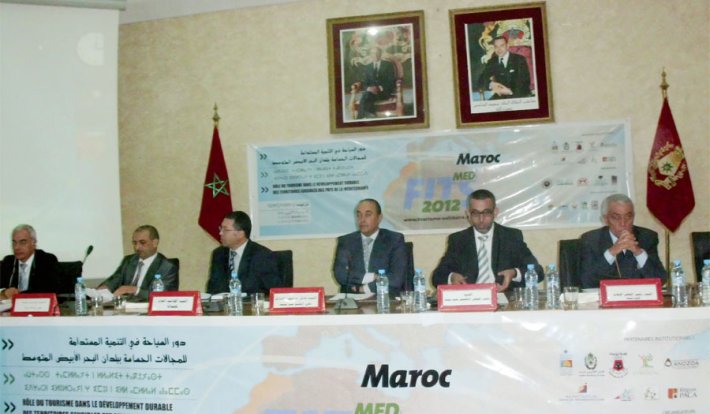
It is also a region that has very significant experiences, with a dynamic mobilisation of local authorities, especially since the social and solidarity economy sector is also well developed there. Like the Taliouine Youth Initiatives Forum, it is young people who have decided to take their destiny into their own hands and contribute to the development of their native land. "I was really very touched by the quality of the welcome and the generosity of the people who received us in different stages of the Southern caravan. I also really liked the climate and the landscapes. I have very good memories of this trip to Morocco as part of the Tiznit International Forum," underlines in substance Geneviève Clastres, journalist for Voyageons-Autrement.Com, the leading French portal on responsible tourism.
Note that the National Organising Committee (CNO) in Morocco associates representatives of Moroccan civil society, in particular the Moroccan Network of Social and Solidarity Economy (REMESS) and the Moroccan Network of Solidarity Ecotourism.
Questions to: Jean-Marie Collombon, General Coordinator of FITS (International Forum on Solidarity Tourism)"Elitist tourism does not contribute to solving the country's essential problems, which are employment and income"How do you envision the future of solidarity tourism?
Solidarity tourism has a bright future. For 60 years, France has been developing territorial tourism capable of creating rural jobs, enhancing heritage, and local production.
It contributes very largely to the success of tourism in a country that welcomes 75 million international tourists each year. If the European tourist brings money to the Douar, it is not necessary to emigrate to go and look for money in Europe. And the Moroccan experience is significant in this regard. It is a very beautiful country that has considerable assets, its natural and cultural heritage, its gastronomy, the hospitality and kindness of its population. Multiple initiatives, supported by local associations, are already highlighting these assets and attracting more and more tourists.
Initiatives are federating. Networks are being formed like the Moroccan Network of Solidarity Ecotourism which ensures the fundamental link between tourism, terroir, and agro-ecology. The Moroccan Social Economy Network ensures, for its part, the link between solidarity tourism and social economy.
The two solidarity caravans that went, one from Tangier to Tiznit, and the other from Oujda to Tiznit, between 15 and 23 October, after the regional forums of Tangier, Oujda, Guelmim, and Tata, mobilised and involved, throughout the journey, very many communities, associations, and cooperatives. They had a very great success.
Each one mobilised a total of more than 400 participants in the various local forums and workshops.
The Tiznit international forum allowed 350 participants, with many Moroccans and French, but also participants from 16 countries, to exchange a lot and to build an ambitious Concerted Action Plan 2013-2015 for the promotion of solidarity tourism in the Mediterranean. The FITS Morocco 2012, with its 14 decentralised events that mobilised 1,460 participants in total, was undoubtedly the strongest event ever held in Morocco in the field of alternative tourism.
It is easy to understand that the tourism policy of the Moroccan government is oriented towards elitist, "sun-and-beach" tourism, concentrated on large seaside complexes. This brings foreign currency and jobs to the country, even if these jobs are precarious and seasonal. This tourism enriches developers and tour operators who are mainly in Europe. It does not contribute to solving the essential problems of the deep country, which are employment and income. My conviction is that this strategy will not allow the objective of 20 million international tourists in 2020 to be reached.
When one has assets like those of the mountain areas and the hinterland of Morocco, one must do everything possible to enhance them.
The proposals of Vision 2020 are insufficient. It is necessary to promote inter-institutional consultation, provide more financial support for projects, adapt regulations, set up training, and support networks.
In the coming years, mass tourism will stagnate and solidarity tourism will develop. Demand in Europe is evolving. More and more travellers want more nature, authenticity, conviviality, and equity. A growing number of travellers wish to meet and exchange with the population.
National and international mass tourism operators can take this new situation into account, take their clients out of the tourist ghettos where they lock them up to bring them to meet village associations and cooperatives.
Tourists will buy saffron or argan oil there and will help villagers and organisations to increase their income. But if it is to apply to these areas the methods they generally apply, which consist of crushing local prices as much as possible to maximise their profit, it is better that they leave their clients in their tourist complexes. The villagers will manage very well without them.


