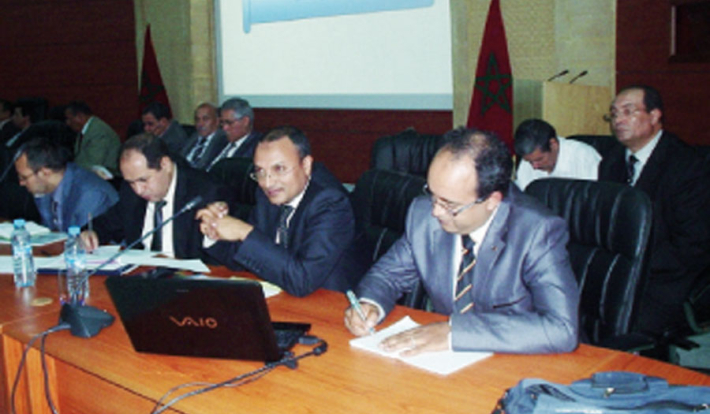
The provincial council of Sidi Kacem met recently in an ordinary session under the chairmanship of Abderrahmane Harfi and in the presence of the members of the council. The latter stressed the commitment of the council to work for the generalisation of the work carried out in the city and to extend it to the various urban and rural communes of the province. He then recalled the subjects on the agenda: the road sector in the province, that of health, the study of the partnership agreement project concerning the development work of tracks in the rural commune of Nouirate, Méchraa Bel Ksiri circle, and that of drinking water supply for the douars of the rural commune of Nouirate.
It was stressed that the achievements in terms of roads in the province of Sidi Kacem, during the last five years, concerned the treatment of 440 km of roads for a total investment of 385 million DH. These achievements are distributed between the maintenance of 170 km of roads, the repair and construction of eight engineering structures, the repair of flood damage over a linear distance of 172 km, as well as the realisation of 100 km of rural roads within the framework of the PNRR 2 programme. Other projects are currently being realised, notably the development project for five roads falling under the PNRR 2 programme over a linear distance of 36 km, as well as the work for treating landslides on the road network of the DPET of Sidi Kacem. Furthermore, it is planned by the end of the year to start work on other operations of the PNRR2 programme. Mr. Harfi concluded by saying that there remained 8 operations, totalling a linear distance of 113.5 km, to be realised within the framework of this programme to reach an accessibility rate of 76%, instead of 59%, recorded at the beginning of the programme in 2005. As for the health aspect, a provincial sensitisation campaign was organised in the province from May 18 to June 3, under the slogan "Move against cancer", in health centres and school establishments to raise awareness of the link that exists between lifestyle and cancer. Similarly, to facilitate the obtaining of the medical assistance scheme card (RAMED) giving the right to care, numerous measures were taken at the level of the various districts of Sidi Kacem which were endowed with human resources to succeed in this operation. A counter was opened, reserved for welcoming people wishing to benefit from this card and provisions were made to facilitate the procedures and allow all people who meet the requirements of the RAMED to benefit from this scheme. Faced with the increased demand for care, notably after the launch of the RAMED, it turns out that Sidi Kacem, despite its multiple potentials, only has one hospital structure, with a capacity of 210 beds. Improvements were undertaken at the level of the CHP and human and material resources were reinforced to welcome patients in good conditions.
On the sidelines of the launch of the RAMED, all services were mobilised to allow beneficiaries to have the right to the services and care available.
Figures in terms of health
The Provincial Hospital Centre (CHP) includes three central blocks and two maternity blocks. As regards the radiology and imaging rooms, the centre includes a standard table, a table for digestive, two mobile devices and two ultrasound devices, a medical analysis laboratory and 16 haemodialysis devices for a number of 16 generators. The CHP has 210 beds, of which 74 for general medicine, i.e. 35.24%, for surgical specialities 80, i.e. 38%, for paediatrics and premature babies 24, i.e. 11.42% and 32 for gynaecology-obstetrics, i.e. 12.24%.
The expected births in the urban fabric are 2,916 and in the rural 7,866. As regards women of childbearing age, they are 46,737 in urban areas and 89,430 in rural areas.