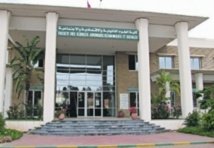
An international colloquium on the Moroccan Sahara opened on Thursday in Settat, with the participation of Moroccan and Spanish experts and academics.
Speaking at the opening of this meeting, Lhaiba Addi, president of the Centre for Political and Strategic Studies and Research on Saharan Affairs, organiser of this event, stressed that this colloquium proposes to open a debate, especially between the sons originating from the southern provinces, on the national cause, just as it will offer the opportunity for participants to reflect on the actions to be taken at the level of institutional actors and civil society for a global mobilisation in the sense of defending the legitimacy of the national cause.
The current situation imposes the need to question the national and international reality and to carry out a diagnosis of the social, political, cultural and economic situation in the Southern provinces, he said, affirming that the question of the Moroccan Sahara requires more than ever the opening of a national debate with the aim of taking advantage of relevant analyses and formulating recommendations that can contribute to helping decision-makers.
For his part, Ahmed Nejmeddine, president of Hassan 1st University of Settat, highlighted the importance of this event, which is in line with academic diplomacy and which goes hand in hand with the diplomatic actions of the executive and legislative apparatus, the goal being to enrich the debate and to favour a global mobilisation in favour of the triumph of the national cause, recalling, on the same occasion, the actions carried out by this university in this sense, notably the organisation in 2006 of a first colloquium in Settat under the theme ''What autonomy for our Southern provinces?'' and the publication of the proceedings of the colloquia organised respectively in Laâyoune in 2007 and in Dakhla in 2008 on the question of the Sahara.
He also called for the strengthening of the role incumbent upon universities and student researchers to dissect and authenticate the historical facts and realities that illuminate and value the secular ties woven between the Southern provinces and the Throne during the millennial history of the Kingdom. Other speakers highlighted the advantages brought by the Moroccan autonomy plan as a framework for settling the artificial conflict of the Sahara, putting the accent on the broad prerogatives contained therein and which go far beyond the prerogatives granted to regions in other countries. They estimated that this initiative, which benefits from broad support at the international level, both from the great powers and from international organisations, remains a serious and credible solution for this conflict.
The speakers noted, in this same framework, the obstacles that the enemies of territorial integrity place before the implementation of this proposal for considerations linked to hegemonistic aims.
News 15 Jun 2013 3 min read
International colloquium in Settat on the Sahara