Rabat is experiencing considerable development in private medical practices. According to data from the regional directorate of Rabat-Salé-Zemmour-Zaër of the Ministry of Health, the Rabat region accounts for 19% of the total national number of private practices, with a concentration in the city of Rabat (860 private practices). As for the regional private hospital supply, it remains significant with a bed capacity of 1,024 beds, or 23% of the total regional capacity. The capital also takes the lion's share of bed capacity (80%). Regarding public bed capacity, and with the exception of the Ibn Sina University Hospital, the Rabat region has 6 hospitals with a total capacity of 603 beds, or 1 bed per 4,500 inhabitants. With the CHIS, the region has one bed per 814 inhabitants. This raises the issue of the weakness of bed capacity in relation to the needs of the population. Added to this is the cramped nature of the premises. It should be remembered that the region has 121 basic healthcare establishments (ESSB), which corresponds to approximately 1 ESSB per 22,438 inhabitants, while the national average is estimated at 1 ESSB per 11,943 inhabitants.
The diagnosis of the distribution of healthcare provision in the region also reveals certain territorial disparities, particularly between urban and rural areas. Indeed, 40% of the rural population of the region is located more than 6 km from a basic healthcare network establishment. A lack of staff is also noted. Only 9% of the region's staff work in healthcare establishments in rural areas. In detail, the Rabat-Salé-Zemmour-Zaër region is characterised by a low regional average of inhabitants per doctor compared to the national average. The same applies to the regional average of inhabitants per nurse (1,873 inhabitants/nurse). The cities of Salé, Skhirat, and Témara suffer from a deficit in nurses. In Salé, there is one nurse for every 2,619 inhabitants. Worse still, half of the nurses in the region are aged 50 and over.
The other characteristic of the supply is the concentration of medical and paramedical staff in the RSSB. As for the administrative staff, it remains underdeveloped in hospitals.
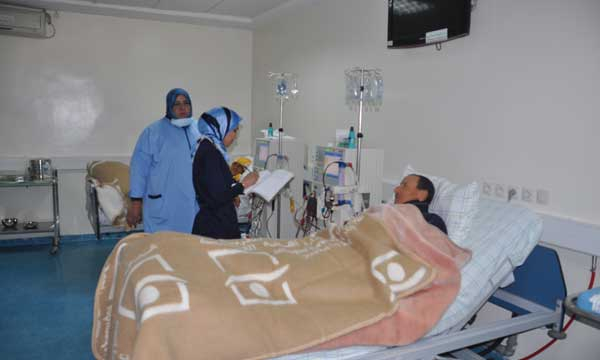
The deficit in human resources is explained, in particular, by staff resignations, early retirements, and the change in status of certain categories of human resources. In order to overcome these shortcomings, a regulation of regional healthcare provision is necessary. This involves a homogeneous distribution of human, material, and financial resources based on clear benchmarks and criteria, the formalisation of care pathways, as well as the pooling of resources by taking into account the potential of the private sector and the non-profit private sector. Public-private partnership is not left out, especially since it has proven its worth in terms of purchasing dialysis services. At the regional level, the private sector takes care of 309 patients.
Strengthening hospital infrastructure: To mitigate this poorly balanced distribution, the Ministry of Health had begun, at the regional level, projects to strengthen the region's hospital infrastructure and mitigate the imbalance observed between the cities that fall under the region. This involves the construction of 2 provincial hospital centres (CHP).
The first, which will be operational in 2 years, is located in Salé. The second, whose construction work will be completed next year, is located in Témara. Mention should also be made of the upcoming construction of a local hospital in Tamesna, for which the call for tenders is underway, as well as three other projects currently under study, namely the provincial hospital centre of Khémisset, the Moulay Youssef regional hospital centre, and the Ibn Sina University Hospital.
Health 02 Jun 2014 3 min read
A regional scheme to balance healthcare provision