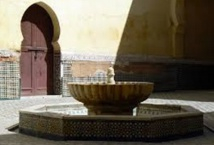
The ancient fountains which, in the past, were an integral part of the cultural, social, and religious legacy of the city of Meknès, are today in a state of advanced deterioration and even on the verge of disappearing, due to increased water consumption and galloping urbanisation.
These fountains, which refer to the idea of sharing an available good without limitation, insofar as all the historical zones of the Ismaili city (Lahdim Square, Bab Mansour, the Kasbah...) and alleys of the old Medina, regardless of their importance, were equipped with these structures to allow visitors and the population to obtain drinking water.
While these precious fountains were an important and useful piece of urban equipment, they are, however, for the most part, in a state of advanced deterioration and their repair must be classified as a priority due to their historical, social, and religious importance.
According to the Autonomous Water and Electricity Distribution Board of Meknès (RADEEM), it was decided in agreement with the urban commune to permanently remove about 27 fountains, four in Toulal and 23 located in neighbourhoods falling under the territorial jurisdiction of the urban commune, due to water wastage by the inhabitants, especially since these neighbourhoods are connected to the drinking water supply network.
Out of 47 fountains, 24 will also be removed as part of a framework agreement between the agency and the urban commune. The objective is to increase the number of houses connected to the drinking water and sanitation distribution network.
In a statement to MAP, the researcher and historian, Mustapha Benfayda, pointed out that the traditional fountains in Meknès are an integral part of the city's architectural heritage and trace its history, specifying that the first fountain built in the Ismaili city dates back to the 12th century during the Almohad era.
Most of the current fountains that supplied the inhabitants with water are on the verge of disappearing, he lamented, highlighting the need to preserve them as the city's architectural heritage.
He noted that some fountains have disappeared and others still remain, calling for the preservation of the latter through restoration programmes given the major role of these fountains in neighbourhoods and Douars that are not yet connected to the drinking water supply network.
For his part, the associative actor Mohamed Najib ben Yahya, president of the “Inqad” association of the city and historical monuments of the Ismaili city, stressed that the fountains that are on the verge of disappearing require more attention insofar as they constitute an architectural heritage that distinguishes the city, noting the efforts made by his association to raise awareness about the importance of preserving what remains of the fountains.
Heritage 04 Dec 2014 3 min read
The fountains of Meknès in constant degradation