

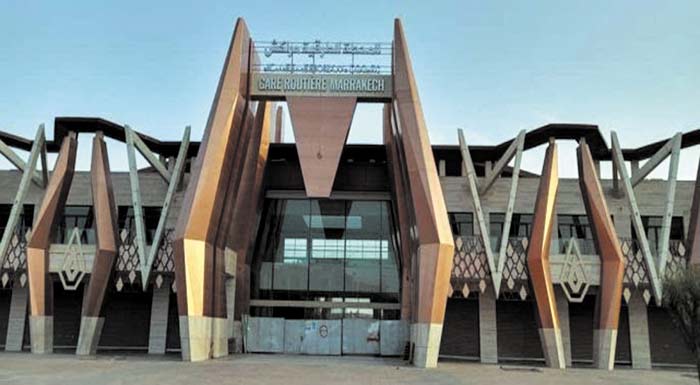
The construction of a new bus station in Marrakech, intended to embody a qualitative leap in urban transport infrastructure, finds itself today at the center of a controversy mixing economic interests, legal ambiguity, and a lack of consultation.
While the initiative was initially welcomed by local public opinion as a step towards modernization, it now raises deep questions about the transparency of urban governance and compliance with commercial and administrative law rules, reveals a complaint filed with the Marrakech Public Prosecutor's Office by the Moroccan Association for the Protection of Public Property – Regional Office.
A project welcomed… but imposed
It was within the framework of the 2009-2015 municipal mandate that the Marrakech city council validated an ambitious project: to build a new bus station in Al Azouzia, south of the city, accompanied by a taxi station and the extension of the municipal market. The whole was to be located on a six-hectare state-owned land, rented to the municipality for an annual sum of 127,200 dirhams – or 21,200 dirhams per hectare. At first glance, an exemplary partnership between local authority and public domain.
But behind the scenes, the file is far from clear.
A decision made without the main stakeholders
The catch? The decision to build this new station was made without consulting or obtaining the agreement of the main operators in the sector. However, transport professionals hold 60% of the shares of the company managing the current Bab Doukkala bus station, against 20% for the Marrakech municipality and 20% for the National Transport and Logistics Company (SNTL).
According to the statutes of this tripartite management company, any competing initiative, such as the creation of a new station, requires the agreement of all associates. This legal imperative has clearly not been respected, according to the professionals, who cry out against a flagrant violation of company law and a forced passage by local authorities.
A project with land-based aims?
Professionals do not hesitate to speak of a project guided not by public interest, but by land covetousness. They point to an attempt to appropriate the strategic land of the current Bab Doukkala station, the value of which is estimated at some 500 million dirhams (50 billion centimes), according to an appraisal whose details remain to be verified.
These accusations, if proven, could constitute a serious breach of the principle of transparent management of public property and the neutrality of municipal action.
A series of legal irregularities
The lease granted for the location of the new bus station contains a clause with heavy consequences: all constructions and improvements made by the municipality will revert to the State without any compensation at the end of the contract or in the event of termination. This automatic transfer of ownership, if not offset by a clear contractual advantage for the municipality, raises the question of the real interest of the operation for local public finances.
Furthermore, the professionals interviewed by the Moroccan Association for the Protection of Public Property denounce an opaque validation process, on the sidelines of the consultation mechanisms provided for by law. Uncertainty also persists regarding the existence of a formal agreement from the municipal council concerning these draconian rental conditions.
A succession of questionable preliminary agreements
Between 2015 and 2017, the project received no less than three preliminary agreements from the Derogations Commission, authorizing in turn its creation, its extension, and then the modification of the latter. This accumulation of derogations raises questions: why such a need for successive adaptations? And above all, have these decisions been subject to sufficient legality control?
A call for transparency and responsibility
Through this file, it is the whole question of local governance and land heritage management that is raised. The Marrakech Regional Office of the Moroccan Association for the Protection of Public Property calls for an in-depth audit of the project, in light of the rules of public law, company law, and good governance.
According to its members, it is urgent to put the principles of transparency, legality, and participation back at the heart of public decisions, without which major urban projects risk becoming vectors of private interests to the detriment of the general interest.
Hassan Bentaleb
While the initiative was initially welcomed by local public opinion as a step towards modernization, it now raises deep questions about the transparency of urban governance and compliance with commercial and administrative law rules, reveals a complaint filed with the Marrakech Public Prosecutor's Office by the Moroccan Association for the Protection of Public Property – Regional Office.
A project welcomed… but imposed
It was within the framework of the 2009-2015 municipal mandate that the Marrakech city council validated an ambitious project: to build a new bus station in Al Azouzia, south of the city, accompanied by a taxi station and the extension of the municipal market. The whole was to be located on a six-hectare state-owned land, rented to the municipality for an annual sum of 127,200 dirhams – or 21,200 dirhams per hectare. At first glance, an exemplary partnership between local authority and public domain.
But behind the scenes, the file is far from clear.
A decision made without the main stakeholders
The catch? The decision to build this new station was made without consulting or obtaining the agreement of the main operators in the sector. However, transport professionals hold 60% of the shares of the company managing the current Bab Doukkala bus station, against 20% for the Marrakech municipality and 20% for the National Transport and Logistics Company (SNTL).
According to the statutes of this tripartite management company, any competing initiative, such as the creation of a new station, requires the agreement of all associates. This legal imperative has clearly not been respected, according to the professionals, who cry out against a flagrant violation of company law and a forced passage by local authorities.
A project with land-based aims?
Professionals do not hesitate to speak of a project guided not by public interest, but by land covetousness. They point to an attempt to appropriate the strategic land of the current Bab Doukkala station, the value of which is estimated at some 500 million dirhams (50 billion centimes), according to an appraisal whose details remain to be verified.
These accusations, if proven, could constitute a serious breach of the principle of transparent management of public property and the neutrality of municipal action.
A series of legal irregularities
The lease granted for the location of the new bus station contains a clause with heavy consequences: all constructions and improvements made by the municipality will revert to the State without any compensation at the end of the contract or in the event of termination. This automatic transfer of ownership, if not offset by a clear contractual advantage for the municipality, raises the question of the real interest of the operation for local public finances.
Furthermore, the professionals interviewed by the Moroccan Association for the Protection of Public Property denounce an opaque validation process, on the sidelines of the consultation mechanisms provided for by law. Uncertainty also persists regarding the existence of a formal agreement from the municipal council concerning these draconian rental conditions.
A succession of questionable preliminary agreements
Between 2015 and 2017, the project received no less than three preliminary agreements from the Derogations Commission, authorizing in turn its creation, its extension, and then the modification of the latter. This accumulation of derogations raises questions: why such a need for successive adaptations? And above all, have these decisions been subject to sufficient legality control?
A call for transparency and responsibility
Through this file, it is the whole question of local governance and land heritage management that is raised. The Marrakech Regional Office of the Moroccan Association for the Protection of Public Property calls for an in-depth audit of the project, in light of the rules of public law, company law, and good governance.
According to its members, it is urgent to put the principles of transparency, legality, and participation back at the heart of public decisions, without which major urban projects risk becoming vectors of private interests to the detriment of the general interest.
Hassan Bentaleb
