
FrançaisEnglishالعربيةDeutschEspañolNederlandsItaliano中文

Your cart is empty

Adventure awaits!

About Kenitra

Kénitra (القنيطرة, which means "small bridge" in Arabic) is a city in Morocco, known during the French protectorate as...

News in Kenitra

Follow the latest news, projects, and official announcements from your ville.

News 12 Jun 2013 4 min read

"Security at the service of the noble objectives of sport"

The first national symposium was opened on the theme, at the Royal Police Institute in Kénitra, "violence in stadiums scrutinised from different angles and approaches"
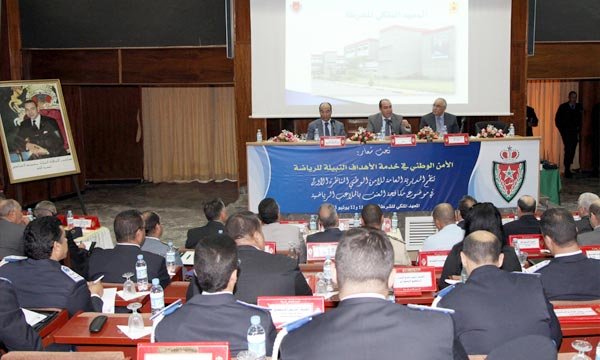
"Security at the service of the noble objectives of sport"

A multidimensional social phenomenon, violence in stadiums was scrutinised from different angles by experts representing different sensibilities, during the first national symposium on this theme opened on Tuesday at the Royal Police Institute in Kénitra. The holding of these meetings comes at the right time, at a moment when this phenomenon has become a source of concern for all political and social actors, given its impact on young people and families whose children, often minors, find themselves involved in these acts and exposed to prosecution. A magistrate presented the jurist's vision of "sports crime", a representative of the DGSN focused on "new forms of support", while the delegate of the FRMF gave an overview of "the security vision of match organisation", given that it is during football matches that acts of violence are generally reported. For magistrate Hicham Bellaoui, from the directorate of criminal affairs and pardons at the Ministry of Justice and Liberties, Law 09.09 on violence in stadiums has reconciled prevention and repression in the treatment of this phenomenon, by taking into consideration the general climate underlying sports activities, namely the spectacle. The fight against sports crime included in the text aims to guarantee a healthy environment for sports practice, protect the public and players, and preserve sports infrastructure, he noted, believing that the repressive approach is likely to contribute to mitigating the effects of violence in stadiums, alongside the pedagogical aspect, awareness-raising, and the supervision of supporters.

The "Ultras" phenomenon

After a historical overview of the "Ultras" phenomenon, generally cited in acts of violence, Mohamed Bouzfour, from the Public Security directorate at the DGSN, explained that these groups are mainly active in Casablanca, Rabat, Kénitra, Fès, and Tétouan where each of the professional teams (football) is followed by at least one group. He insisted on specifying that the "Ultras" are distinguished from hooligans, known in England and Italy, in particular by "their penchant for structuring, organisation, collective participation, and social integration", even if "some troops of the ultra movement, pushing adolescent revolt to its climax, indeed reject the institutions of social control ( ) and show themselves to be little receptive to messages that would come to undermine them". Nevertheless, he observed, "some police officers must adapt to the 'ultra' philosophy in its festive and peaceful dimension, in order to operate a permanent conciliation between this new public and the security authorities".

What measures and solutions?

To better manage this phenomenon, Bouzfour formulated certain proposals, namely an institutionalisation of cooperation and coordination between the DGSN and the FRMF to evaluate high-risk matches and ensure their proper management, the imposition of seat numbering, and the prospect of ticketing based on the supporter's national card, like the regulations established in European stadiums. Representing the FRMF, Ahmed Ghaibi, president of the programming commission, in this context, called for a partnership with the Directorate of Local Authorities for the rehabilitation and redevelopment of stadiums, as well as another with the DGSN for the appointment of a high advisor for security and the training of stewards and club security managers.

The establishment of new commissions

The FRMF is also looking into the establishment of regional commissions to fight against violence, the appointment by clubs of match organisation managers, the improvement of conditions for welcoming supporters, and their involvement in the organisation of matches and away trips, he indicated. With the help of slideshows and infographics, the deputy director of the Public Order Directorate of the Paris Police Prefecture, Olivier Paquette, presented the security system and techniques used for the management of a high-risk match like PSG-OM, of the crowd during sporting events, and of acts of hooliganism both inside and outside Parisian stadiums. In addition to those responsible for security services, the symposium, placed under the theme "national security at the service of the noble objectives of sport", brings together sports leaders, former athletes, representatives of supporter groups (Ultras), and the concerned ministerial departments. French security officials are to give presentations on the national experience in organising large-scale sporting events and fighting against violence in stadiums. The programme of these meetings, which end on Wednesday, also provides for an intervention by a member of the Ultras on the role of civil society in the supervision of supporters.

Listen
Size:

