

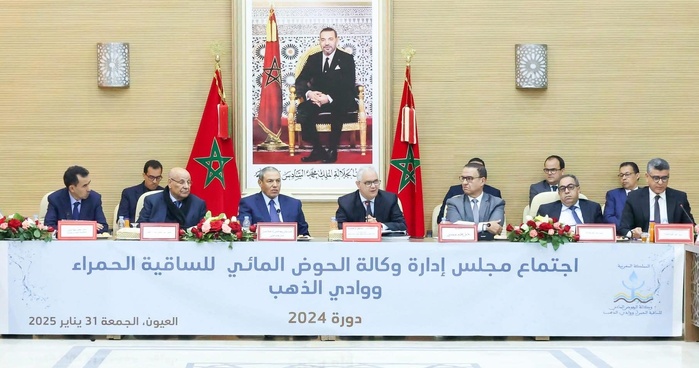
Speaking on this occasion, Baraka recalled the strategic importance of water resources in the economic and social development process, highlighting in this regard the issue of structural drought in most regions of the Kingdom, linked in particular to the phenomenon of climate change.
In this sense, he affirmed that the government is working at all levels to address this issue in light of the Royal Directives contained in the speech of HM King Mohammed VI on the occasion of the 25th anniversary of the Throne Day, in which the Sovereign emphasised the need to redouble efforts, design innovative solutions, and employ good governance in managing the water issue.
After providing an overview of the Kingdom's significant achievements in the water sector, Mr. Baraka noted that his department is continuing the study to update the National Water Strategy, taking into account the state of national water resources.
This also involves revising the draft National Water Plan in light of the High Royal Directives and the results of the adopted Integrated Water Resources Management Master Plans.
Furthermore, he noted that during the past year, the Sakia El Hamra and Oued Eddahab basin underwent redevelopment work on the Sakia El Hamra and Oued Eddahab dam, which was damaged by the 2016 floods, noting that the completion rate for this project has reached 74%.
It also concerns the continued construction of the seawater desalination plant in the city of Dakhla, the start of operations at the seawater desalination plant in the Amgriou centre, and the completion of 27 exploration boreholes to strengthen the supply of drinking water.
Mr. Baraka explained that the Sakia El Hamra and Oued Eddahab basin experienced a significant rainfall deficit of around 82% compared to the annual average during the 2023-2024 hydrological year, which negatively impacted groundwater levels, noting that the government is focusing on implementing numerous structural projects in the Sakia El Hamra and Oued Eddahab basin.
This includes, in particular, the scheduling of several projects, namely the expansion of the brackish water demineralisation plant in El Ouattia and Tantan, the construction of hill lakes in the Es Smara province, the continued equipping of boreholes, and the execution of exploration drilling work.
Among the planned projects are the preparation of preliminary technical studies for the construction of two small dams in the communes of Galtat Zemmour in the Boujdour province and El Hagounia in the Tarfaya province, according to the proposals of the regional committees chaired by the Walis, and the start of projects for the reuse of treated wastewater from the cities of Dakhla and Laâyoune for watering green spaces.
To combat the illegal exploitation of water resources, Mr. Baraka welcomed the development of the participatory water resources management contract for the Dakhla aquifer, by the basin agency in coordination with all stakeholders and relevant services.
Mr. Baraka emphasised that 2024 was marked by the launch of a major awareness campaign on the need to reduce water consumption and adopt responsible and civic-minded behaviour in this regard.
During this board meeting, several projects were approved, including the participatory management contract for the Dakhla groundwater aquifer, as well as four convention projects related to the water sector and five concession contracts.
On the sidelines of this meeting, Mr. Baraka and his accompanying delegation carried out a field visit to the Sakia El Hamra dam construction site.
In this sense, he affirmed that the government is working at all levels to address this issue in light of the Royal Directives contained in the speech of HM King Mohammed VI on the occasion of the 25th anniversary of the Throne Day, in which the Sovereign emphasised the need to redouble efforts, design innovative solutions, and employ good governance in managing the water issue.
After providing an overview of the Kingdom's significant achievements in the water sector, Mr. Baraka noted that his department is continuing the study to update the National Water Strategy, taking into account the state of national water resources.
This also involves revising the draft National Water Plan in light of the High Royal Directives and the results of the adopted Integrated Water Resources Management Master Plans.
Furthermore, he noted that during the past year, the Sakia El Hamra and Oued Eddahab basin underwent redevelopment work on the Sakia El Hamra and Oued Eddahab dam, which was damaged by the 2016 floods, noting that the completion rate for this project has reached 74%.
It also concerns the continued construction of the seawater desalination plant in the city of Dakhla, the start of operations at the seawater desalination plant in the Amgriou centre, and the completion of 27 exploration boreholes to strengthen the supply of drinking water.
Mr. Baraka explained that the Sakia El Hamra and Oued Eddahab basin experienced a significant rainfall deficit of around 82% compared to the annual average during the 2023-2024 hydrological year, which negatively impacted groundwater levels, noting that the government is focusing on implementing numerous structural projects in the Sakia El Hamra and Oued Eddahab basin.
This includes, in particular, the scheduling of several projects, namely the expansion of the brackish water demineralisation plant in El Ouattia and Tantan, the construction of hill lakes in the Es Smara province, the continued equipping of boreholes, and the execution of exploration drilling work.
Among the planned projects are the preparation of preliminary technical studies for the construction of two small dams in the communes of Galtat Zemmour in the Boujdour province and El Hagounia in the Tarfaya province, according to the proposals of the regional committees chaired by the Walis, and the start of projects for the reuse of treated wastewater from the cities of Dakhla and Laâyoune for watering green spaces.
To combat the illegal exploitation of water resources, Mr. Baraka welcomed the development of the participatory water resources management contract for the Dakhla aquifer, by the basin agency in coordination with all stakeholders and relevant services.
Mr. Baraka emphasised that 2024 was marked by the launch of a major awareness campaign on the need to reduce water consumption and adopt responsible and civic-minded behaviour in this regard.
During this board meeting, several projects were approved, including the participatory management contract for the Dakhla groundwater aquifer, as well as four convention projects related to the water sector and five concession contracts.
On the sidelines of this meeting, Mr. Baraka and his accompanying delegation carried out a field visit to the Sakia El Hamra dam construction site.
