

One must return to the task a hundred times… that is what I have advised my students throughout my career. Feedback is indeed essential for anyone who wants to advance safely. It allows for correcting the past, valuing projects, and optimising objectives.
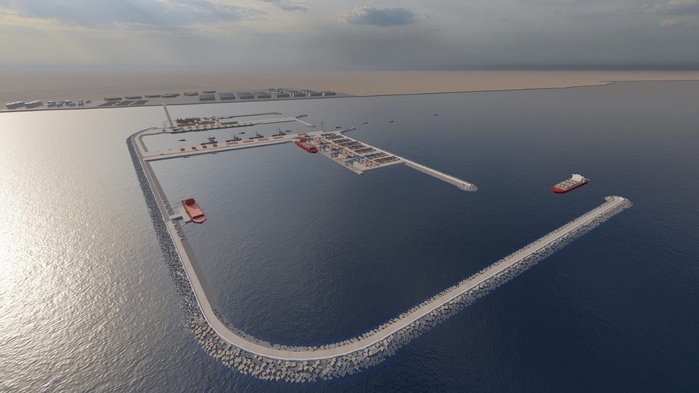
I find proof of this regularly in this old Kingdom of Morocco, which I have been travelling through for several decades, observing with attention the multiple axes of development it conducts with wisdom and determination. Among these, the launch of the Dakhla Atlantic port has symbolic value.
The world was astonished by this royal decision. But it did not surprise me at all because I see it within the dynamic that was born in 1912, with the decision to build the port of Casablanca, where there was only a small village of a few thousand inhabitants.
This port became, in about ten years, the economic heart and the business lung of the country. Then came Tanger Med, initiated in 2007. Less than twenty years later, the port is ranked 19th in the world for container traffic. The Kingdom has entered the top 20, alongside China, Singapore, Korea, the United States, Hong Kong, the United Arab Emirates, Malaysia, the Netherlands, Belgium, Thailand, Taiwan, and Vietnam. It is the only African country to belong to this exclusive club. Then came the roads, which, from Tangier to Guerguerat, give Morocco the function of a public service for international transport from Northern Europe to Southern Africa. This is indeed what it is about, as it is the only land route. There is, in fact, nothing further East, from Algeria to Egypt. These are roads of superior quality, which required heavy investments. In parallel, the high-speed train from Tangier to Marrakech arrived.
So many action plans that contribute to the global transformation of the territory that is taking shape before us today.
It is in this multidimensional perspective that we must consider this Dakhla Atlantic port project that His Majesty Mohammed VI has just launched.
Its central position immediately underlines that it does not tend to satisfy only local interests. The Dakhla region will undoubtedly draw many very advantageous profits from it, because it will very quickly become a major hub of multiple activities, but the dynamic will necessarily be of an international order. The geophysical epicentre of a maritime system corresponding to a third of our planet, Dakhla will radiate to the North Pole, the South Pole, and the American continent. This is what is taking shape before us for the coming years.
This pure product of an Act of sovereignty has numerous political assets to succeed in this adventure beyond its walls. Its fundamentals are solid. Morocco never ceases to extend its political influence, not only on the African continent but in the world, due to the stability of its democratic institutions, its rule of law which inspires confidence in foreign investors, and its capacity to establish a peaceful and respectful “living together” between peoples. Its economy is enhanced by a good public-private balance, a guarantor of safety and dynamism.
Finally, social reforms and the latest one underway on the generalisation of health insurance have, for a quarter of a century, shaped the country around a middle class concerned with stability and social peace.
This action programme must, however, be structured around 3 types of concrete objectives: engaging African, European, and American states to become responsible partners; identifying specific development axes in the 3 primary, secondary, and tertiary sectors based on public-private cooperation; creating dedicated institutions in Dakhla to provide assistance and advice as needed.
On this last point, a research and development system thought of in continuous rather than punctual terms, having a mission of sustainable innovation, would favour the permanence of analysis, evaluation, and risk management, which are the conditions for systemic managerial conduct in permanent alert.
The creation of multidisciplinary postgraduate studies, coordinated around this goal, could then constitute a determining factor for the success of the whole.
I find proof of this regularly in this old Kingdom of Morocco, which I have been travelling through for several decades, observing with attention the multiple axes of development it conducts with wisdom and determination. Among these, the launch of the Dakhla Atlantic port has symbolic value.
The world was astonished by this royal decision. But it did not surprise me at all because I see it within the dynamic that was born in 1912, with the decision to build the port of Casablanca, where there was only a small village of a few thousand inhabitants.
This port became, in about ten years, the economic heart and the business lung of the country. Then came Tanger Med, initiated in 2007. Less than twenty years later, the port is ranked 19th in the world for container traffic. The Kingdom has entered the top 20, alongside China, Singapore, Korea, the United States, Hong Kong, the United Arab Emirates, Malaysia, the Netherlands, Belgium, Thailand, Taiwan, and Vietnam. It is the only African country to belong to this exclusive club. Then came the roads, which, from Tangier to Guerguerat, give Morocco the function of a public service for international transport from Northern Europe to Southern Africa. This is indeed what it is about, as it is the only land route. There is, in fact, nothing further East, from Algeria to Egypt. These are roads of superior quality, which required heavy investments. In parallel, the high-speed train from Tangier to Marrakech arrived.
So many action plans that contribute to the global transformation of the territory that is taking shape before us today.
It is in this multidimensional perspective that we must consider this Dakhla Atlantic port project that His Majesty Mohammed VI has just launched.
Its central position immediately underlines that it does not tend to satisfy only local interests. The Dakhla region will undoubtedly draw many very advantageous profits from it, because it will very quickly become a major hub of multiple activities, but the dynamic will necessarily be of an international order. The geophysical epicentre of a maritime system corresponding to a third of our planet, Dakhla will radiate to the North Pole, the South Pole, and the American continent. This is what is taking shape before us for the coming years.
This pure product of an Act of sovereignty has numerous political assets to succeed in this adventure beyond its walls. Its fundamentals are solid. Morocco never ceases to extend its political influence, not only on the African continent but in the world, due to the stability of its democratic institutions, its rule of law which inspires confidence in foreign investors, and its capacity to establish a peaceful and respectful “living together” between peoples. Its economy is enhanced by a good public-private balance, a guarantor of safety and dynamism.
Finally, social reforms and the latest one underway on the generalisation of health insurance have, for a quarter of a century, shaped the country around a middle class concerned with stability and social peace.
This action programme must, however, be structured around 3 types of concrete objectives: engaging African, European, and American states to become responsible partners; identifying specific development axes in the 3 primary, secondary, and tertiary sectors based on public-private cooperation; creating dedicated institutions in Dakhla to provide assistance and advice as needed.
On this last point, a research and development system thought of in continuous rather than punctual terms, having a mission of sustainable innovation, would favour the permanence of analysis, evaluation, and risk management, which are the conditions for systemic managerial conduct in permanent alert.
The creation of multidisciplinary postgraduate studies, coordinated around this goal, could then constitute a determining factor for the success of the whole.
Hubert SEILLAN
President of the France-Morocco Foundation,
Peace and Sustainable Development,
Lawyer at the Paris Bar
President of the France-Morocco Foundation,
Peace and Sustainable Development,
Lawyer at the Paris Bar
