

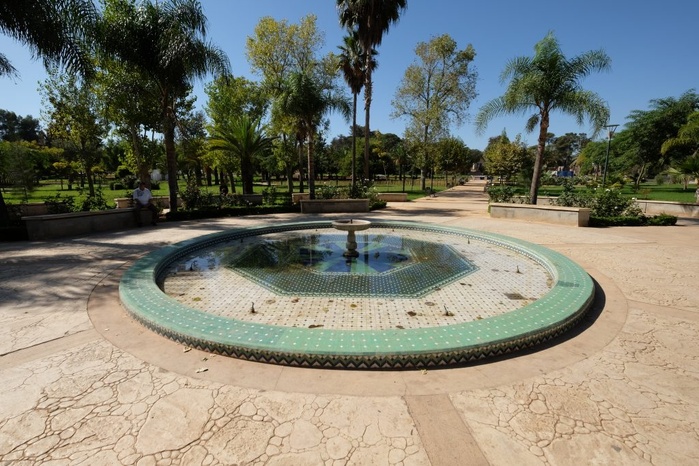
We are in Aïn Tizgha, a peaceful locality backed by the largest forest in Morocco, falling under the commune of Benslimane, not far from Bouznika. Known for its preserved environment and often highlighted by pulmonologists for the quality of its microclimate, this region has carved out a place among the "well-being" destinations in the Kingdom. Many asthmatic people stay there, attracted by the reputation of healthier air, in guest houses and hotels designed, for some, as therapeutic refuges.
It must be said that the context is not insignificant: according to the International Study of Asthma and Allergies in Childhood (ISAAC), between 10 and 20% of the Moroccan population suffers from asthma, a chronic pathology that affects all age groups and can, in some cases, prove severe. Curative tourism, in this context, is one response among others. Not a miracle solution, but a way to alleviate, prevent, and live better with the disease.
"Medical monitoring combined with a stay in a place with a favourable microclimate can contribute to reducing the frequency and intensity of asthma attacks," explains Dr Mustapha El Moubarik, a general practitioner who has been based in Benslimane for several decades. He adds that "for receptive patients, this setting allows for the stabilisation of symptoms and a reduction in exposure to usual triggers like urban pollution or certain allergens."
But while this type of environment can act as a helpful factor, it is not a guarantee. Dr El Moubarik recalls this observation: "There are asthmatic patients born and raised in Benslimane. The microclimate is a plus, not an absolute protection. Asthma is multifactorial and is not limited to air quality alone."
What is a microclimate?
The microclimate corresponds to the set of climatic characteristics specific to a restricted geographical location. In Benslimane, this translates into the presence of a vast forest area, stable humidity levels, low atmospheric pollution, and rich plant diversity. These elements contribute to an atmosphere that is gentler on the respiratory tract, particularly in the absence of industrial nuisances or high concentrations of pollutants like carbon monoxide and nitrogen dioxide.
According to the Köppen-Geiger climate classification, the city benefits from a hot Mediterranean climate with a dry summer, with an average annual temperature of 17.3°C and about 530 mm of precipitation. A setting that, without being idyllic, fits into a logic of respiratory comfort for certain patient profiles.
But one must keep in mind that the microclimate is not a prescription in itself. It can accompany a treatment, support it, and promote a form of well-being, but it does not replace rigorous medical monitoring or an adapted lifestyle. And above all, it cannot be presented as a universal solution.
It must be said that the context is not insignificant: according to the International Study of Asthma and Allergies in Childhood (ISAAC), between 10 and 20% of the Moroccan population suffers from asthma, a chronic pathology that affects all age groups and can, in some cases, prove severe. Curative tourism, in this context, is one response among others. Not a miracle solution, but a way to alleviate, prevent, and live better with the disease.
"Medical monitoring combined with a stay in a place with a favourable microclimate can contribute to reducing the frequency and intensity of asthma attacks," explains Dr Mustapha El Moubarik, a general practitioner who has been based in Benslimane for several decades. He adds that "for receptive patients, this setting allows for the stabilisation of symptoms and a reduction in exposure to usual triggers like urban pollution or certain allergens."
But while this type of environment can act as a helpful factor, it is not a guarantee. Dr El Moubarik recalls this observation: "There are asthmatic patients born and raised in Benslimane. The microclimate is a plus, not an absolute protection. Asthma is multifactorial and is not limited to air quality alone."
What is a microclimate?
The microclimate corresponds to the set of climatic characteristics specific to a restricted geographical location. In Benslimane, this translates into the presence of a vast forest area, stable humidity levels, low atmospheric pollution, and rich plant diversity. These elements contribute to an atmosphere that is gentler on the respiratory tract, particularly in the absence of industrial nuisances or high concentrations of pollutants like carbon monoxide and nitrogen dioxide.
According to the Köppen-Geiger climate classification, the city benefits from a hot Mediterranean climate with a dry summer, with an average annual temperature of 17.3°C and about 530 mm of precipitation. A setting that, without being idyllic, fits into a logic of respiratory comfort for certain patient profiles.
But one must keep in mind that the microclimate is not a prescription in itself. It can accompany a treatment, support it, and promote a form of well-being, but it does not replace rigorous medical monitoring or an adapted lifestyle. And above all, it cannot be presented as a universal solution.
