

Freeze frame
By: Driss Makkoudi
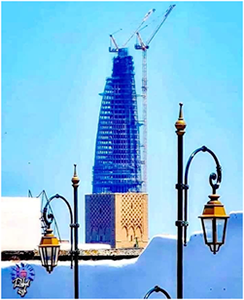
The image is striking: two towers overlap, as if one were finally completing the other after centuries of waiting. The Hassan Tower, an unfinished vestige of the 12th century, seems extended by the Mohammed VI Tower, which rises with boldness towards the sky. In a fascinating optical illusion, the ancient stone and modern glass align, giving the illusion that history is resuming its course where it had been interrupted.
Between memory and modernity, imperial aspirations and contemporary ambitions, these two edifices tell a silent dialogue through time. On the bank of the Bouregreg, between sky and earth, the Hassan Tower watches over its past while the Mohammed VI Tower traces the lines of a future in full ascent.
The Hassan Tower was to be the minaret of an immense mosque wanted by the Almohad sultan Yacoub el-Mansour, a sovereign whose ambition rivalled that of the greatest builders of the Islamic world. Inspired by the Koutoubia of Marrakech and the Giralda of Seville, it was to dominate the imperial capital projected by the sultan.
But the sudden death of the sultan in 1199 stopped the work dead, leaving the stone frozen in an incompleteness that resonates like the echo of many thwarted imperial dreams. Over the centuries, Rabat transformed, but the Hassan Tower remained immobile, standing facing the Bouregreg, a silent witness to a past suspended in time.
Centuries later, another tower began to rise a few kilometres away. The Mohammed VI Tower, 250 metres high, aspires to become the largest in Africa, a strong signal of a Morocco that wants to combine its history with its future. Its glass facade reflects the sky and the changing city, where once stone alone captured the light. It is the symbol of a new era where the country wants to be a major player in globalisation, embracing innovation, the green economy and technological ambitions.
But beyond the symbol, the Mohammed VI Tower profoundly transforms the horizon of Rabat. Until now, the silhouette of the city was dominated by horizontal monuments: the Kasbah of the Oudayas, the Almohad walls and the Hassan Tower. With the arrival of this skyscraper, an architectural turning point is taking place. For the first time, Rabat is adopting a vertical model, modifying the visual balance of the Bouregreg valley. If some see it as a marker of progress, others wonder: can such a tower coexist harmoniously with the historical heritage of the capital? Does it not risk breaking the harmony that made Rabat a city where the past and the present coexisted without friction?
Behind its imposing stature, the Mohammed VI Tower is also a major economic project. It aspires to be a financial and commercial hub, housing offices, hotels and conference spaces. It is part of a broader plan for the redevelopment of the Bouregreg valley, aiming to transform Rabat, city of lights, into an international metropolis.
And yet, in a curious twist of fate, a detail strikes the minds of those who observe these two edifices: one belongs to the 12th century, the other to the 21st. As if the numbers 12 and 21 had themselves reversed in the mirror of time, linking two opposite but curiously linked eras. The Hassan Tower, a monument to an unfinished dream, finds in the Mohammed VI Tower a late response, almost a reparation of the past by the present.
But at the foot of the Hassan Tower, in the heart of the unfinished mosque, prayers have never ceased through the centuries. Between the columns that remained standing, the faithful gather, perpetuating an immutable fervour that traverses time, like a living echo of a past never quite interrupted.
Every Friday, a large crowd gathers, transforming this open-air place into a living mosque. During the holy month of Ramadan, the influx reaches its peak, and under the glow of the lamps and the stars, the voices of the faithful rise like an echo of these centuries of waiting. The murmur of prayers seems to mingle with the wind of the Bouregreg, reminding us that if stones can remain unfinished, faith and determination, they, never break.
In the golden light of twilight, the two towers merge into a single silhouette, that of a Morocco which, between memory and modernity, continues to write its history. But beyond the play of forms, an essential question remains: can this modernity be anchored without betraying the legacy of the past? Does the glass tower extend the unfinished dream of the stone one, or does it symbolise a break towards a completely different vision of Morocco? Only time, that invisible builder, will provide the answer.
The article Capture 9: History in two stages appeared first on ALBAYANE.