

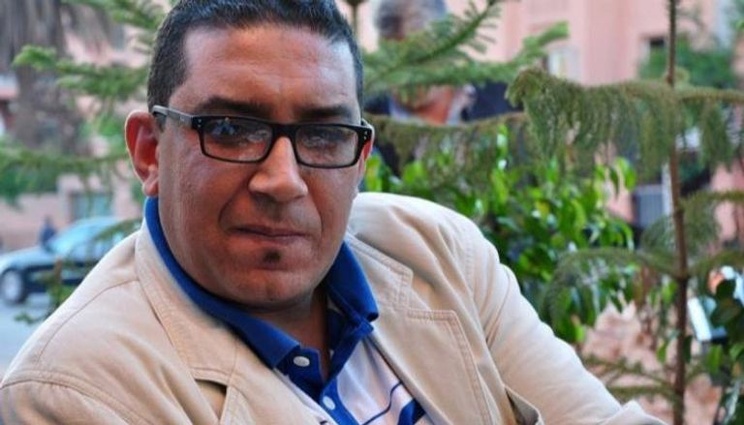
The Scheherazade Forum Association for Education and Culture organised, on Friday in Casablanca, a literary meeting in tribute to the Moroccan writer Anis Al Rafei, in the presence of several literary critics and actors from the world of culture.
This event, organised in partnership with the Casablanca School of Fine Arts, was an opportunity to celebrate the publication of Anis Al Rafei's new collection of short stories, entitled "Maristan of Masks". It is part of an approach to promote the most striking Moroccan creative experiences, by highlighting the work of this writer considered one of the great names of contemporary Moroccan short stories.
"Anis Al Rafei's texts constitute a true narrative laboratory, open to various genres and artistic expressions, such as philosophy, visual arts, or even theatre," the speakers emphasised during this meeting, noting that his practice of the short story is perceived as a free artistic act, which goes beyond classical norms, praises experimentation, cultivates ambiguity, and affirms a singularity marked by difference. Al Rafei's work, deeply rooted in an inventive aesthetic, renews both the structure and the expressive horizons of the short story.
The participants also indicated that, in Maristan of Masks, the author continues his literary adventure with highly poetic language and deep introspective sensitivity. Thus, narrative genres and techniques intertwine to create unprecedented universes, requiring active involvement from the reader, both aesthetic and intellectual.
The author was praised for his ability to make the short story a site of linguistic and artistic experimentation, establishing himself as a writer who builds his work through accumulation, without ever setting limits for himself. The speakers also highlighted his mastery of the possibilities of narrative, his ability to shape language through techniques of composition, fragmentation, textual stitching, as well as playing with paradoxes and going beyond habitual narrative boundaries.
In a critical reading of Maristan of Masks, the writer Imane Razi stressed that Anis Al Rafei's work constitutes a unique model in Moroccan and Arab literature, due to its experimental construction inscribed in a postmodern language, explaining that this text weaves a dialogue between intellectual reflection and visual spectacle, going well beyond simple narrative to question meaning, representation, and subjectivity.
For his part, the writer and journalist Saïd Moutansib estimated that the work relies on a "Meta-imaginary", in which everything – real, fictional, or absurd – becomes material for narration. The text, according to him, transforms everyday elements into possible narratives, by mobilising processes such as contradiction, contrast, and randomness.
Asked about his own work, Anis Al Rafei specified that Maristan of Masks features a reinvented clown, not from a classical circus or entertainment theatre, but rather emerging from an eternal temporal suitcase, a shop of imaginary toys, or even a fantasised dictionary of literary machines.
He added that the image of this clown disperses like dust, sometimes resembling the shards of a leaping jester endowed with a spotted leopard tail, sometimes merging into a mosaic of Moroccan zellige, embedded in the ruins of an ancient vanished Roman city, known as Volubilis.
It should be noted that Anis Al Rafei is the author of 30 literary works. He has received several distinctions, including the Naji Naaman Grand Prize for literary merit (2008), the International Gutenberg Book Prize (2013), the Chinese Akiyode Prize (2014), the Grand Prize of the Reading Network in Morocco (2022), as well as the Al Multaqa Prize for the Arab short story in Kuwait (2023).