
FrançaisEnglishالعربيةDeutschEspañolNederlandsItaliano中文

Your cart is empty

Adventure awaits!

About Meknes

Meknes (Arabic: مكناس, romanized: maknās, pronounced [maknaːs]) is one of the four Imperial cities of Morocco, located in...

News in Meknes

Follow the latest news, projects, and official announcements from your ville.

News 25 Nov 2012 4 min read

Wood, a Moroccan know-how

The first edition of the National Wood Craft Fair has just opened in Meknes from 23 November to 2 December. Organised by the Ministry of Handicrafts under the high patronage of His Majesty King Mohammed VI, this fair lifts the veil on Moroccan woodwork, rich in various Andalusian and oriental influences.
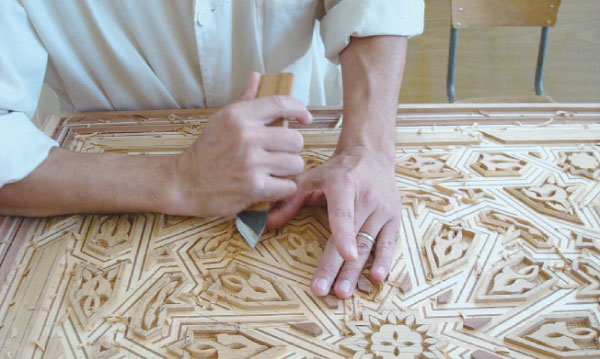
Wood, a Moroccan know-how

Domiciled at Sahrij Sawni, one of the most renowned historical sites in the Ismaili city, the National Wood Craft Fair celebrates woodworking, namely painted wood, carved wood, turned wood, and inlaid wood, in addition to cooperage and lutherie. Spanning an area of 4,800 m², this fair is divided into four distinct yet interconnected spaces. The first commercial space, designed over an area of 3,600 m², highlights the four major woodcraft trades: architectural wood, carpentry wood for buildings, furniture and decorative wood, and finally, wood crafts related to gift items. Its purpose is to showcase the exhibitors' products and it is expected to host a rich and varied programme of events. The second educational, cultural, and scientific space is dedicated to young graduates from training centres. The fair also includes a space dedicated to rural products and rare objects that are on the verge of disappearing. "This space will be enhanced by a museum where the public can appreciate the historical journey of wood arts and crafts in Morocco firsthand. The history of woodcraft will be told through the exhibition of rare and precious objects. The scenography is designed to take visitors on a journey through time and regions. It is also an opportunity to highlight pieces unknown to the general public," the organisers explain in a press kit. Finally, the last space is dedicated to new trends and wood design. Reflecting the educational dimension of the woodcraft fair, this space will see the daily organisation of conferences and debates with themes focused on the world of woodcraft, which will allow both professionals and amateurs to deepen their knowledge of the subject.

"The exhibition area is arranged according to a carefully studied scenography to ensure a certain coherence for the fair while reflecting the diversity of wood trades and arts in Morocco," the organisers explain. They add that this socio-cultural event, dedicated to industry professionals and targeting the general public, professionals, other prescribers, as well as the specialised press, falls within the framework of Vision 2015, specifically in its component relating to the promotion of artisanal products on the national market. As a reminder, Moroccan handicrafts have their own development strategy called "Vision 2015".

Launched in 2007, this strategy plans to double the overall turnover of the sector to reach 24 billion dirhams by 2015 and also provides for a number of measures to boost exports of artisanal products, particularly through the promotion of these products at the national and international level, with the goal of reaching 7 billion dirhams in exports. The aim is to foster the emergence of reference players through the support and encouragement of the restructuring and modernisation of companies operating in the sector, the support of SMEs operating in the sector, and the encouragement of the creation of new companies to reach the figure of 300 SMEs by 2015, the promotion of mono-artisans, whose number amounts to 350,000 out of the 2.1 million artisans registered across all sectors, and the generalisation of continuing education and the encouragement of research & development in the craft sector in collaboration with national universities and technological institutes to allow the Moroccan offer to distinguish itself from competing products and to open up new markets such as the Russian and American markets.


Woodcraft in figures

Woodcraft is mainly found in the following cities: Rabat, Essaouira, Meknès, Azrou, Fès, and Tétouan. This craft has given rise to various techniques, mainly used in architecture and furniture and decoration: painted wood, carved wood, turned wood (mashrabiya), inlaid wood (marquetry), in addition to cooperage and lutherie. Exports of woodcraft products represented 10.21% of total craft exports in 2011, with 34,761,041 DH out of a total turnover of 340,162,547 DH. Furthermore, wood products occupied the fifth position in total exports of artisanal products, ahead of pottery (61,250,779 DH), carpets (53,647,966 DH), basketry (41,386,706 DH), and wrought iron.

Listen
Size:

