

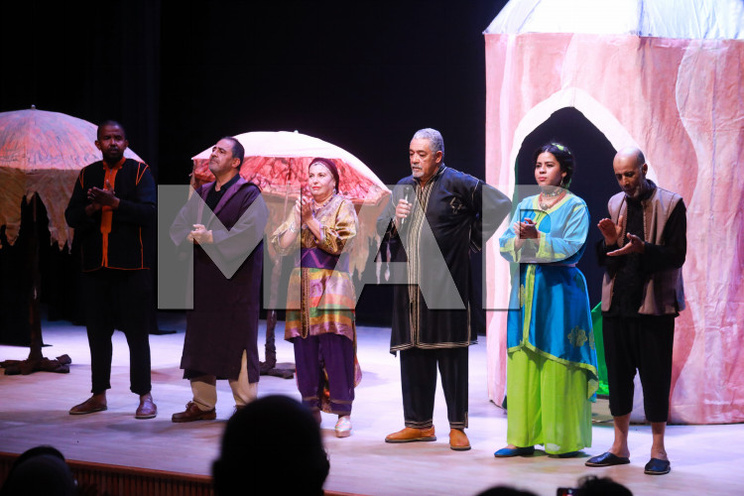
The play "Lalla Ghzala", by the troupe "Warchat Ibdaâ Drama" (Drama Creation Workshop), was presented on Wednesday, as part of the 11th edition of the Marrakech International Theatre Festival.
This play, written by screenwriter and author Boubker Fahmi, plunges the spectator into the heart of the realities of daily life through the story of an archaeologist discovering a mysterious engraving representing a gazelle on an abandoned site.
This discovery occurs at a pivotal moment, namely the last day of his mission before he leaves to ask for an extension of his excavation period. Between his departure and his return, events take a dramatic turn, giving the play a captivating narrative tension rich in twists and turns.
The performance aroused great enthusiasm from the public, who expressed their admiration for the performance and professionalism of the actors on stage.
In a statement to MAP, Mohamed Belmokadem, president of the Marrakech section of the Moroccan Union of Dramatic Art Professionals, rejoiced at the return of the festival after more than eight years of suspension, specifying that this edition is devoted exclusively to local troupes, who presented their shows in different halls of the city.
In this context, he stressed that "the strong turnout of the public reflects a great attachment to theatre as an art and a noble means of expression", noting that this event is likely to enrich the local artistic scene and consolidate Marrakech's position as a hub of creation and cultural dialogue.
Organised by the local section of the Moroccan Union of Dramatic Art Professionals, in partnership with the Communal Council, under the aegis of the Ministry of Youth, Culture, and Communication, this 11th edition includes intellectual meetings, training workshops, and tributes to prominent figures of the national theatrical scene.
This play, written by screenwriter and author Boubker Fahmi, plunges the spectator into the heart of the realities of daily life through the story of an archaeologist discovering a mysterious engraving representing a gazelle on an abandoned site.
This discovery occurs at a pivotal moment, namely the last day of his mission before he leaves to ask for an extension of his excavation period. Between his departure and his return, events take a dramatic turn, giving the play a captivating narrative tension rich in twists and turns.
The performance aroused great enthusiasm from the public, who expressed their admiration for the performance and professionalism of the actors on stage.
In a statement to MAP, Mohamed Belmokadem, president of the Marrakech section of the Moroccan Union of Dramatic Art Professionals, rejoiced at the return of the festival after more than eight years of suspension, specifying that this edition is devoted exclusively to local troupes, who presented their shows in different halls of the city.
In this context, he stressed that "the strong turnout of the public reflects a great attachment to theatre as an art and a noble means of expression", noting that this event is likely to enrich the local artistic scene and consolidate Marrakech's position as a hub of creation and cultural dialogue.
Organised by the local section of the Moroccan Union of Dramatic Art Professionals, in partnership with the Communal Council, under the aegis of the Ministry of Youth, Culture, and Communication, this 11th edition includes intellectual meetings, training workshops, and tributes to prominent figures of the national theatrical scene.
Culture bouillon
INSMAC
The National Higher Institute of Music and Choreographic Arts (INSMAC) will be open from the start of the 2025-2026 academic year, announced the Ministry of Youth, Culture, and Communication, as part of its strategy for the development of artistic education, the promotion of creativity, and support for cultural and creative industries.
Established on an area of more than 9000 m², in the heart of the capital, in the immediate vicinity of the Mohammed V Theatre in Rabat, INSMAC constitutes the first university institution of this type in Morocco, indicated a ministry statement, noting that it aims to become a hub of excellence in terms of academic training and research in the fields of music and choreographic arts.
This new establishment, which is fully in line with the national dynamic of valuing artistic education, aims to train a new generation of artists, educators, and creative professionals, capable of meeting the requirements of the cultural market, both nationally and internationally.
It issues diplomas according to the LMD system (Licence, Master, Doctorate) and offers both practical and theoretical teaching: technical courses for musicians and choreographers, transversal subjects, as well as general training open to contemporary issues in the cultural sector, notes the same source.
Registrations will begin after the baccalaureate results in July 2025.
The National Higher Institute of Music and Choreographic Arts (INSMAC) will be open from the start of the 2025-2026 academic year, announced the Ministry of Youth, Culture, and Communication, as part of its strategy for the development of artistic education, the promotion of creativity, and support for cultural and creative industries.
Established on an area of more than 9000 m², in the heart of the capital, in the immediate vicinity of the Mohammed V Theatre in Rabat, INSMAC constitutes the first university institution of this type in Morocco, indicated a ministry statement, noting that it aims to become a hub of excellence in terms of academic training and research in the fields of music and choreographic arts.
This new establishment, which is fully in line with the national dynamic of valuing artistic education, aims to train a new generation of artists, educators, and creative professionals, capable of meeting the requirements of the cultural market, both nationally and internationally.
It issues diplomas according to the LMD system (Licence, Master, Doctorate) and offers both practical and theoretical teaching: technical courses for musicians and choreographers, transversal subjects, as well as general training open to contemporary issues in the cultural sector, notes the same source.
Registrations will begin after the baccalaureate results in July 2025.
