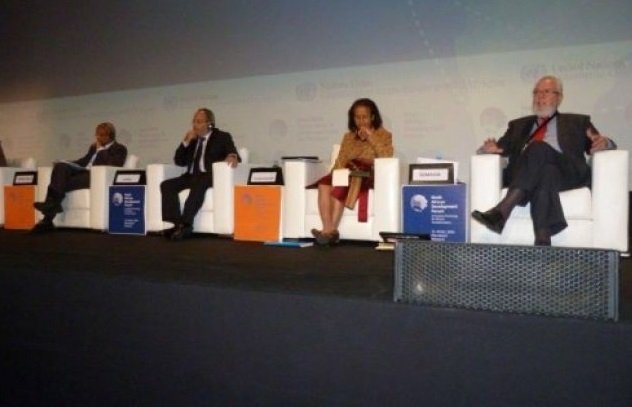
The 9th Forum for the Development of Africa organized in the ochre city by the United Nations Economic Commission for Africa (ECA) ended yesterday, Thursday.
It saw the participation of several actors and experts in the political and economic field but also of certain personalities including Heads of State and Government and ministers.
Many of these speakers respected the programming of this important event by presenting their analyses on the various debates focusing essentially on innovative financing mechanisms in five areas, namely "mobilization of domestic resources", "illicit financial flows", "private equity", "new types of partnerships", and "financing the fight against climate change". This was not the case for all Moroccan speakers. And even if some speeches by some of them were noted, others shone if not by their absence, at least by their disrespect for the scheduled programme.
For their part, the foreign speakers all kept their promise and took turns sharing their reflections with the audience. Ali Abou Sabaa, an official at the African Development Bank (AfDB), was one of them, and in his speech during a plenary session on the theme "Mobilization of domestic resources: challenges and opportunities", he was given the opportunity to call on African countries to rely on their internal resources to maintain strong and sustained growth.
African countries must adopt policies capable of broadening the tax base, he recommended, noting that tax revenues, which constitute the most important source of internal resources, continue to improve in Africa.
During the same workshop, the CEO of the Moroccan Bank for Foreign Trade (BMCE Bank), Brahim Benjelloun Touimi, recommended broadening savings opportunities and therefore additional finances, developing proximity finance (microfinance), disseminating financial and banking services, and integrating the informal sector into African economies.
He also highlighted the importance of Casablanca Finance City, which is a financial centre working for the development of Africa, in particular the countries of the North, West, and Central Africa region.
For its part, the session on "illicit financial flows" was fruitful in terms of data, and it was Hassan Ennasser, Secretary General of the Financial Intelligence Processing Unit (UTRF), among others, who spoke on this subject by advocating for the creation of an African network for the exchange of information to fight against illicit capital flows, the average amount of which oscillates between 50 and 148 billion dollars per year on the continent.
He also indicated that in order to face this scourge which compromises Africa's ability to mobilize the resources created to finance development, it is also necessary to create a forum to exchange the experiences of countries.
In the process, and not without recalling that illicit financial flows are unaccounted capital flows resulting from theft and bribes but also from criminal activities including terrorist financing, drug trafficking, smuggling, racketeering, counterfeiting, and all forms of money laundering operations, he deemed it necessary to strengthen financial intelligence units (FIUs) for greater vigilance, through continuous staff training, given that money launderers often change techniques.
Following in his footsteps on this subject, the Minister of Finance and Planning of Cape Verde, Cristina Duarte, lamented the long-term battle that is the fight against these criminal activities, which threaten development in Africa. Straight away, she declared that governments and civil servants in public administrations in Africa are all responsible for this phenomenon which perpetuates the continent's dependence on external aid.
As a reminder, according to the ECA, commercial transactions of multinationals, tax fraud, laundering of the proceeds of commercial transactions, abusive tax evasion through harmful tax exemptions, exemptions, and false invoicing between companies would represent 60% of illicit financial flows.
Furthermore, another problem, another plenary session, with "financing the fight against climate change". Indeed, in this regard, Ahmed Sahiri, an analyst at the Moroccan Agency for Solar Energy (MASEN), noted that Morocco has put in place a long-term strategy and an integrated plan relating to renewable energies that are among the most ambitious, while citing the latest report of the United Nations Environment Programme (UNEP) on "adaptation gaps", which had reported staggering costs of adaptation to climate change for sub-Saharan Africa, if no measures are taken of course, which could reach between 14 and 15 billion dollars per year and reach 70 billion in 2045.
Initiated for the first time outside Addis Ababa, this meeting was once again timely in that it allowed for a sharing of experiences and points of view between different nationalities, certainly, but belonging to the same continent. Although the audience lamented, all in all, the absence of some Moroccan experts as well as a lack of documentation from Moroccan participants.
News 17 Oct 2014 4 min read
Curtain falls on the Marrakech Forum