

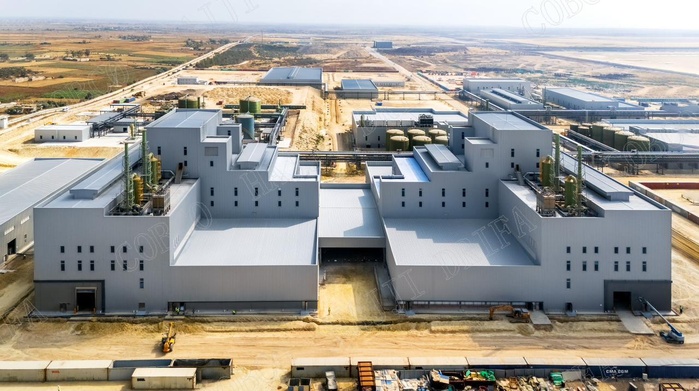
This pioneering project is part of the first investment phase of COBCO's integrated industrial complex for Nickel Manganese-Cobalt (NMC) cathode precursors (pCAM).
These materials, developed from critical metals including nickel, cobalt, and manganese, are essential components for electric vehicle batteries and stationary energy storage, states a press release from COBCO, a Moroccan company resulting from a strategic partnership between AL MADA, a Moroccan pan-African investment fund, and CNGR Advanced Materials, a global leader in battery materials.
This industrial platform, spanning over 200 hectares, represents a strategic milestone for the development of the Moroccan clean technology industry.
This key step marks both the launch of a pioneering project outside of Asia and catalyzes the growth of a Moroccan ecosystem dedicated to the strategic electric battery industry for the MENA, European, and United States markets.
With this first strategic industrial base, Morocco affirms its ambition to become a central player in global green technology value chains, the statement notes, highlighting that COBCO embodies the vision of a new-generation industry that is competitive, integrated, sustainable, and resolutely focused on the needs of future markets.
The total investment mobilized over time will amount to several billion dirhams, spread across three complementary industrial projects, with a capacity equivalent to 70 GWh/year, enough to equip nearly one million electric vehicles per year.
Thus, the COBCO industrial production complex will include 120,000 tonnes per year of NMC precursor production capacity and 60,000 tonnes per year of LFP (Lithium-Iron Phosphate) cathode production capacity, the deployment of which is planned upon the emergence of a regional LFP battery ecosystem.
It will also include units for refining critical metals and recycling black mass, with a processing capacity of over 60,000 tonnes per year, allowing for maximized local integration and material circularity.
Through its strategic positioning, COBCO, which embodies the realization of a world-class industrial project at the crossroads of the African, European, American, and Asian continents, strengthens Morocco's industrial sovereignty and contributes to the consolidation of its automotive ecosystem in the face of the electric transition. More than 5,000 jobs will be mobilized during the construction phase, and eventually, 1,800 qualified direct jobs and 1,800 indirect jobs will be created.
The project also places a central focus on training, skills transfer, and the emergence of national expertise in battery-related trades, in connection with Moroccan universities and technological partners.
The company COBCO operates within an international context of improving value chains, marked by evolving regulatory requirements (including the European carbon tax) and the search for competitive, decarbonized production solutions close to markets.
From its launch, it positions itself as a credible and competitive player, capitalizing on the respective strengths of both partners, AL MADA and CNGR Advanced Materials, as well as Morocco's assets: an attractive industrial environment, low-cost green energy, proximity to Europe and the United States, world-class mineral deposits (phosphate, cobalt, copper, manganese), and an extensive network of free trade agreements.
The Board of Directors of COBCO praised the construction and operational ramp-up of the plant, which was brought to life in less than a year since the start of construction, marking a major industrial milestone, the same source continues.
COBCO thus proves that the Moroccan environment allows for the hosting and development in record time of a cutting-edge technological sector that is globally competitive and fully integrated locally.
In an industry driven by innovation, COBCO supports its clients' progress through advanced technical solutions that generate real levers for differentiation. Its constant demand for operational and industrial excellence strengthens their competitiveness while placing the sustainability of ecosystems at the heart of its strategy.
Designed from the outset as a low-carbon footprint site, COBCO is deploying an ambitious environmental strategy: responsible processes, progressive use of Moroccan green energy (80% in 2025, 100% by the end of 2026), desalinated water, industrial recycling, and projects for certification to international ISO standards (14064, 14044, 50001). The ESG trajectory will also include participation in the Carbon Disclosure Project and alignment with SBTi objectives.
These materials, developed from critical metals including nickel, cobalt, and manganese, are essential components for electric vehicle batteries and stationary energy storage, states a press release from COBCO, a Moroccan company resulting from a strategic partnership between AL MADA, a Moroccan pan-African investment fund, and CNGR Advanced Materials, a global leader in battery materials.
This industrial platform, spanning over 200 hectares, represents a strategic milestone for the development of the Moroccan clean technology industry.
This key step marks both the launch of a pioneering project outside of Asia and catalyzes the growth of a Moroccan ecosystem dedicated to the strategic electric battery industry for the MENA, European, and United States markets.
With this first strategic industrial base, Morocco affirms its ambition to become a central player in global green technology value chains, the statement notes, highlighting that COBCO embodies the vision of a new-generation industry that is competitive, integrated, sustainable, and resolutely focused on the needs of future markets.
The total investment mobilized over time will amount to several billion dirhams, spread across three complementary industrial projects, with a capacity equivalent to 70 GWh/year, enough to equip nearly one million electric vehicles per year.
Thus, the COBCO industrial production complex will include 120,000 tonnes per year of NMC precursor production capacity and 60,000 tonnes per year of LFP (Lithium-Iron Phosphate) cathode production capacity, the deployment of which is planned upon the emergence of a regional LFP battery ecosystem.
It will also include units for refining critical metals and recycling black mass, with a processing capacity of over 60,000 tonnes per year, allowing for maximized local integration and material circularity.
Through its strategic positioning, COBCO, which embodies the realization of a world-class industrial project at the crossroads of the African, European, American, and Asian continents, strengthens Morocco's industrial sovereignty and contributes to the consolidation of its automotive ecosystem in the face of the electric transition. More than 5,000 jobs will be mobilized during the construction phase, and eventually, 1,800 qualified direct jobs and 1,800 indirect jobs will be created.
The project also places a central focus on training, skills transfer, and the emergence of national expertise in battery-related trades, in connection with Moroccan universities and technological partners.
The company COBCO operates within an international context of improving value chains, marked by evolving regulatory requirements (including the European carbon tax) and the search for competitive, decarbonized production solutions close to markets.
From its launch, it positions itself as a credible and competitive player, capitalizing on the respective strengths of both partners, AL MADA and CNGR Advanced Materials, as well as Morocco's assets: an attractive industrial environment, low-cost green energy, proximity to Europe and the United States, world-class mineral deposits (phosphate, cobalt, copper, manganese), and an extensive network of free trade agreements.
The Board of Directors of COBCO praised the construction and operational ramp-up of the plant, which was brought to life in less than a year since the start of construction, marking a major industrial milestone, the same source continues.
COBCO thus proves that the Moroccan environment allows for the hosting and development in record time of a cutting-edge technological sector that is globally competitive and fully integrated locally.
In an industry driven by innovation, COBCO supports its clients' progress through advanced technical solutions that generate real levers for differentiation. Its constant demand for operational and industrial excellence strengthens their competitiveness while placing the sustainability of ecosystems at the heart of its strategy.
Designed from the outset as a low-carbon footprint site, COBCO is deploying an ambitious environmental strategy: responsible processes, progressive use of Moroccan green energy (80% in 2025, 100% by the end of 2026), desalinated water, industrial recycling, and projects for certification to international ISO standards (14064, 14044, 50001). The ESG trajectory will also include participation in the Carbon Disclosure Project and alignment with SBTi objectives.