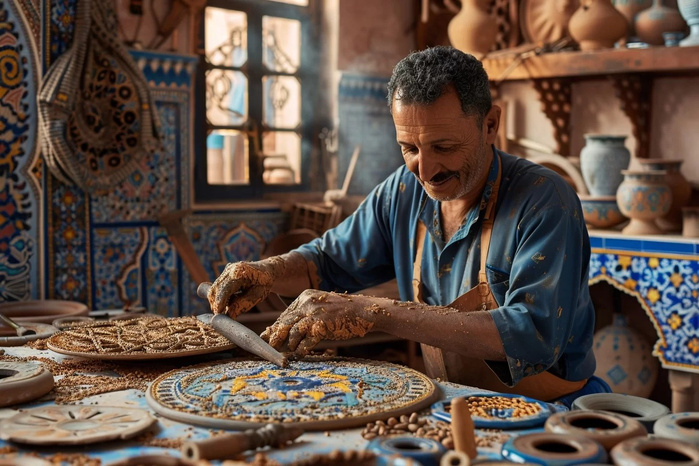
In this regard, two partnership agreements were signed during the last ordinary general assembly of the Regional Chamber of Crafts with the aim of revitalising training in crafts professions, recognised as an economic pillar and an essential element of the region's cultural heritage.
The challenge is to address the shortage of qualified labour, which is increasingly felt, and to ensure the transmission of artisanal techniques to future generations.
Speaking on this occasion, the president of the Regional Chamber of Crafts, Naji Fakhari, stressed the importance of these initiatives aimed at addressing the issue of labour, which is becoming increasingly scarce in the market, thus jeopardising the future of many professions.
According to him, "support for training in artisanal professions is therefore essential for the preservation of this ancestral know-how and to prevent the disappearance of certain trades".
The first agreement, with a budget of 38 million dirhams, is dedicated to supporting apprentices. It notably provides for the granting of a monthly allowance to each apprentice, as well as a special scholarship for apprentices in endangered trades.
In addition, equipment and educational materials will be provided to improve the quality of training.
The second agreement, on the other hand, focuses on continuous training for artisans and the validation of acquired experience (VAE). With a budget of 8 million dirhams, it will enable artisans to train in new technologies and modern marketing techniques, including digital transformation.
For the regional director of crafts in Fès, Abderrahim Belkhayat, "this agreement meets the expectations of artisans in terms of continuous training, the law for which is over a quarter of a century old".
He added that "the crafts department encourages the establishment of platforms for digital commerce, similar to the brassware sector in Fès, which is leading a pilot project at the national level in this area".
Mr. Belkhayat also announced the creation of a space dedicated to endangered crafts within the crafts complex.
This space, according to him, aims to encourage production in these sectors and ensure the sustainability of these threatened artisanal activities.
The challenge is to address the shortage of qualified labour, which is increasingly felt, and to ensure the transmission of artisanal techniques to future generations.
Speaking on this occasion, the president of the Regional Chamber of Crafts, Naji Fakhari, stressed the importance of these initiatives aimed at addressing the issue of labour, which is becoming increasingly scarce in the market, thus jeopardising the future of many professions.
According to him, "support for training in artisanal professions is therefore essential for the preservation of this ancestral know-how and to prevent the disappearance of certain trades".
The first agreement, with a budget of 38 million dirhams, is dedicated to supporting apprentices. It notably provides for the granting of a monthly allowance to each apprentice, as well as a special scholarship for apprentices in endangered trades.
In addition, equipment and educational materials will be provided to improve the quality of training.
The second agreement, on the other hand, focuses on continuous training for artisans and the validation of acquired experience (VAE). With a budget of 8 million dirhams, it will enable artisans to train in new technologies and modern marketing techniques, including digital transformation.
For the regional director of crafts in Fès, Abderrahim Belkhayat, "this agreement meets the expectations of artisans in terms of continuous training, the law for which is over a quarter of a century old".
He added that "the crafts department encourages the establishment of platforms for digital commerce, similar to the brassware sector in Fès, which is leading a pilot project at the national level in this area".
Mr. Belkhayat also announced the creation of a space dedicated to endangered crafts within the crafts complex.
This space, according to him, aims to encourage production in these sectors and ensure the sustainability of these threatened artisanal activities.