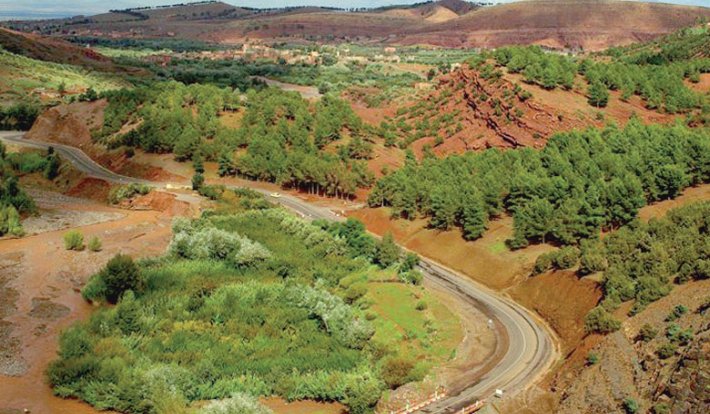
Often isolated, mountainous areas suffer from many imbalances and problems, including low income, degradation of natural resources, and lack of access to information. In this capacity, the International Fund for Agricultural Development (IFAD) has granted Morocco, during the last decade, more than 21 million dollars in the form of donations for the benefit of more than 750,000 households living in very difficult conditions, particularly in mountainous areas.
The presence of IFAD in the Kingdom has, in fact, made it possible to improve synergies between the Fund's investments and those of Morocco, notably through the Green Morocco Plan-Pillar II which focuses exclusively on peasant agriculture. In this framework, the Vice-President of IFAD, Perin Saint-Ange, has just carried out a visit to the Al-Haouz province where he inquired about the achievements made in the wake of the Agricultural Sector Development Project in the mountainous areas of the said province (PDFAZMH). This project has the ambition to contribute, within the framework of the PMV-Pillar II and the IFAD intervention strategy in Morocco, to the alleviation of rural poverty through the sustainable growth of the incomes of mountain populations involved in the three agricultural production sectors that are olives, apples, and sheep meat.
This is how the IFAD official visited successively the rural communes of Takerkouste, Ouled Mtaa, and Azgour where he met the members of the National Association of Sheep and Goat Breeders, those of the Imiouardouz Cooperative, and the members of the "Am Al-Khair" trade team, just as he visited an olive crushing unit and two apple plantations.
According to the IFAD project management unit under the Provincial Directorate of Agriculture of Marrakech, the flagship achievements of the PDFAZMH have focused notably on the training of 19,000 farmers from 14 rural communes belonging to the circles of Asni and Amizmiz, the planting of 230 hectares of apple trees, the creation of 12 trade teams organized into service provision cooperatives, the upgrading of three olive crushing units, the export of olive oil to the United Arab Emirates, and the initiation to the marketing of sheep via the website made available to breeders "Hawli.net".
With a duration of five years, this Project, which should reach its term on September 30, 2017, also provides for the construction of eight valorization units in the olive and apple sectors as well as other hydro-agricultural development actions, adds the same source, noting that the proximity training envisaged by the project mainly aims to improve productivity upstream of the sectors and the quality of the valorized products. It should be noted that since 1979, IFAD has financed 13 projects in Morocco for an amount of 222 million dollars, while the total cost of the PDFAZMH is 9.1 million dollars, including a contribution from the Fund in the form of a loan of 6.4 million and a donation of 140,000 dollars.