

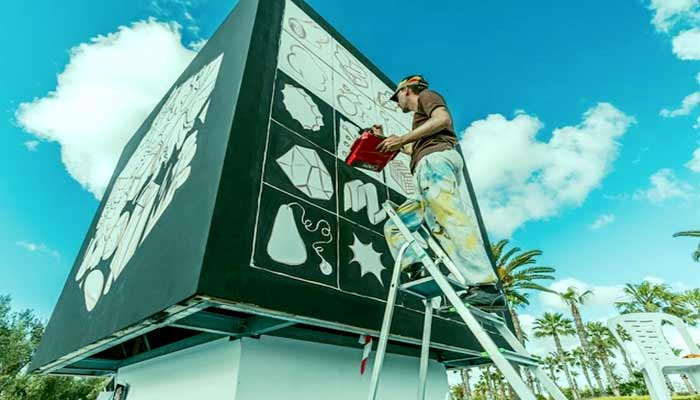
Hassan II Park in Rabat hosts the artistic project "Cubic Landscapes", an initiative mobilising three artists who have given free rein to their talents for the creation of a multidimensional visual work combining comics, illustration, and graphic art, as part of the 10th edition of the Jidar-Rabat Street Art Festival.
The artists, of Moroccan, Japanese, and Spanish nationalities, worked for two weeks on the blank faces of three cubes with a diameter of three metres, transformed for the occasion into true visual works of Street Art, which the public can discover during guided tours.
In a statement to MAP, Spanish artist Ivan McGill stated that his cube acts as a sequence, and that each of its four faces lists individual elements referring to the experiences of the artists present at the festival and coming from different cultural backgrounds.
According to him, each artist who participated in the festival left a mark through their mural works, thus contributing to enriching the urban space of the city.
The Spanish artist also confided that Moroccan architecture, in all its aspects, deeply inspired him, particularly on cultural and historical levels.
For his part, Hideyuki Katsumata said he drew the essence of his work from traditional Japanese art, combining yökai, a generic Japanese term designating supernatural creatures, and the colourful cartoon drawing style.
The representations of yökai, derived from Japanese folklore and manifesting in the form of deities or demons, he specified, are deeply rooted in the daily life of Japanese citizens and, by extension, in Japanese culture.
The Japanese artist, who is visiting Morocco for the second time, said he was "dazzled" by Moroccan craftsmanship, more particularly the mosaics, a "source of inspiration" for his future murals.
Mr. Katsumata expressed his joy at participating in this large-scale artistic event, bringing together a galaxy of renowned artists.
For his part, the artistic director of the Jidar Festival, Salah Malouli, declared that the objective of this event is to invite the best artists from the world of Street Art to come and share their work with the inhabitants and visitors of the capital.
He noted that Rabat is carving out a central place in this dynamic, adding that the festival aims to enrich the local artistic scene and position the city among the major world capitals of Street Art.
The artistic director of the festival also indicated that this edition encompasses all forms of artistic expression in the public space, whether it be graffiti or murals falling under this urban art.
Jidar-Rabat Street Art Festival is an invitation to travel where cultures from all over the world rub shoulders with the Moroccan collective imagination and are projected onto the walls of Rabat, making this event a field of artistic experimentation where identities intersect and nourish each other.
Designed as a bridge between muralism and other types of visual storytelling, the "Cubic Landscapes" project foreshadows the future artistic orientation of the festival, which is called upon to expand into the world of drawing in all its forms.
The artists, of Moroccan, Japanese, and Spanish nationalities, worked for two weeks on the blank faces of three cubes with a diameter of three metres, transformed for the occasion into true visual works of Street Art, which the public can discover during guided tours.
In a statement to MAP, Spanish artist Ivan McGill stated that his cube acts as a sequence, and that each of its four faces lists individual elements referring to the experiences of the artists present at the festival and coming from different cultural backgrounds.
According to him, each artist who participated in the festival left a mark through their mural works, thus contributing to enriching the urban space of the city.
The Spanish artist also confided that Moroccan architecture, in all its aspects, deeply inspired him, particularly on cultural and historical levels.
For his part, Hideyuki Katsumata said he drew the essence of his work from traditional Japanese art, combining yökai, a generic Japanese term designating supernatural creatures, and the colourful cartoon drawing style.
The representations of yökai, derived from Japanese folklore and manifesting in the form of deities or demons, he specified, are deeply rooted in the daily life of Japanese citizens and, by extension, in Japanese culture.
The Japanese artist, who is visiting Morocco for the second time, said he was "dazzled" by Moroccan craftsmanship, more particularly the mosaics, a "source of inspiration" for his future murals.
Mr. Katsumata expressed his joy at participating in this large-scale artistic event, bringing together a galaxy of renowned artists.
For his part, the artistic director of the Jidar Festival, Salah Malouli, declared that the objective of this event is to invite the best artists from the world of Street Art to come and share their work with the inhabitants and visitors of the capital.
He noted that Rabat is carving out a central place in this dynamic, adding that the festival aims to enrich the local artistic scene and position the city among the major world capitals of Street Art.
The artistic director of the festival also indicated that this edition encompasses all forms of artistic expression in the public space, whether it be graffiti or murals falling under this urban art.
Jidar-Rabat Street Art Festival is an invitation to travel where cultures from all over the world rub shoulders with the Moroccan collective imagination and are projected onto the walls of Rabat, making this event a field of artistic experimentation where identities intersect and nourish each other.
Designed as a bridge between muralism and other types of visual storytelling, the "Cubic Landscapes" project foreshadows the future artistic orientation of the festival, which is called upon to expand into the world of drawing in all its forms.