

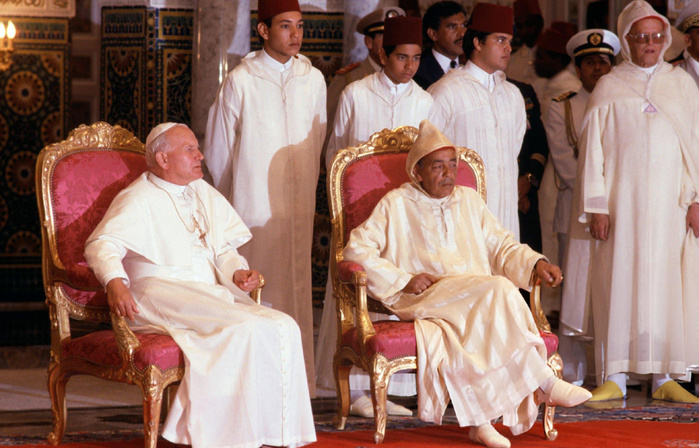
On an August afternoon in 1985, Casablanca was the scene of a historic meeting with profound resonances: that of the Sovereign Pontiff John Paul II and the late His Majesty Hassan II, King of Morocco. This interview, marking the Holy Father's third African trip, was not merely a diplomatic visit, but a hand extended between two shores, between the Cross and the Crescent, between Rome and Rabat, in the luminous spirit of the Second Vatican Council.
On August 19, 1985, to be precise, the papal plane cut through the African sky to land in Casablanca, and upon his descent, a gesture struck everyone: John Paul II knelt and kissed the soil of the Kingdom. "It is an act of humility and reverence that was perceived by the nationals as a sign of deep respect towards our land and our values," immediately states historian and university professor Noureddine Belhaddad. "At the reception, the late Hassan II, a charismatic Sovereign with a recognized diplomatic stature, greeted him fraternally, testifying to a welcome beyond protocol, that is to say, a welcome from human to human, from faith to faith," comments the fine connoisseur of Morocco's history.
This moment, seemingly brief, was part of a broader historical sequence. From the Charles de Foucauld college, a sanctuary for the Moroccan Catholic community, to the vibrant heart of the Mohammed V stadium, each stage of the Pope's visit was thought of as a sign: that of encounter and testimony.
At the college, John Paul II celebrated mass surrounded by the archbishops of Rabat and Tangier. His homily, delivered with fervor, greeted the Christians living in Morocco, a discreet but faithful minority. He urged them to become "bridges between different traditions," taking up the image of the link, the passage, the mediation... so many words resonating in this country whose history has always been a crossroads between East and West, North and South.
That day, the Pope, praising the faith, piety, and charity of the Muslim faithful, encouraged his own to contemplate with respect the virtues of the other, to go beyond the borders of doctrine to open themselves to a lived fraternity. In an era still haunted by identity tensions and remnants of colonialism, this voice resonated as a call to reason.
But it was at the Royal Palace in Rabat that the most solemn moment occurred, in the intimacy of a fifty-minute one-on-one, when the Holy Pontiff and the late King spoke as men of vision. The precise content of their exchange remains veiled in the usual discretion, but the image transmitted was striking: a Pope and a King, each representing a universal faith, discussing peace. Following this interview, the King presented the Supreme Council of Ulema of Morocco to the Holy Father. It was, as historical writings testify, "a gesture of rare symbolic significance, placing the scholars of Islam face to face with the head of the Catholic Church, in a peaceful and respectful encounter."
The highlight of this historic visit was undoubtedly the meeting at the Mohammed V stadium. Before 90,000 Moroccan citizens, the late Hassan II, in a vibrant speech, recalled the meaning of this meeting: to weave the threads of love and concord. It was then the Holy Father's turn to address the Muslim youth, with boldness and tenderness, speaking of Abraham, the common patriarch of both religions, of the unique faith in a living and merciful God, and of the moral responsibility of each individual towards the world.
Evening came, and the Pope returned to the airport. At 10:30 PM, his plane rose towards Rome. But in the sky of Casablanca, something had changed. This brief visit by John Paul II had not been a simple diplomatic visit, but an act of faith in Man, of faith in God, and of faith in the future.
This day in August 1985 remains, in the annals of interreligious dialogue, as a precious milestone, since it symbolizes a moment when the word was peace and the gesture was fraternity. "The late Hassan II, in His political wisdom and His art of speech, offered the world the image of a welcoming, curious, and open Islam, and John Paul II inscribed his pontificate in the horizon of spiritual and cultural rapprochement," concludes university professor Noureddine Belhaddad.
And it will be remembered in the annals of History that this month of August 1985, on the tarmac of Casablanca, remains the torch of a possible peace, where great souls do not challenge each other, but meet, recognize each other, and unite.
3 questions for Noureddine Belhaddad: "The late King Hassan II considered human values as fundamental"
- In 1985, John Paul II met the late Hassan II in Morocco. How was this symbolic event perceived?
-This visit remains crucial for interreligious and intercultural relations. When the Pope knelt and kissed the Moroccan soil, he marked his respect and admiration for the Land of tolerance, a gesture of humility and recognition towards the culture and History of Morocco. The late Hassan II, for his part, showed great open-mindedness, emphasizing through His words and His gestures that He favored dialogue, peace, and mutual respect between religions. During this meeting, He particularly insisted on the need for precision in discourse and actions, while encouraging international cooperation for peace and mutual understanding.
- What was the late Hassan II's vision of interreligious dialogue, in Morocco and elsewhere?
The late King Hassan II considered human values as fundamental to guarantee a peaceful and harmonious coexistence between different religious communities. The Sovereign advocated an approach of mutual respect, listening, and understanding, far from intolerance and prejudice, and saw in Morocco a model of tolerance, where Muslim, Jewish, and Christian communities had coexisted for centuries in relative harmony.
- What common points do you see between the visits to Morocco by Pope John Paul II in 1985 and that of Pope Francis in 2019?
Pope Francis's visit in 2019 took up the same message as that of John Paul II: tolerance, peace, and dialogue between religions. It strengthened the ties between the Vatican and Morocco, and extended the late Hassan II's vision of a coexistence based on mutual respect. These two visits marked key stages in the promotion of interreligious coexistence.
Flashback: A papal visit with an old-fashioned feel
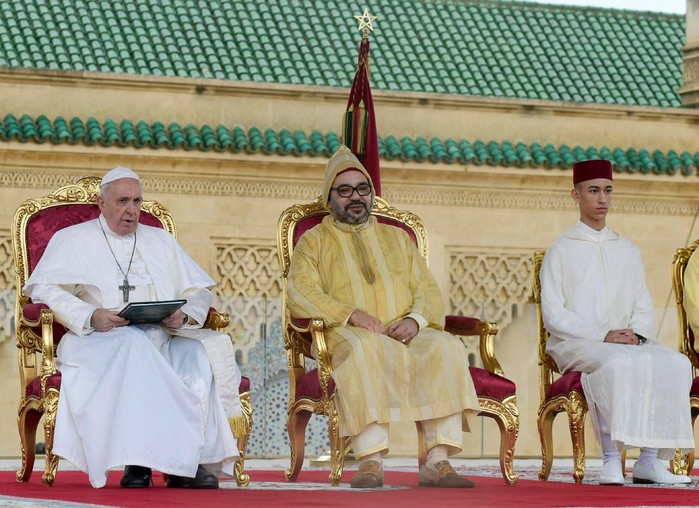
On March 30 and 31, 2019, the late Pope Francis made his 28th apostolic journey, this time to Morocco. This trip, now inscribed in the history of his pontificate, bore the strong imprint of his commitment to interreligious dialogue, a major axis of his spiritual and diplomatic teaching. Until the end, the late sovereign pontiff worked to weave ties between religious traditions, in a spirit of peace, fraternity, and mutual respect.
Welcomed in Rabat by His Majesty King Mohammed VI, Francis was received with the solemnity due to a high spiritual authority. Faithful to his message of unity, he recalled upon his arrival that "cultivating openness, respect, and cooperation" was today more than ever a necessity. He affirmed that "authentic faith in God always leads to love, never to hatred," a conviction he carried throughout his pontificate.
In reference to his predecessor John Paul II, who came to Morocco in 1985, Francis himself spoke of walking "in the footsteps of the late John Paul II," but by resolutely inscribing his action in the present. Through meetings with Muslim religious leaders, young people, migrants, and the local Catholic community, he demonstrated a desire to build a concrete human fraternity rooted in mutual listening.
Before the Moroccan youth, the Pope launched a vibrant appeal that will remain in the annals, urging them to be builders of bridges and not walls. He also emphasized that religious freedom, a leitmotif of his pontificate, is not limited to tolerance, but implies the active recognition of the other in their faith and dignity.
This visit helped consolidate the ties between the Kingdom of Morocco and the Holy See (diplomatic relations established in 1976) and to reaffirm the importance of a sincere and lasting Islamic-Christian dialogue. This trip is in line with major initiatives such as the signing of the Document on Human Fraternity, co-written with the Grand Imam of Al-Azhar in 2019 in Abu Dhabi.
As reported by the official Vatican website, this visit was a moment of grace, both memorial and prophetic, and Pope Francis, in the humility and firmness of his faith, left a powerful testimony: that of a man of peace convinced that fraternity is not a dream, but a necessary horizon.
Historiography: The highlights of an epic meeting
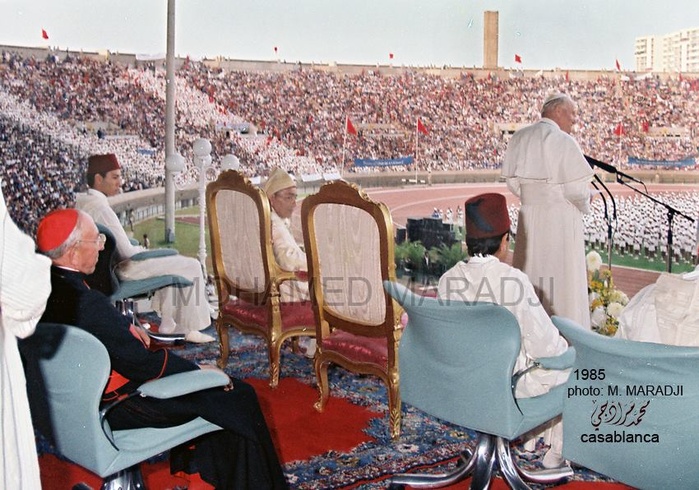
On August 19, 1985, at the Mohammed V stadium in Casablanca, John Paul II left a mark on the minds of tens of thousands of Moroccans. That day, he surprised and moved the crowd from his very first words. By pronouncing "Assalamou alaykoum" in Arabic, or "peace be upon you" to remain in French, he showed as he should that he came as a friend and brother, in full respect of his audience. This simple greeting, in the country's official language, created an immediate proximity through which he was not perceived as a protocol speech. It, all in all, allowed for the establishment of a rare trust in such an important meeting.
Then, in simple and direct French, John Paul II launched an appeal for peace, for the importance of education, and for respect for interreligious and intercommunal coexistence. He had not come to preach or convince, but to bear witness to love for his brothers in humanity. He evoked Abraham, a leading figure for believers of both religions, to recall what Christians and Muslims share: faith in God, the importance of prayer, and the search for good.
This moment deeply marked the minds, because seeing a pope welcomed by King Hassan II, addressing the Moroccan youth in a climate of respect and calm, had something unprecedented and strong about it. John Paul II, without seeking to erase differences, knew how to convey the idea that a true exchange can be born even between distant traditions, provided it rests on listening, sincerity, and recognition of the other. By speaking with the quiet strength of a man of faith animated by the desire for peace, he made a gesture that was perceived as a turning point, a new way of meeting, at human level, beyond religious barriers. For many, this meeting left a lasting imprint, like the memory of a rare instant where convictions were not a wall, but a starting point to better understand each other.
Highlights: Interreligious dialogue, the pillars of the Alaouite dynasty
Some contemporary accounts want to confine Islamic-Christian friendship to a few papal visits, but that is not the case. Already, under the successive reigns of Moulay Mohammed ben Ismail (who reigned in 1736) and his brother Moulay Abdallah ben Ismail (who had intermittent reigns between 1729 and 1757), Alaouite Morocco laid the concrete foundations for an interreligious dialogue with Europe. This dialogue, far from being ideological, took shape through maritime privateering, considered a legitimate resistance against colonial powers. But behind this activity, a subtle diplomacy was deployed: when the Sultans returned goods or released European captives, European heads of state responded with equivalent gestures. This reciprocity founded a form of mutual recognition, anchored in justice more than in words.
Moulay Abdallah perpetuated this tradition. He practiced the restitution of ships or the release of Christian captives when agreements were respected, thus consolidating a Moroccan approach to interreligious dialogue, based on balance and dignity.
His son, Mohammed ben Abdallah (reign from 1757 to 1790), continued this legacy by forging peaceful relations with various powers and by being the first head of state to recognize the independence of the United States. Even Moulay Yazid (reign from 1790 to 1792), despite a more unstable power, did not entirely break this diplomatic thread. Through these Sovereigns, Islamic-Christian dialogue became rooted in Moroccan history as an act of sovereignty, justice, and respect for the other.