

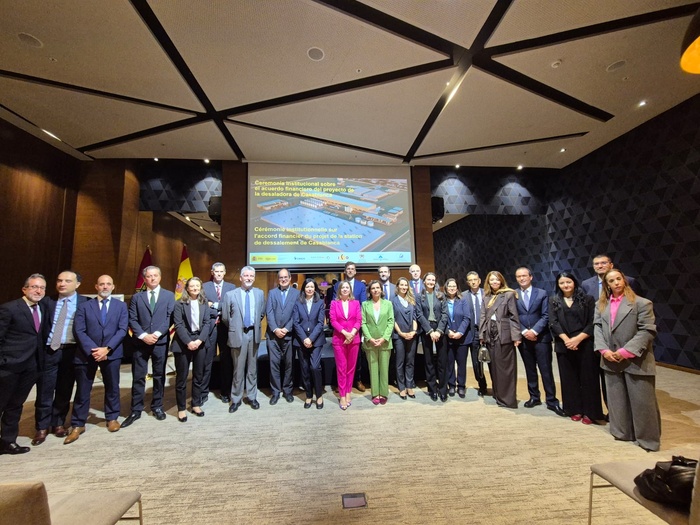
This Wednesday, May 7, 2025, the Secretary of State for Trade, Amparo López Senovilla, participated in Casablanca in an institutional support ceremony for the construction project of the largest desalination plant in Africa. This event, which was held in the presence of the Moroccan Minister of Economy and Finance Nadia Fettah, highlights the importance that the Spanish government attaches to this plant, which will be the largest in Africa.
The project has been entrusted to a consortium led by the Spanish company Acciona. It benefits from public financial support of 340 million euros from the Spanish Ministry of Economy, Trade and Enterprise, via the Secretariat of State for Trade. This financing, one of the most significant in terms of bilateral cooperation for sustainable infrastructure, is mobilised through three main instruments:
The project has been entrusted to a consortium led by the Spanish company Acciona. It benefits from public financial support of 340 million euros from the Spanish Ministry of Economy, Trade and Enterprise, via the Secretariat of State for Trade. This financing, one of the most significant in terms of bilateral cooperation for sustainable infrastructure, is mobilised through three main instruments:
- A loan of 250 million euros from the Fund for the Internationalisation of Enterprise (FIEM), dedicated to the design, construction and operation of the plant.
- Export credit insurance managed by CESCE, covering up to 80% of another part of the financing, i.e. approximately 70 million euros, granted by Société Générale.
- A loan of 31 million euros from the Fund for Foreign Investment (FIEX), managed by COFIDES, to support Acciona's participation in the project's share capital.
The Casablanca desalination plant, planned to produce 838,000 cubic metres of water per day (300 million cubic metres per year), will constitute a model of public-private partnership over 30 years, including 3 years of construction and 27 years of operation. Using cutting-edge technologies and renewable energies, it will ensure the supply of drinking and agricultural water for millions of people while creating jobs in Morocco and Spain.
Dynamic economic relations between Morocco and Spain
This project testifies to the strength of the economic relations between Morocco and Spain, based on growing cooperation and expanding trade. Currently, more than 350 Spanish companies are established in Morocco, particularly in key sectors such as energy, infrastructure and automotive. Their involvement actively contributes to Moroccan economic development.
Spain, Morocco's main trading partner, records a volume of bilateral trade exceeding 22.5 billion euros, with a trade surplus of more than 3 billion euros. In 2024, Spanish exports to Morocco grew by nearly 6%, confirming the strategic importance of the Moroccan market for the Spanish economy.
Towards a sustainable and cooperative future
The Casablanca desalination plant is part of the momentum of modernising Moroccan infrastructure, where Spanish companies provide their expertise. This innovative project, exemplary in terms of water resource management, could inspire other initiatives in regions facing the challenges of climate change and water stress.