

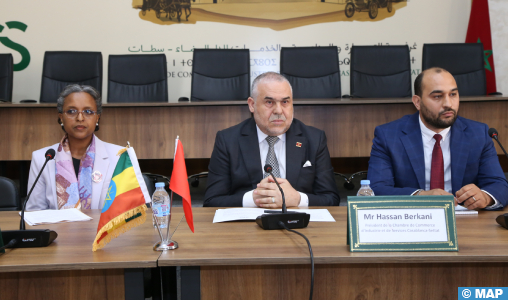
Ethiopian and Moroccan economic operators called, on Tuesday in Casablanca, for the strengthening of trade exchanges between Rabat and Addis Ababa.
In a statement to MAP on the occasion of her participation in a high-level economic meeting organised by the Casablanca-Settat Chamber of Commerce, Industry and Services (CCISCS), in partnership with the Ethiopian Embassy in Morocco, the Ambassador of the Federal Democratic Republic of Ethiopia to Morocco, Nardos Ayalew Belay, affirmed that "diplomatic relations between Ethiopia and Morocco date back many years, and experienced a significant turning point with the visit of His Majesty King Mohammed VI to Addis Ababa in 2016."
"This visit marked the beginning of a new chapter in bilateral cooperation, concretised by the signing of numerous agreements in various sectors, notably the economy and trade," she recalled.
Evoking this meeting which brought together a delegation of Ethiopian coffee exporters and numerous Moroccan economic operators interested in the opportunities offered by the Ethiopian market, the diplomat estimated that it marks "a significant step in the strengthening of our trade relations and will undoubtedly contribute to further stimulating exchanges, particularly in the strategic coffee sector."
She took this opportunity to highlight Ethiopian coffee as an iconic and strategic product, embodying both the richness of the terroir, ancestral know-how, and Ethiopian values of conviviality. "Coffee is not just an export product, it is a reflection of our culture, our hospitality, and our social cohesion," she remarked.
For his part, the President of the CCISCS, Hassane Berkani, stressed that "this meeting is intended as a strategic opportunity to explore possible synergies, build lasting partnerships, and initiate high-value-added projects between our two countries."
"It is also part of a broader dynamic of South-South cooperation, which our Chamber actively supports," he said. "Coffee, beyond its economic importance, is a product that carries history, culture, and values of sharing. Ethiopia, the cradle of coffee, offers exceptional richness in this field, through the quality of its beans, the diversity of its terroirs, and the ancestral know-how of its producers," he noted, noting that Morocco, for its part, represents a dynamic market, with consumers who are increasingly demanding, curious, and open to the flavours of the world.
"We are convinced that these B2B meetings will allow Moroccan and Ethiopian companies to get to know each other better, to identify concrete opportunities for collaboration, and to lay the foundations for fruitful trade exchanges, in a spirit of trust and complementarity," he maintained.
On the sidelines of this meeting, B2B sessions allowed Moroccan companies to exchange directly with Ethiopian exporters, to examine the conditions for commercial collaboration, and to envisage concrete projects for import, distribution, or industrial processing.