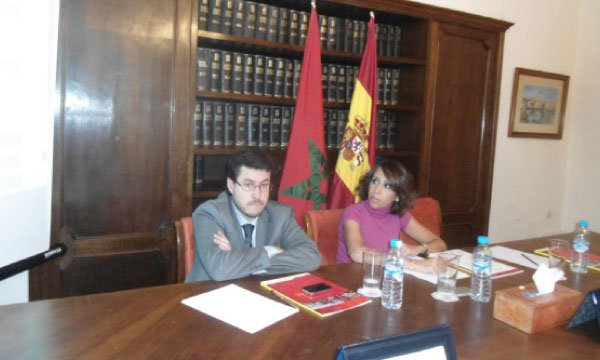
As part of the support actions intended to promote the National Pact for Industrial Emergence, the Spanish Chamber of Commerce and Industry of Tangier recently organised a seminar to present financing and support programmes for local small and medium-sized enterprises. This event was organised in close collaboration with the National Agency for the Promotion of Small and Medium Enterprises (ANPME) and the Centre for Technical and Industrial Development.
The central objective of this seminar was to promote support programmes to the thirty business managers present at this event by presenting to them in detail the financing measures put in place for the benefit of SMEs: the "Imtiaz" and "Moussanada" programmes.
To this end, Mounir Zraidi, head of the distribution of support programmes for SMEs, presented the two programmes in detail. Indeed, "Imtiaz" aims to accompany selected companies on the basis of a growth contract, through the granting of an investment premium, for tangible and intangible assets, corresponding to 20% of the total investment, and capped at 5 million DH. "Moussanada", for its part, aims to accompany companies in their process of modernisation and improvement of their productivity.
The speaker took the opportunity to present the initiatives and measures implemented by the ANPME to allow companies to gain points in terms of productivity and competitiveness and thus consolidate their markets. Mounir Zraidi thus recalled that the "Imtiaz" programme aims to allow about fifty SMEs with high potential each year, in all sectors combined, to concretise their development projects and to facilitate their access to bank credit. The manager also presented the results of the 2010 and 2011 editions of "Imtiaz".
Thus, he explained, some 33 projects had been selected in 2010, with a total investment of 666 million DH and an "Imtiaz" premium amounting to 112 million DH, all with 2,045 jobs to be created. During the year 2011, there was a clear increase in the number of selected projects, which rose to 47 supported files for a total investment of 1 billion DH and 174 million DH in "Imtiaz" premiums, all with 4,709 jobs to be created.
The "Moussanada" programme, let us recall, aims at several essential objectives, notably to accompany 500 SMEs each year to strengthen their competitiveness factors, in terms of costs, deadlines, and quality. It also aims to accelerate the use of information technologies within SMEs. The head of the distribution of support programmes for SMEs ended his presentation by drawing up the balance sheet of the actions selected in different sectors of the economy, within the framework of his department's action, by concluding his intervention on the eligibility criteria of SMEs for the two programmes put in place by the public authorities.
In turn, Marc Marchador presented the CDTI, the Spanish state body he represents and which operates in the promotion of innovation and technological development of Iberian companies. In his presentation, Marc Marchador explained that the CDTI is a public entity dedicated to entrepreneurship, founded in 1977 and operating under the supervision of the Spanish Ministry of Economy and Competitiveness. Its main mission consists of the technical and economic evaluation as well as the financing of projects led by Spanish companies in the field of research and development. Among the other tasks that the CDTI assigns to itself, explained Marc Marchador, who spoke to testify to the Spanish experience in the matter, one must also mention the support for the participation of Iberian companies in international technological cooperation programmes as well as technology transfer and the creation of technology-oriented companies. It must be stressed that the CDTI has been collaborating with the National Agency for the Promotion of Small and Medium Enterprises since 1998. Several projects have been carried out between this Spanish body and Moroccan organisations, besides the ANPME, such as the General Confederation of Moroccan Enterprises (CGEM) and at the government level, the Ministry of Industry, Trade, and New Technologies.
The speaker concluded his presentation by recalling the importance of the function of the external network. "Our function consists of advising and supporting companies in their technological collaboration projects, searching for partners, information on the market, and local financing. We have opened nine offices in different countries, namely the United States, Mexico, Brazil, Chile, Morocco, India, China, South Korea, and Japan," specified Marc Marchador.
The director of the Spanish Chamber of Commerce and Industry of Tangier, Amal Boussouf, for her part, opened the debate, which was very rich in terms of interventions. The speakers, for the most part, raised interesting questions related to the file presentation process, selection criteria, the financing process, etc.
-* Geographical distribution of projects supported by "Imtiaz" and "Moussanada": Casablanca (55 projects), Rabat (6), Fès (5), Marrakech (4), El-Jadida (2), Kénitra (2), Meknès (2), Mohammedia (2)
-* and Agadir (1).
-* In 2011, 47 projects were supported by "Imtiaz" for a total investment of
-* 1 billion DH and
-* 174 million DH in "Imtiaz" premiums, all with
-* 4,709 jobs to be created.