

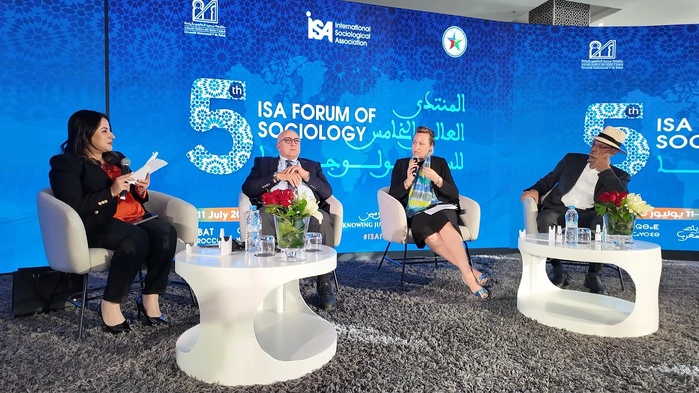
For the first time, the International Sociological Association (ISA) has chosen the African continent to host this world-class event, bringing together more than 4,500 researchers from a hundred countries. Placed under the theme "Knowing justice in the Anthropocene", the forum is at the heart of contemporary debates on the societal and environmental challenges of our time. This major event is co-organized by the ISA, Mohammed V University of Rabat, and the Moroccan Instance of Sociology (IMS), illustrating the growing recognition of Morocco as a leading academic actor, capable of playing a driving role in global sociological reflection.
Since its creation in 2008, the World Forum of Sociology has established itself as a privileged space for intellectual exchanges on major contemporary issues. It is intended to be an extension between the world congresses of the ISA, allowing the 67 research committees and thematic groups to deepen their work in a collaborative framework, while preserving their scientific autonomy.
The organizers recall that these scientific structures have their origins in working groups, which evolve into thematic groups before being consecrated as research committees according to the statutes of the ISA. During this edition, these entities will host no less than 1,329 sessions, addressing essential topics such as socio-environmental inequalities, the role of social sciences in the face of contemporary crises, or the integration of perspectives from the South into global debates.
An academic and diplomatic showcase for Morocco
In this sense, Professor Mohammed Rhachi, President of Mohammed V University, welcomed the holding of this event in Rabat, noting that as "a co-organizing institution, our university reaffirms its position as an academic leader in Morocco and internationally. This forum will allow us to value the contributions of our researchers and strengthen our global scientific influence". He adds that the forum will offer an exceptional framework, both intellectual and logistical, conducive to reflection on social and environmental transformations.
For her part, Allison Marie Loconto, Vice-President in charge of research at the ISA and President of the forum, highlighted the ambition to bring together 6,000 sociologists and researchers from 147 countries, around scientific discussions on justice in the era of the Anthropocene. As for Abdelfattah Ezzine, national coordinator of the Moroccan Instance of Sociology, he insisted on the symbolic and epistemological scope of this event, specifying that "sociology is, fundamentally, an exercise in highlighting the power of knowledge in the service of social engineering. The Moroccan School of Sociology, through its vitality, overcomes epistemological, socio-historical, and ideocultural constraints, both locally and globally."
He concludes by affirming that hosting the forum constitutes a strong commitment to building knowledge capable of meeting contemporary challenges and promoting diversity as a lever to imagine another world.
Beyond its academic dimension, the World Forum of Sociology will have significant repercussions for Morocco. On an intellectual level, it will establish Rabat as a reference hub for sociological reflection. On an economic level, the arrival of thousands of participants will stimulate the hotel, restaurant, and tourism sectors. On a diplomatic level, this event will strengthen Morocco's image as a land of dialogue, fitting into a prestigious calendar that already includes CAN 2025 and the co-organization of the 2030 World Cup.