

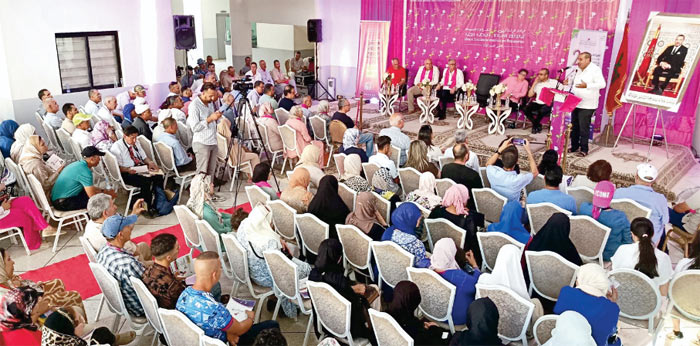
In the midst of the prodigious project of restructuring the regional, provincial, and local bodies of the party of popular forces, the First Secretary of the USFP, Driss Lachguar, is touring all urban and rural agglomerations in a laborious process of reorganizing the Ittihadi structures and examining the various economic, social, and political issues at the heart of the Moroccan population’s concerns.
Continuing a process of reorganization and restructuring in view of the upcoming elections, the USFP official, after visiting several provinces and prefectures, went to Taourirt where he launched the work of the second Provincial Congress of this local authority, organized on Sunday, June 21, 2025, under the theme “Spatial equity and the challenges of the development momentum of the Taourirt province”.
In his inaugural address, the First Secretary of the Socialist Union of Popular Forces recalled the various challenges facing the province on the social and economic levels, mentioning the national context and the major changes Morocco has experienced after 25 years of the reign of His Majesty King Mohammed VI.
This, he highlighted, requires well-thought-out action from all stakeholders, including elected officials and local authorities, but also the central administration with “the perspective of doing justice to the Taourirt agglomeration, revaluing its potential and its emigrating skills, and working to motivate its local investment through the real consolidation of this process, tax cuts, and structural support capable of meeting the population’s expectations”.
In this same context, the USFP leader addressed the decisive stages that have marked Morocco in the new era, recalling the pioneering role of the late Meziane Belfquih, a child of the province and one of the architects of the 50-year report “which was, moreover, introduced to parliament during a study day and which constituted the starting point for a broad national debate around human rights and societal reforms that formed the first foundations of the rule of law”.
In this regard, Driss Lachguar recalled that the first five years of the reign of His Majesty King Mohammed VI were marked by openness to individual freedoms, human rights, and the building of democratic institutions, noting that this was followed by years of structural projects carried out by the State which, however, did not lack unsuccessful social consequences revealed with acuity by the acute health crisis, particularly during the Covid crisis, which justified the Sovereign’s development of a new strategy materialized notably by health coverage and direct social support.
Furthermore, the Ittihadi leader emphasized that the ambitious Royal vision could not be fruitful if it is not truly translated into equitable policies capable of avoiding the injustice suffered by marginalized provinces, through efficient government management, recalling that this requires the emergence of local political elites capable of assuming this responsibility and strong and sincere advocacy for the development of the province, “particularly in the shadow of the upcoming legislative, regional, and communal elections”.
In this regard, Driss Lachguar called on the participants in this event to select their representatives based on the rule of integrity, competence, and commitment to defending the interests of the Taourirt agglomeration, with the sole aim of bringing about change from within the institutions, stemming from a collective will that intrinsically breaks with the practices that empty the province of its real vital forces.
He concluded by inviting all party militants to constantly evoke the fighting spirit of the glorious inhabitants of the province who founded their greatness and their national positions on their patriotic activism and sincere dedication, while emphasizing that the Socialist Union of Popular Forces, by accumulating its action, its experiences, and its unwavering attachment to its democratic and social values, will forever remain a decisive partner regarding spatial justice and the realization of the development momentum required for the Taourirt province, with the sole aim of regaining its influence and its central role within the national fabric.
Rachid Meftah
Continuing a process of reorganization and restructuring in view of the upcoming elections, the USFP official, after visiting several provinces and prefectures, went to Taourirt where he launched the work of the second Provincial Congress of this local authority, organized on Sunday, June 21, 2025, under the theme “Spatial equity and the challenges of the development momentum of the Taourirt province”.
In his inaugural address, the First Secretary of the Socialist Union of Popular Forces recalled the various challenges facing the province on the social and economic levels, mentioning the national context and the major changes Morocco has experienced after 25 years of the reign of His Majesty King Mohammed VI.
The ambitious Royal vision could not be fruitful if it is notDriss Lachguar noted the demographic decline that has been eroding this province in recent years, with official statistical data showing a drop in the number of inhabitants from 130,000 to only about 100,000 souls, as a result of the hemorrhage caused by immigration which has emptied the province of its productive human forces.
truly translated into equitable policies capable of avoiding the injustice suffered by marginalized provinces
This, he highlighted, requires well-thought-out action from all stakeholders, including elected officials and local authorities, but also the central administration with “the perspective of doing justice to the Taourirt agglomeration, revaluing its potential and its emigrating skills, and working to motivate its local investment through the real consolidation of this process, tax cuts, and structural support capable of meeting the population’s expectations”.
In this same context, the USFP leader addressed the decisive stages that have marked Morocco in the new era, recalling the pioneering role of the late Meziane Belfquih, a child of the province and one of the architects of the 50-year report “which was, moreover, introduced to parliament during a study day and which constituted the starting point for a broad national debate around human rights and societal reforms that formed the first foundations of the rule of law”.
In this regard, Driss Lachguar recalled that the first five years of the reign of His Majesty King Mohammed VI were marked by openness to individual freedoms, human rights, and the building of democratic institutions, noting that this was followed by years of structural projects carried out by the State which, however, did not lack unsuccessful social consequences revealed with acuity by the acute health crisis, particularly during the Covid crisis, which justified the Sovereign’s development of a new strategy materialized notably by health coverage and direct social support.
Furthermore, the Ittihadi leader emphasized that the ambitious Royal vision could not be fruitful if it is not truly translated into equitable policies capable of avoiding the injustice suffered by marginalized provinces, through efficient government management, recalling that this requires the emergence of local political elites capable of assuming this responsibility and strong and sincere advocacy for the development of the province, “particularly in the shadow of the upcoming legislative, regional, and communal elections”.
In this regard, Driss Lachguar called on the participants in this event to select their representatives based on the rule of integrity, competence, and commitment to defending the interests of the Taourirt agglomeration, with the sole aim of bringing about change from within the institutions, stemming from a collective will that intrinsically breaks with the practices that empty the province of its real vital forces.
He concluded by inviting all party militants to constantly evoke the fighting spirit of the glorious inhabitants of the province who founded their greatness and their national positions on their patriotic activism and sincere dedication, while emphasizing that the Socialist Union of Popular Forces, by accumulating its action, its experiences, and its unwavering attachment to its democratic and social values, will forever remain a decisive partner regarding spatial justice and the realization of the development momentum required for the Taourirt province, with the sole aim of regaining its influence and its central role within the national fabric.
Rachid Meftah