

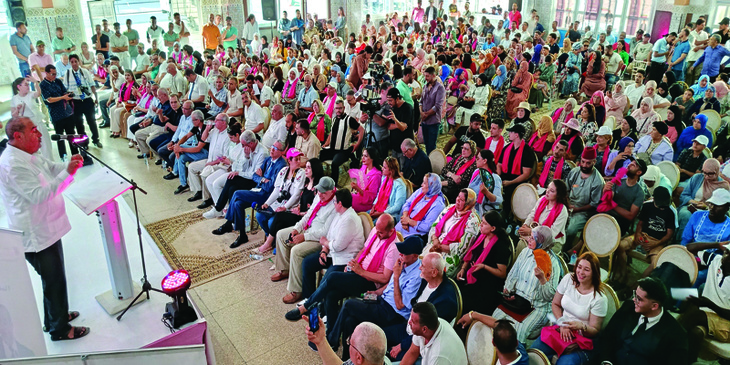
"Contributing to facilitating women's access to leadership positions is considered a sine qua non condition for the realisation of spatial equity and sustainable development in Morocco," this is how the First Secretary of the Socialist Union of Popular Forces (USFP), Driss Lachguar, opened the inaugural session of the provincial Congress of the Popular Forces party in Berkane, organised under the theme "For spatial justice and sustainable development in the Berkane province".
Furthermore, Driss Lachguar highlighted the role played by Ittihadi women at the local level, indicating, in this regard, the advent of a woman at the head of the provincial secretariat of Berkane, namely the USFP member Souad Kada, thus translating women's capabilities regarding the management of public affairs on an equal footing with men, and expressing his wish to see this process, which is very revealing of female potential, crowned by the election of a first secretary at the head of the party at the national level.
On this, Driss Lachguar did not fail to note the importance of the reform of the status of women which will, without a doubt, consecrate the principle of equality and the effective strengthening of women's rights, while emphasising the imperative of not being content with making the empowerment of women a simple slogan but of promoting it as a real societal project encompassing all aspects of life, evolving from administration and family to effective contribution to economic and social processes.
In this regard, the Ittihadi official expressed his wish to see the expected revisions of the family status favour stronger guarantees regarding doing justice to women, while emphasising the fact that the exclusion of half of the components of society from effective participation leads to the loss of precious horizons regarding development as a whole.
On the other hand, the First Secretary of the Popular Forces party recalled that the Supreme Law of the Kingdom and its institutions, under the Leadership of His Majesty King Mohammed VI, favours the appropriate framework regarding the optimal realisation of development and democracy, calling, furthermore, to establish rules capable of guaranteeing the integrity of the next electoral deadlines by making them a real introduction to sustainable development and the consecration of a real democracy.
Driss Lachguar, in this vein, encouraged the participating women to seize the political initiative: "You, the activists of the Socialist Union of Popular Forces, farmers, educators, nurses, teachers, and housewives, you must not hesitate to nominate women from among you to the leadership of elected local authorities and for access to Parliament," adding that "the election of a woman from among you could constitute a real mutation within the party but also in society."
And he concluded by calling for combining efforts for the promotion of the Berkane province and the activation of spatial justice but also the realisation of a real economic momentum capable of consolidating spatial justice and guaranteeing the participation of men and women, on an equal footing, in a global national development project (...)
Rachid Meftah
Furthermore, Driss Lachguar highlighted the role played by Ittihadi women at the local level, indicating, in this regard, the advent of a woman at the head of the provincial secretariat of Berkane, namely the USFP member Souad Kada, thus translating women's capabilities regarding the management of public affairs on an equal footing with men, and expressing his wish to see this process, which is very revealing of female potential, crowned by the election of a first secretary at the head of the party at the national level.
You, the activists of the USFP, farmers, educators, nurses, teachers, and housewives, you must not hesitate to nominate women from among you to the leadership of elected local authorities and for access to Parliament, says the First SecretaryThe USFP leader, in this same vein, stressed that the promotion of the status of women should not be confined to their political deployment but also focus on all aspects of social and administrative life in addition to family responsibilities.
On this, Driss Lachguar did not fail to note the importance of the reform of the status of women which will, without a doubt, consecrate the principle of equality and the effective strengthening of women's rights, while emphasising the imperative of not being content with making the empowerment of women a simple slogan but of promoting it as a real societal project encompassing all aspects of life, evolving from administration and family to effective contribution to economic and social processes.
In this regard, the Ittihadi official expressed his wish to see the expected revisions of the family status favour stronger guarantees regarding doing justice to women, while emphasising the fact that the exclusion of half of the components of society from effective participation leads to the loss of precious horizons regarding development as a whole.
On the other hand, the First Secretary of the Popular Forces party recalled that the Supreme Law of the Kingdom and its institutions, under the Leadership of His Majesty King Mohammed VI, favours the appropriate framework regarding the optimal realisation of development and democracy, calling, furthermore, to establish rules capable of guaranteeing the integrity of the next electoral deadlines by making them a real introduction to sustainable development and the consecration of a real democracy.
Driss Lachguar, in this vein, encouraged the participating women to seize the political initiative: "You, the activists of the Socialist Union of Popular Forces, farmers, educators, nurses, teachers, and housewives, you must not hesitate to nominate women from among you to the leadership of elected local authorities and for access to Parliament," adding that "the election of a woman from among you could constitute a real mutation within the party but also in society."
And he concluded by calling for combining efforts for the promotion of the Berkane province and the activation of spatial justice but also the realisation of a real economic momentum capable of consolidating spatial justice and guaranteeing the participation of men and women, on an equal footing, in a global national development project (...)
Rachid Meftah