

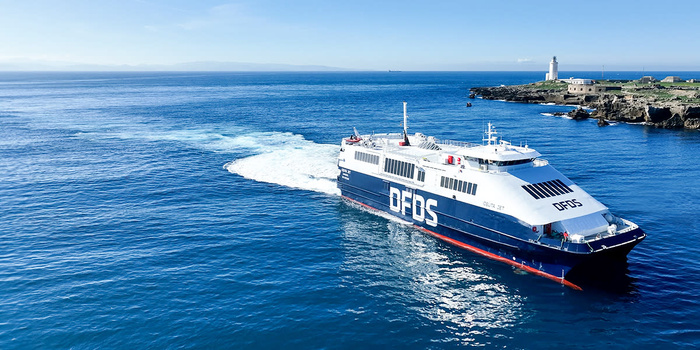
The project presentation ceremony took place in the presence of the Minister of Transport and Logistics, Abdessamad Kayouh, and the Spanish Ambassador to Morocco, Enrique Ojeda, as well as the President of the Port Authority of the Bay of Algeciras, the President of the Tangier City Port, the Spanish Secretary General for Air and Maritime Transport, and the President of the Tangier-Tetouan-Al Hoceima Regional Council.
This project, which is part of a public-private partnership, aims to create a maritime “green corridor” between Europe and Africa, allowing for an entirely electric and CO2-emission-free crossing between the two shores of the Strait.
It includes the construction of two twin ships in Spain, as well as the installation of the necessary port infrastructure for electric charging in Tangier and Tarifa.
In a statement to MAP, Mr. Kayouh emphasized that the strengthening of the maritime fleet is part of a broader strategy aimed at ensuring fluid and sustainable mobility, particularly within the framework of Operation Marhaba, conducted under the supervision of the Mohammed V Foundation for Solidarity.
He noted, in this sense, that the ministry is supporting this operation through the mobilization of some 29 ships with a weekly capacity of 500,000 passengers and 130,000 vehicles, via four Moroccan ports and twelve European ports.
“The goal is to provide the maximum number of ships to meet growing demand and ensure the best crossing conditions for Moroccans residing abroad,” he noted.
For his part, the General Manager of Baleària, Georges Bassoul, indicated that each ship will develop an electric power of 16 MW generated by four electric thrusters powered by batteries with a capacity of 11,500 kWh, allowing them to complete the entire crossing solely by electric propulsion and without generating emissions.
In a presentation detailing the technical aspects of the project, Mr. Bassoul affirmed that these will be completely decarbonised journeys, which will meet the objectives set for 2050 as early as 2027, noting that electric propulsion will eliminate not only emissions but also noise and vibrations.
In addition, each ship will be equipped with four emergency generators running on diesel, with a total power of 11,200 kW, designed to cover potential emergency situations, he added, noting that the full recharging of the fast ferries' batteries will take place during the one-hour stopover scheduled in each city.
To this end, storage systems will be installed in both ports with batteries of 8 MWh gross each, and will be added to the onshore power supply of 5 MW in Tarifa and 8 MW in Tangier, Mr. Bassoul specified, noting that the charging of the ships will be carried out by two innovative autonomous robotic arms, which will allow the batteries necessary for the crossing to be recharged in just 40 minutes.
It should be noted that the two ships will have a width of 25 meters, with a capacity of 804 passengers and 225 vehicles, and will be able to reach a maximum speed of 26 knots. In addition to spacious and bright interiors equipped with numerous amenities, passenger comfort will be guaranteed thanks to a T-Foil system that reduces the vertical movement of the ship.
Furthermore, the ships will have great maneuverability thanks to their fins on the deck, their two bow thrusters, and their four rudders. They will also have two high-capacity ramps at the rear, designed for faster operations and maneuvers while in port.
(With MAP)