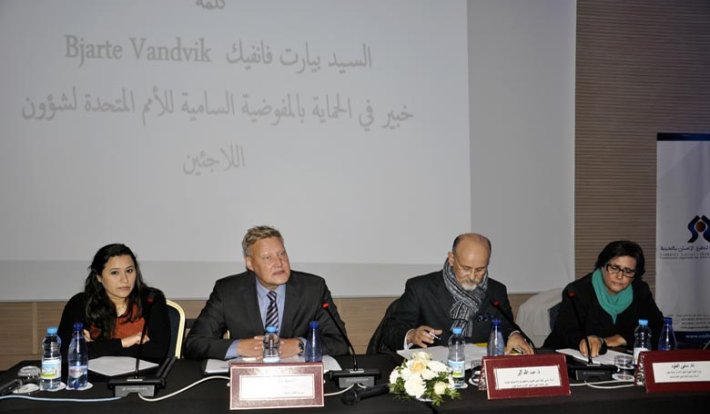
Meeting in Tangier within the framework of a colloquium on urban growth and access to essential services, the participants examined themes related to the dynamics of urban governance.
A panel of Moroccan and foreign experts met on Thursday in Tangier to debate issues relating to urban growth and access to essential services in developing countries.
Gathered within the framework of a colloquium under the theme "Urban growth and access to essential services", organised by the think tank on water and energy access issues "(Re)Sources", the participants examined themes related to the dynamics of urban governance, essential services within sprawling and fragmented urban territories, the financing of access to essential urban services, and the consideration of climate risk.
Speaking at the opening of this colloquium, the President of the think tank, Patrice Fonlladosa, made it known that the phenomenon of urbanisation, which remains "prevalent" especially in the cities of emerging countries, will have to accelerate in the coming decades, estimating that the number of urban inhabitants would reach 6.4 billion by 2050.
Urbanisation, when it is done in an uncontrolled manner, fragments the city and creates informal neighbourhoods not connected to essential services, observed Patrice Fonlladosa.
Moreover, he noted, efforts to develop access to essential services are often cancelled out by galloping urbanisation, adding that in this context of intense concentration of populations, infrastructure needs will be considerable and require a real strategy for their definition, financing, and implementation in cities threatened by extreme weather events and which do not always have the means to take charge of their own urbanisation.
Faced with this urban pressure exerted on essential services, he called for a partnership between public authorities and project owners and for an improvement in dialogue by reaching an intelligent symbiosis between stakeholders, with a view to satisfying local populations.
Furthermore, Patrice Fonlladosa explained that the choice of the city of Tangier to host this 11th colloquium organised by the network is due to the demographic explosion that the city has experienced for several decades, which has been accompanied by a spectacular, proactive urban development to favour the emergence of a Mediterranean metropolis and raise Tangier to the rank of a regional economic hub.
He did not fail to recall, in this regard, the ambitious projects initiated by H.M. King Mohammed VI, notably the Tangier-Metropolis and Tangier-Med plans, which have allowed for the revitalisation of the city's port.
For his part, the President of the Tetouan City Council, Mohamed Idaomar, who indicated that urbanisation is around 60% of the population in Morocco, estimated that its speed of development by 2050 would reach the global estimate, that is to say, 80% of the population would be in the urban space.
The situation will be "catastrophic" if it is not associated with good management and forward-looking governance, he warned.
In a statement to MAP, the former Prime Minister of France, former Member of the European Parliament, Ambassador of the Republic in charge of negotiations for polar zones, and member of (Re)Sources, Michel Rocard, noted that the predictability of urban concentration and the speed of the phenomenon constitute one of the major factors for organising the supply of essential services, stressing that access to good information concerning new arrivals in the city, as well as their needs, is one of the challenges to be met to face this organisational problem.