

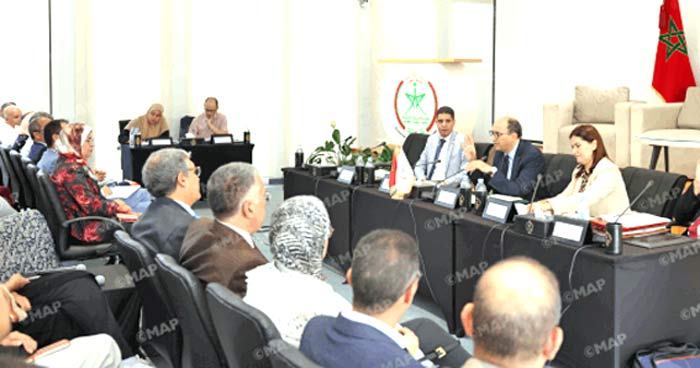
Mediation institutions are facing new issues concerning the impact of the digital transformation of public administration on users' access to their rights, the consecration of justice values, as well as equitable and fluid access to public services, indicated the Ombudsman of the Kingdom, Hassan Tariq, on Wednesday in Rabat.
Speaking at the opening of a study day on "the role of the Ombudsman of the Kingdom between improving administrative services and addressing governance dysfunctions: public procurement, urban planning, and communication as examples", Mr. Tariq stressed that these changes call for moving beyond the fascination with the exceptional capabilities of Artificial Intelligence to analyse data, design government programmes, simplify procedures, and save administrative time and effort, to focus instead on the protection of personal data, respect for privacy, non-discrimination, and the ethical framework of this technology.
The generalisation of digital administration calls into question the major definitions of public service, which is shifting from a vertical logic to a horizontal construction, from a hierarchical base to a reality of networks, as well as from legitimacy to efficiency and from general interest to performance, he said.
Some administrations are resorting to automatic conversation programmes to develop institutional communication, he added, noting that even if a digital competence is developed that allows for the integration of countless situations and possibilities and ensures rapid legal adaptation, it will be incapable of grasping the need for equity, particularly when it concerns an injustice resulting from the strict application of a legal rule.
For his part, the director of the research laboratory on comparative democratic transition at Hassan 1st University of Settat, Abdeljabbar Arrach, noted that this scientific meeting is part of the university's opening up to national constitutional institutions and the strengthening of scientific dialogue on current issues.
He also affirmed that it comes in the wake of the academic dynamic aimed at deepening the scientific debate around the multiple roles of mediation institutions in the consecration of good governance, the consolidation of rights and development, as well as in the analysis and deconstruction of the functions exercised by the Institution of the Ombudsman as a constitutional mechanism for the protection of rights and the management of administrative conflicts, in addition to its roles in supporting territorial and administrative justice.
He added that the scientific debates focus on the institutional functions of mediation and its role in consolidating the values of good governance in the context of the democratic transition that Morocco is experiencing.
For his part, the president of the coordination committee for this study day, Said Raho, highlighted the role of the university space in implementing mechanisms for open dialogue for the benefit of various stakeholders, with a view to establishing bridges between academic knowledge and the practice of managing public affairs.
The work of this study day, organised in partnership with the Research Laboratory on Comparative Democratic Transition of Hassan 1st University of Settat, is structured around several sessions, notably "Reading the reports of the Institution of the Ombudsman on public tenders, the case of the 2023 report", "The prerogatives of the National Commission regarding the settlement of disputes relating to public procurement", "The principle of competition in Moroccan public procurement between legal and contractual constraints", as well as "practical aspects of the action of the Institution of the Ombudsman in the field of public procurement".
Speaking at the opening of a study day on "the role of the Ombudsman of the Kingdom between improving administrative services and addressing governance dysfunctions: public procurement, urban planning, and communication as examples", Mr. Tariq stressed that these changes call for moving beyond the fascination with the exceptional capabilities of Artificial Intelligence to analyse data, design government programmes, simplify procedures, and save administrative time and effort, to focus instead on the protection of personal data, respect for privacy, non-discrimination, and the ethical framework of this technology.
The generalisation of digital administration calls into question the major definitions of public service, which is shifting from a vertical logic to a horizontal construction, from a hierarchical base to a reality of networks, as well as from legitimacy to efficiency and from general interest to performance, he said.
Some administrations are resorting to automatic conversation programmes to develop institutional communication, he added, noting that even if a digital competence is developed that allows for the integration of countless situations and possibilities and ensures rapid legal adaptation, it will be incapable of grasping the need for equity, particularly when it concerns an injustice resulting from the strict application of a legal rule.
For his part, the director of the research laboratory on comparative democratic transition at Hassan 1st University of Settat, Abdeljabbar Arrach, noted that this scientific meeting is part of the university's opening up to national constitutional institutions and the strengthening of scientific dialogue on current issues.
He also affirmed that it comes in the wake of the academic dynamic aimed at deepening the scientific debate around the multiple roles of mediation institutions in the consecration of good governance, the consolidation of rights and development, as well as in the analysis and deconstruction of the functions exercised by the Institution of the Ombudsman as a constitutional mechanism for the protection of rights and the management of administrative conflicts, in addition to its roles in supporting territorial and administrative justice.
He added that the scientific debates focus on the institutional functions of mediation and its role in consolidating the values of good governance in the context of the democratic transition that Morocco is experiencing.
For his part, the president of the coordination committee for this study day, Said Raho, highlighted the role of the university space in implementing mechanisms for open dialogue for the benefit of various stakeholders, with a view to establishing bridges between academic knowledge and the practice of managing public affairs.
The work of this study day, organised in partnership with the Research Laboratory on Comparative Democratic Transition of Hassan 1st University of Settat, is structured around several sessions, notably "Reading the reports of the Institution of the Ombudsman on public tenders, the case of the 2023 report", "The prerogatives of the National Commission regarding the settlement of disputes relating to public procurement", "The principle of competition in Moroccan public procurement between legal and contractual constraints", as well as "practical aspects of the action of the Institution of the Ombudsman in the field of public procurement".