

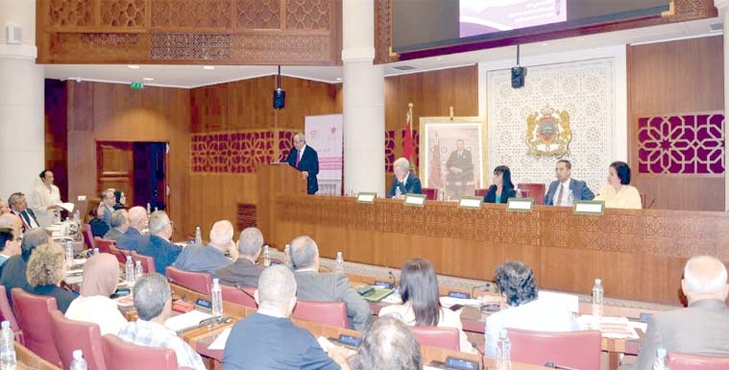
With the participation of many university researchers, teachers, experts, and actors concerned with issues related to higher education, the Socialist Group-Ittihadi Opposition in the House of Representatives and the USFP sector of higher education organized a study day in the hemicycle under the theme: "The law governing higher education after a quarter of a century: May 2000/May 2025."
This meeting is part of the process initiated by the Socialist Union of Popular Forces regarding the public debate on the major reforms underway in the country related to economic, social, cultural, and geopolitical fields. It also reflects the determination of the party of popular forces regarding active contribution to the development of the Moroccan legislative system, which diligently conveys the requirements of development and the stakes of major global socio-economic changes.
The interventions of the participants, while observing a patent constructive objectivity, focused essentially on the structural challenges facing the Moroccan university and the issues related to the project to revise the law governing higher education adopted in 2000, which has not been revised despite the major changes marking the country's evolution, in particular the education system as a whole.
Thus, in his intervention, the Minister of Higher Education, Scientific Research, and Innovation, Azzeddine El Midaoui, emphasized that the new reform project is based on three essential pillars: the connectivity of public policies, the activation of legal texts, and the autonomy of the university, while highlighting that the reform in question should not be a "reform of the reform" but must imperatively be global and profound, just as the university is called upon to regain its position as a space for scientific research, culture, and creativity...
The government official also indicated that his department is actively working on the formulation of the final project, emphasizing the need to invest legislative and scientific time in the direction of opening a broad debate on the matter.
He further affirmed that the organization by the Ittihadi Opposition Group of this study day is part of the traditional register of the action of the USFP parliamentary group dedicated to broadening the public debate around major societal problems, particularly that relating to education, which "we consider as a structural and historical cause that transcends the contours of higher education and encompasses the system in its entirety."
In this vein, the Ittihadi parliamentarian Lachguar virulently deplored the braking that has obstructed the higher education reform process, recalling that Law 01.00 issued in the year 2000 during the era of the alternation government constituted a decisive step in the middle of the reform process.
However, he developed, the lack of updating and adaptation to the spirit of the 2011 Constitution, the 2015-2030 strategic vision, and Framework Law 51-17 has emptied this process of its initial content...
In this regard, El Hassan Lachguar did not fail to formulate a sharp criticism of the current government for having renounced many initially promising provisions (...).
And to emphasize the need to make higher education a democratic right accessible to all Moroccans, sheltered from spatial or social segregation, calling, for this purpose, to make this study day an efficient station for diagnosing reality and suggesting profound revisions capable of meeting the aspirations of Moroccan youth and facing the challenges of global development...
For his part, the Secretary General of the National Union of Higher Education, Habri El Habri, estimated in his intervention that higher education is no longer just a sectoral affair but rather a largely societal issue, calling for the adoption of a participatory approach that guarantees the effective involvement of all stakeholders in building a strong and civic public university.
For her part, the representative of the Ittihadi higher education sector, Souâd Bennour, noted that the USFP has constantly contributed to the building of productive and efficient higher education, calling for the design of a global vision capable of making this sector a lever for societal cohesion...
Souâd Bennour explained, on the other hand, that the "quantitative and qualitative successes recorded in terms of higher education cannot hide the structural failures, with school dropout rates remaining very high (50%) in addition to worrying unemployment rates among graduates (more than 20%)."
Furthermore, it should be specified that this university meeting was based on a framework platform presented by the parliamentarian Khaddouj Slassi, who highlighted the major changes that the world has experienced thanks to scientific progress, but also the central role played by the university in building a "knowledge society."
The said platform emphasizes the manifest relationship between the performance of higher education and the economic, social, and democratic progress of countries (...)
In addition, this did not fail to formulate central questions, namely:
This meeting is part of the process initiated by the Socialist Union of Popular Forces regarding the public debate on the major reforms underway in the country related to economic, social, cultural, and geopolitical fields. It also reflects the determination of the party of popular forces regarding active contribution to the development of the Moroccan legislative system, which diligently conveys the requirements of development and the stakes of major global socio-economic changes.
The interventions of the participants, while observing a patent constructive objectivity, focused essentially on the structural challenges facing the Moroccan university and the issues related to the project to revise the law governing higher education adopted in 2000, which has not been revised despite the major changes marking the country's evolution, in particular the education system as a whole.
Thus, in his intervention, the Minister of Higher Education, Scientific Research, and Innovation, Azzeddine El Midaoui, emphasized that the new reform project is based on three essential pillars: the connectivity of public policies, the activation of legal texts, and the autonomy of the university, while highlighting that the reform in question should not be a "reform of the reform" but must imperatively be global and profound, just as the university is called upon to regain its position as a space for scientific research, culture, and creativity...
The government official also indicated that his department is actively working on the formulation of the final project, emphasizing the need to invest legislative and scientific time in the direction of opening a broad debate on the matter.
Azeddine MidaouiAs for the parliamentarian El Hassan Lachguar, a member of the Socialist Group-Ittihadi Opposition in the House of Representatives, he highlighted that the reform of higher education in Morocco cannot succeed without going beyond the postulate of the "reform of the reform" and adopting a clear long-term strategic vision, based on the objective evaluation of previous experiences...
The university is called upon to regain its position
as a space for scientific research,
culture, and creativity
He further affirmed that the organization by the Ittihadi Opposition Group of this study day is part of the traditional register of the action of the USFP parliamentary group dedicated to broadening the public debate around major societal problems, particularly that relating to education, which "we consider as a structural and historical cause that transcends the contours of higher education and encompasses the system in its entirety."
In this vein, the Ittihadi parliamentarian Lachguar virulently deplored the braking that has obstructed the higher education reform process, recalling that Law 01.00 issued in the year 2000 during the era of the alternation government constituted a decisive step in the middle of the reform process.
However, he developed, the lack of updating and adaptation to the spirit of the 2011 Constitution, the 2015-2030 strategic vision, and Framework Law 51-17 has emptied this process of its initial content...
In this regard, El Hassan Lachguar did not fail to formulate a sharp criticism of the current government for having renounced many initially promising provisions (...).
And to emphasize the need to make higher education a democratic right accessible to all Moroccans, sheltered from spatial or social segregation, calling, for this purpose, to make this study day an efficient station for diagnosing reality and suggesting profound revisions capable of meeting the aspirations of Moroccan youth and facing the challenges of global development...
For his part, the Secretary General of the National Union of Higher Education, Habri El Habri, estimated in his intervention that higher education is no longer just a sectoral affair but rather a largely societal issue, calling for the adoption of a participatory approach that guarantees the effective involvement of all stakeholders in building a strong and civic public university.
For her part, the representative of the Ittihadi higher education sector, Souâd Bennour, noted that the USFP has constantly contributed to the building of productive and efficient higher education, calling for the design of a global vision capable of making this sector a lever for societal cohesion...
Souâd Bennour explained, on the other hand, that the "quantitative and qualitative successes recorded in terms of higher education cannot hide the structural failures, with school dropout rates remaining very high (50%) in addition to worrying unemployment rates among graduates (more than 20%)."
Furthermore, it should be specified that this university meeting was based on a framework platform presented by the parliamentarian Khaddouj Slassi, who highlighted the major changes that the world has experienced thanks to scientific progress, but also the central role played by the university in building a "knowledge society."
The said platform emphasizes the manifest relationship between the performance of higher education and the economic, social, and democratic progress of countries (...)
In addition, this did not fail to formulate central questions, namely:
- What philosophy will be adopted regarding the preparation of a new draft law?
- Will this project have sufficient audacity to overcome the failure of successive reforms?
- Will it be able to examine the historical and structural problems that impact the sector in question?...