

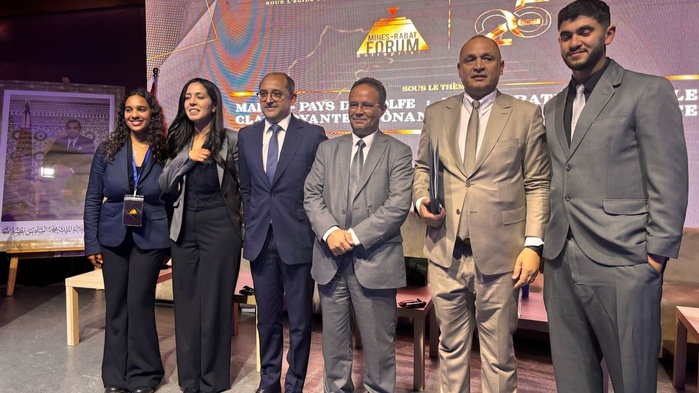
A quarter of a century has passed since the Mines-Rabat Forum, and the momentum has never dried up. Students remain at the helm of this event, which has become an unavoidable reference. With the attentive support of their director Omar Oussouaddi, the 25th edition marked a turning point, by broadening the scope of debates and instilling a new dimension, made of openness, innovation, and a shared vision.
For two days, the Forum was a place of convergence between know-how and future projects. From 16 to 17 April, experts, companies, and young engineers met for a series of conferences, interactive workshops, and direct meetings with recruiters. The stands of major industries allowed students to expand their network and lay the foundations for future professional collaborations.
Speaking on this occasion, the director of the National Higher School of Mines of Rabat, Omar Oussouaddi, specified that the theme chosen for this edition reflects both the deep commitment and the increased awareness of our young people, as well as Morocco's involvement in its strategic projects. He also stressed the importance of strengthening ties of friendship and cooperation with the Gulf countries, not only on a political level, but also economically and culturally.
Preparing a committed next generation
The first meeting on Morocco-Gulf Countries relations brought together experts, who explored new dynamics and emerging perspectives. Approached by the newspaper 'L'Opinion', Mounir Ferram, Director General of ASMEX, highlighted the strategic complementarities between Morocco and the Gulf countries, specifying that Morocco, thanks to its expertise, is positioning itself as a key player in Africa, a market of 1.7 billion consumers. He then highlighted the fact that the economies of the two regions can create great mutual value thanks to Moroccan expertise and investments from the Gulf countries. 'The debate covered themes such as decarbonisation, competitiveness, and job creation, highlighting the importance of this cooperation for economic development,' he added.
Speaking on new economic trends, he stressed the importance of building a clean economy, based on renewable energies, innovation, and emerging technologies such as artificial intelligence, databases, and data. According to him, economic transformation cannot happen without strong investment in human capital.
'There can be no development without the human element,' he affirmed, insisting on the need to train a new generation capable of adapting to the rapid changes in the labour market. He recalled that nearly 30% of the jobs of tomorrow are not yet known, which imposes a flexible, innovative, and future-oriented training system.
Mounir Ferram also emphasised the importance of soft skills, this ability to learn, question oneself, and evolve permanently. 'You have to learn, unlearn, and relearn. Knowledge must never be frozen, but always dynamic,' he concluded, stressing that the success of this transition rests above all on the women and men of Morocco.
Morocco, a key player in the energy transition
Present during the afternoon session, the Minister of Industry and Commerce, Ryad Mezzour, highlighted Morocco's progress in several areas, despite a complex context. He highlighted a key point: 'In the fertiliser industry, there is currently no alternative more competitive than what Morocco offers. The world depends on Moroccan fertilisers to feed itself.'
Regarding the energy transition, Omar Alaoui Mhamdi, DG of Acwa Power, affirmed in an interview granted to 'L'Opinion' that Morocco benefits from a privileged geographical location and ideal climatic conditions to produce a highly competitive green electron. This potential naturally attracts investors from the Gulf, including Acwa Power, who are showing growing interest in the development of renewable energies and seawater desalination. 'A green hydrogen project and its derivatives will soon see the light of day in the south of Morocco, on land that has recently been allocated to us,' he specified.
Mr Alaoui Mhamdi also insisted on the nature of the partnership between Morocco and the Gulf countries, describing it as win-win. 'Saudi Arabia, the United Arab Emirates, Qatar, and Kuwait are solid and committed partners. Together, we can collaborate on key sectors like renewable energies and desalination,' he affirmed.
Recalling the Kingdom's growing water needs, he stressed that 'Morocco will need about 1.7 billion cubic metres of water by 2030. Acwa Power's goal is to support the Kingdom in its desalination projects throughout this decade.'
Internship and employment: Seven new partners
On the occasion of the forum, seven partnership agreements were signed between the National Higher School of Mines of Rabat and several major players, including national and multinational companies, design offices, and renowned laboratories. These agreements aim to strengthen the quality of training offered to students, by guaranteeing them internship opportunities from the first year until the end of their course, while paving the way for future employment opportunities.
The signatory partners include the Research Institute for Solar Energy and New Energies (IRESEN), the LPEE laboratory, Akkodix (specialised in smart industry), TE Connectivity (world leader in connectivity and sensors), MADREX (industrial engineering), the EM Energie Group, Capgemini Engineering, as well as OMCo, a company active in natural gas transport. Through these conventions, the objective is to consolidate an ecosystem conducive to the emergence of future skills, to bring the academic world closer to the industrial fabric, and to further anchor training in a dynamic of innovation and social responsibility.