

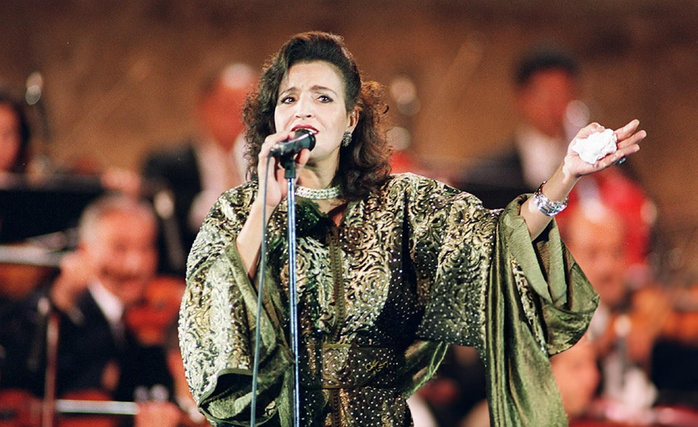
Give her a text to sing and she makes it her own. It is no longer yours, through the magic of a subtle appropriation. She puts all her emotions, all her heart, all her soul into it. Give her a copper surface to caress and she converts it into gold. In short, she is what we call an interpreter. And what an interpreter, what a charismatic artist! Naïma Samih wrote one of the most beautiful tales in the history of Moroccan music. With talent and humility. Her gentle character hides a formidable vocal depth. Emotional charge, indefinable strength, and regenerative sadness characterize a voice that escaped the ordinary, coming out of nowhere.
For her, every project is tackled head-on. As proof, the diversity of the lyrics and compositions that make up her vast repertoire. Between authenticity and innovation, Samih juggles with dexterity: "El Behara", "Allah Aâliha Kssara", "Amri Lillah", "Jrit Ou Jarit", "Jari Ya Jari", "Tfetteh El Ward", "Ahla Soura", "Cheft El Khatem", "Aâla Ghafla", "Ghab Aâliya Lahlal"... Recognized for an unparalleled technique, she leaves a mark on professionals and the general public alike. Yet, her path knew no academic bifurcation. The child dreamed of singing, having caught the singing bug at age 9. The schoolgirl left her institution in the mid-1960s for vocational training. This did not distance her from her first love, music. Quite the opposite. With a hairdressing diploma in hand, she opened a salon in the Casablanca district of Derb Soltane, where she let out her first cry in 1953. As she aged, she suffered from anemia, which forced her to travel abroad frequently for specialized care. Her career was punctuated by the looming shadow of retirement. But she recovered and sporadically returned to her audience.
For her, every project is tackled head-on. As proof, the diversity of the lyrics and compositions that make up her vast repertoire. Between authenticity and innovation, Samih juggles with dexterity: "El Behara", "Allah Aâliha Kssara", "Amri Lillah", "Jrit Ou Jarit", "Jari Ya Jari", "Tfetteh El Ward", "Ahla Soura", "Cheft El Khatem", "Aâla Ghafla", "Ghab Aâliya Lahlal"... Recognized for an unparalleled technique, she leaves a mark on professionals and the general public alike. Yet, her path knew no academic bifurcation. The child dreamed of singing, having caught the singing bug at age 9. The schoolgirl left her institution in the mid-1960s for vocational training. This did not distance her from her first love, music. Quite the opposite. With a hairdressing diploma in hand, she opened a salon in the Casablanca district of Derb Soltane, where she let out her first cry in 1953. As she aged, she suffered from anemia, which forced her to travel abroad frequently for specialized care. Her career was punctuated by the looming shadow of retirement. But she recovered and sporadically returned to her audience.
Conservative Father
As was often the case at the time in Morocco, parents' hair would stand on end when their daughters expressed the wish to enter the artistic world. Naïma Samih was no exception, unlike the doyenne Bahija Idriss. After two successful attempts at the RTM, with Mohamed Bouanani ("Khamiss Al Hadh") and Abdenbi Jirari ("Mawahib"), Naïma found herself blocked by her father. She owed her salvation to the efforts of a few names in the artistic-media sphere, including the great composer Mohamed Ben Abdesslam, who managed to convince the recalcitrant father, though he set some conditions, including elegance in the choice of themes and music. And he was served.
Regarding the lyrics, Naïma Samih rubbed shoulders with the finesse of authors like Ali Haddani, Ahmed Taïeb El Alj, Mehdi Zeriouh, Mustapha Baghdad, Tahar Sabbata, Fathallah Mghari, Badr Ben Fayçal... As for the composers, they were chosen with care: Brahim El Alami, Mohamed Ben Abdesslam, My Ahmed Alaoui, Abdelkader Wahbi, Abdelkader Rachidi, Abdallah Issami, Abdelwahab Doukkali, Saïd Chraïbi, Abderrahim Sekkat... A dream team for an exceptional voice! Naïma Samih later said: "The day the Mawahib show was broadcast, an internal war broke out at home, but my father was quickly convinced of my value as an artist, especially since the song I sang was not considered disrespectful." In the wake of this joy that opened the doors of the music world to her, Naïma became friends with another protégé of Abdenbi Jirari, Samira Bensaïd, who paid tribute to her the day after her passing through remarks reported by Bladi.net: "Today, I lost a childhood friend, a large part of my memories, and a face that always radiated life and spontaneity. Naïma was not just an exceptional voice, she was also a warm person, generous in her feelings, filling the world with her laughter and her kind soul. Since our childhood, I was the turbulent child and she was the natural one, acting with rare spontaneity. She was very close to me and my family and was part of my life. Her love will remain engraved in my heart. You are gone, but your presence will never disappear." Tributes poured out like tears on the cheeks of millions of admirers in Morocco and across the Arab world.
Some are more poignant than others, like a piece by the essayist and former director of the Higher Institute of Dramatic Art and Cultural Animation, Ahmed Messaia: "They drop off and disappear one after the other, the dead souls behind the door and are immediately forgotten, leaving behind a multitude of posts, just to clear themselves of oblivion. Under other skies, where the slightest citizen has the value of a rare jewel, time is stopped and the dead are celebrated, radio and television programs are immediately dedicated to them, their past is unearthed and their work is highlighted because transmission is the true ferment of progress and recognition. So that we never forget. Goodbye Naïma. I had the immense pleasure of spending quite a lot of time with you when I was director of the Rabat Festival. I will never forget your frankness and your tenacity in defending authenticity, Moroccan identity, when you clashed with Laïla Ghofrane during a dinner." Naïma Samih is gone. Such is life, such is how death wins.
Anis HAJJAM