

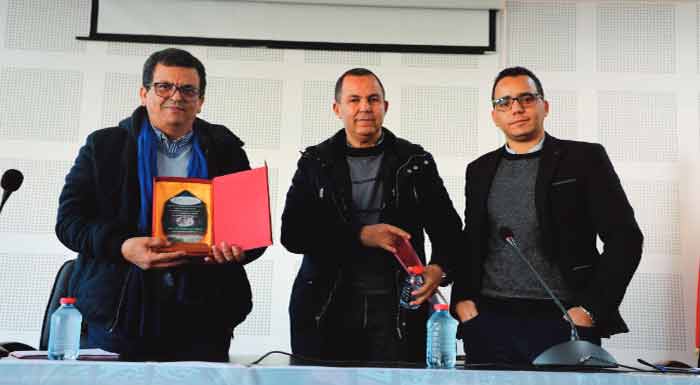
On the initiative of the École Normale Supérieure of Moulay Ismail University of Meknes, a literary gathering, themed "El Mostafa Bouignane: writing History", was held on December 24th, 2024, on the premises of this institution, in the presence of students, professors, and a good number of writers.
Direct contact with the writer as a person sparks students' interest in his works, or even in reading in general. It also allows for questioning the opinion ingrained in the student's mind that the writer is a distant, absent, unreal character. It is also an invitation to (re)visit the relationship between literature and history in its various aspects. The event also aims to promote the works of new-generation Moroccan writers, while raising students' awareness of the equally important contribution of Moroccan literature to "Weltliteratur".
It should be recalled that El Mostafa Bouignane is a Moroccan writer with a substantial body of work. He is also a cinephile. Between 1997 and 2000, he was president of the Ciné-club Reggab in Fès. He successively wrote La Porte de la chance in 2006 (Marsam); nominated for the Grand Atlas in 2007 and the Prix Plaisir de lire at the International Book Fair in Tangier.
In 2010, he published Des Houris et des Hommes (Marsam) and won the Prix du Magazine littéraire du Maroc. With De Fès à Kaboul, published in 2013 (Marsam) and L’Année de Bacchus in 2021 (Virgule), he also won the Prix des Jeunes de Marrakech. In 2022, he published L’Orchestre de Jacob, une histoire marocaine with Georges Abitbol (Marsam). La Demoiselle d’Ahermoumou, published in 2024 (Marsam) is his latest novel.
In all his novels, El Mostafa Bouignane often re-examines the vicissitudes of history, highlighting its detrimental impact on individuals' destinies. Through the simplicity of his writing, he often seeks to bring novelistic writing closer to historical writing.
In this sense, history is a vast field of possibilities for writers as it allows for understanding past fractures in order to grasp the present. In this perspective, L’Année de Bacchus rewrites a news item against a historical backdrop. The author tells the story of the theft of the statue of Bacchus from the archaeological site of Volubilis, on the outskirts of the city of Meknes.
Through this narrative, he lifts the veil on the tragedy experienced by the villagers of Fartassa, tormented by history and corrupt politics in 1982. The inhabitants of this cursed village were subjected to "kafkaesque" violence, where the victim did not know the cause of their punishment, which took on the colour of retribution.
Throughout the novel, Bouignane problematises this existential situation by anchoring it in a complex historical and political context, questioning alienating practices and behaviours, such as authoritarianism, religiosity, corrupt politics, illiteracy, patriarchy, material and sexual poverty, marginalisation, and madness. These alienating forms shaped the picture of that era haunted by terror, of which the body becomes the receptacle.
The author thus confronts the horrors of history to expose the fragility of the body. The novel paradoxically highlights the importance of love, literature, or friendship as mechanisms of resilience against the adversity of fate and history.
This return to the past allows for deconstructing and understanding the traumas that are passed down from one generation to another.
However, the "writing of history" does not fall into the trap of resentment but ensures the creation of a space enriched by the writing of resilience as a dynamic resistance to shock.
Furthermore, it transforms surviving victims into actors to regain a certain serenity, deactivating the suspended life that characterises the fear-stricken character through the activation of forgiveness and forgetting. But this only becomes constructive when the past is subjected to critical examination. Bouignane's novels show how poverty, precariousness, abuse of power, fundamentalism, and the perversion of "the political" become an obstacle to the emergence of the individual, or even a source of frustration for them.
They also illustrate how literature can serve as a tool for knowledge through historical imagination. It is engaged literature, as the author-narrator, particularly in L’Année de Bacchus where biographemes occasionally appear, supports values of autonomy while denouncing political and historical injustices. In other words, the reader occasionally notices the author's personal involvement in the narrative. Bouignane's literary universe is, however, full of life; the author transforms the traumas of history into life energy. His literary prose thus explores the ambiguities and paradoxes of the individual's existence in the face of history.
By Abdelouahed Hajji
Bouignane's novels show how poverty, precariousness, abuse of power, fundamentalism, and the perversion of "the political" become an obstacle to the emergence of the individual, or even a source of frustration for themThe guest of honour, El Mostafa Bouignane, shared an enriching reflection on his work with the audience, focusing on the porous links between literature and history. Organised by the research laboratory "Language Sciences, Art, Literature, Education and Culture" (SCALEC - ENS - Meknès) and coordinated by professors Abdelouahed Hajji and Mohammed Dekhissi, this study day's main objective was to bring students closer to the literary world of the author of L’Année de Bacchus (Virgule, 2021), to help them understand his aesthetics and writing techniques, as well as the major themes of his literature.
Direct contact with the writer as a person sparks students' interest in his works, or even in reading in general. It also allows for questioning the opinion ingrained in the student's mind that the writer is a distant, absent, unreal character. It is also an invitation to (re)visit the relationship between literature and history in its various aspects. The event also aims to promote the works of new-generation Moroccan writers, while raising students' awareness of the equally important contribution of Moroccan literature to "Weltliteratur".
It should be recalled that El Mostafa Bouignane is a Moroccan writer with a substantial body of work. He is also a cinephile. Between 1997 and 2000, he was president of the Ciné-club Reggab in Fès. He successively wrote La Porte de la chance in 2006 (Marsam); nominated for the Grand Atlas in 2007 and the Prix Plaisir de lire at the International Book Fair in Tangier.
In 2010, he published Des Houris et des Hommes (Marsam) and won the Prix du Magazine littéraire du Maroc. With De Fès à Kaboul, published in 2013 (Marsam) and L’Année de Bacchus in 2021 (Virgule), he also won the Prix des Jeunes de Marrakech. In 2022, he published L’Orchestre de Jacob, une histoire marocaine with Georges Abitbol (Marsam). La Demoiselle d’Ahermoumou, published in 2024 (Marsam) is his latest novel.
In all his novels, El Mostafa Bouignane often re-examines the vicissitudes of history, highlighting its detrimental impact on individuals' destinies. Through the simplicity of his writing, he often seeks to bring novelistic writing closer to historical writing.
In this sense, history is a vast field of possibilities for writers as it allows for understanding past fractures in order to grasp the present. In this perspective, L’Année de Bacchus rewrites a news item against a historical backdrop. The author tells the story of the theft of the statue of Bacchus from the archaeological site of Volubilis, on the outskirts of the city of Meknes.
Through this narrative, he lifts the veil on the tragedy experienced by the villagers of Fartassa, tormented by history and corrupt politics in 1982. The inhabitants of this cursed village were subjected to "kafkaesque" violence, where the victim did not know the cause of their punishment, which took on the colour of retribution.
Throughout the novel, Bouignane problematises this existential situation by anchoring it in a complex historical and political context, questioning alienating practices and behaviours, such as authoritarianism, religiosity, corrupt politics, illiteracy, patriarchy, material and sexual poverty, marginalisation, and madness. These alienating forms shaped the picture of that era haunted by terror, of which the body becomes the receptacle.
The author thus confronts the horrors of history to expose the fragility of the body. The novel paradoxically highlights the importance of love, literature, or friendship as mechanisms of resilience against the adversity of fate and history.
This return to the past allows for deconstructing and understanding the traumas that are passed down from one generation to another.
However, the "writing of history" does not fall into the trap of resentment but ensures the creation of a space enriched by the writing of resilience as a dynamic resistance to shock.
Furthermore, it transforms surviving victims into actors to regain a certain serenity, deactivating the suspended life that characterises the fear-stricken character through the activation of forgiveness and forgetting. But this only becomes constructive when the past is subjected to critical examination. Bouignane's novels show how poverty, precariousness, abuse of power, fundamentalism, and the perversion of "the political" become an obstacle to the emergence of the individual, or even a source of frustration for them.
They also illustrate how literature can serve as a tool for knowledge through historical imagination. It is engaged literature, as the author-narrator, particularly in L’Année de Bacchus where biographemes occasionally appear, supports values of autonomy while denouncing political and historical injustices. In other words, the reader occasionally notices the author's personal involvement in the narrative. Bouignane's literary universe is, however, full of life; the author transforms the traumas of history into life energy. His literary prose thus explores the ambiguities and paradoxes of the individual's existence in the face of history.
By Abdelouahed Hajji
