

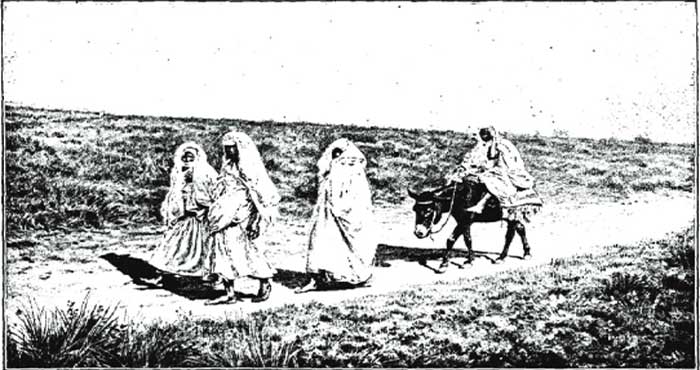
After the departure of the Portuguese from Mazagan in 1769 and the subsequent abandonment, the fortress was rehabilitated in the mid-19th century and called El Jadida (the new one), becoming a commercial centre and a multicultural society comprising Muslim, Jewish, and Christian inhabitants.
Indeed, around 1824/1825 (1240 of the Hegira), Sultan Moulay Abderrahmane appointed his cousin Mohammed ben Ettayeb as governor of the Doukkala province, of which Mazagan was the natural port. The latter, writes the historian An-Naciri in his "Kitâb al-Istiqsa li-Akhbar duwwal Al-Maghrib al-Aqsa", "then went to El Jadida, which he found in ruins, just as it had been left after the conquest, during the reign of Sultan Sidi Mohammed (may God have mercy on him). This city was called El Brija before the conquest, then, as the wall had been demolished by mines during the conquest, it was given the name El Mehdonma. Sidi Mohammed ben Ettayeb had the perimeter wall rebuilt and the ruins of the city cleared. He named it El Jadida. And he threatened with severe penalties anyone who would refer to it by any other name. Since that time, it has been called nothing but El Jadida".
In July 2004, the Portuguese city of Mazagan was inscribed on the UNESCO World Heritage List, because it "is an exceptional example of the exchange of influences between European and Moroccan cultures from the 16th to the 18th century, and one of the very first settlements of Portuguese explorers in West Africa on the route to India. These influences are clearly reflected in the architecture, technology, and urban planning of the city". (Criterion ii), and "is an exceptional example and one of the first of the realization of Renaissance ideals integrated into Portuguese construction techniques. Among the most remarkable constructions of the Portuguese period are the cistern and the Church of the Assumption, built in the Manueline style of the early 16th century". (Criterion iv).
One hundred and four years before this inscription, the Frenchman Eduard Montet had visited Mazagan and described his stay there.
Indeed, around 1824/1825 (1240 of the Hegira), Sultan Moulay Abderrahmane appointed his cousin Mohammed ben Ettayeb as governor of the Doukkala province, of which Mazagan was the natural port. The latter, writes the historian An-Naciri in his "Kitâb al-Istiqsa li-Akhbar duwwal Al-Maghrib al-Aqsa", "then went to El Jadida, which he found in ruins, just as it had been left after the conquest, during the reign of Sultan Sidi Mohammed (may God have mercy on him). This city was called El Brija before the conquest, then, as the wall had been demolished by mines during the conquest, it was given the name El Mehdonma. Sidi Mohammed ben Ettayeb had the perimeter wall rebuilt and the ruins of the city cleared. He named it El Jadida. And he threatened with severe penalties anyone who would refer to it by any other name. Since that time, it has been called nothing but El Jadida".
In July 2004, the Portuguese city of Mazagan was inscribed on the UNESCO World Heritage List, because it "is an exceptional example of the exchange of influences between European and Moroccan cultures from the 16th to the 18th century, and one of the very first settlements of Portuguese explorers in West Africa on the route to India. These influences are clearly reflected in the architecture, technology, and urban planning of the city". (Criterion ii), and "is an exceptional example and one of the first of the realization of Renaissance ideals integrated into Portuguese construction techniques. Among the most remarkable constructions of the Portuguese period are the cistern and the Church of the Assumption, built in the Manueline style of the early 16th century". (Criterion iv).
One hundred and four years before this inscription, the Frenchman Eduard Montet had visited Mazagan and described his stay there.
The author
Eduard Montet (1856/1934) was a French orientalist, doctor of theology, and dean of the Faculty of Theology at the University of Geneva. He taught Hebrew, oriental languages, Old Testament exegesis, and especially Arabic (1894-1923).
He is the author of numerous works on the history of the Bible, Judaism, Christianity, and Islam, and a translation of the Quran (1925) which was frequently reprinted. Thanks to his knowledge of the Arab world and language, he was entrusted with a mission to Morocco by France in 1900/1901 and 1914.
The second trip was carried out in July and August 1914, with the objective of studying the Muslim University of Fez and searching for what had become of its famous Karaouine library, reported as missing at the time; investigations published in 1915 by "Le Globe, Geneva geography review", under the title "The city of Fez, Exploration in Morocco in July and August 1914".
The 1900/1901 trip
As for the first trip, the one that concerns our subject (*), its purpose was, as Montet himself reveals, to conduct an inquiry into the organization and the political, religious, and social role of Muslim religious brotherhoods. To do this, and under the guise of a scientific mission under the aegis of several institutes and academic societies, he gave his Moroccan journey an official character by equipping himself with letters of introduction addressed to the French Legation in Tangier and to the Moroccan authorities. "The trip I am making," he writes, "has an official character, in the sense that I am undertaking it under the protection of the French Government and, subsequently, the Moroccan Government. This amounts to saying that the Moroccan gendarme (mkhâzni), who will accompany me, will be the representative of a power responsible for my life and my property."
Eduard Montet (1856/1934) was a French orientalist, doctor of theology, and dean of the Faculty of Theology at the University of Geneva. He taught Hebrew, oriental languages, Old Testament exegesis, and especially Arabic (1894-1923).
He is the author of numerous works on the history of the Bible, Judaism, Christianity, and Islam, and a translation of the Quran (1925) which was frequently reprinted. Thanks to his knowledge of the Arab world and language, he was entrusted with a mission to Morocco by France in 1900/1901 and 1914.
The second trip was carried out in July and August 1914, with the objective of studying the Muslim University of Fez and searching for what had become of its famous Karaouine library, reported as missing at the time; investigations published in 1915 by "Le Globe, Geneva geography review", under the title "The city of Fez, Exploration in Morocco in July and August 1914".
The 1900/1901 trip
As for the first trip, the one that concerns our subject (*), its purpose was, as Montet himself reveals, to conduct an inquiry into the organization and the political, religious, and social role of Muslim religious brotherhoods. To do this, and under the guise of a scientific mission under the aegis of several institutes and academic societies, he gave his Moroccan journey an official character by equipping himself with letters of introduction addressed to the French Legation in Tangier and to the Moroccan authorities. "The trip I am making," he writes, "has an official character, in the sense that I am undertaking it under the protection of the French Government and, subsequently, the Moroccan Government. This amounts to saying that the Moroccan gendarme (mkhâzni), who will accompany me, will be the representative of a power responsible for my life and my property."
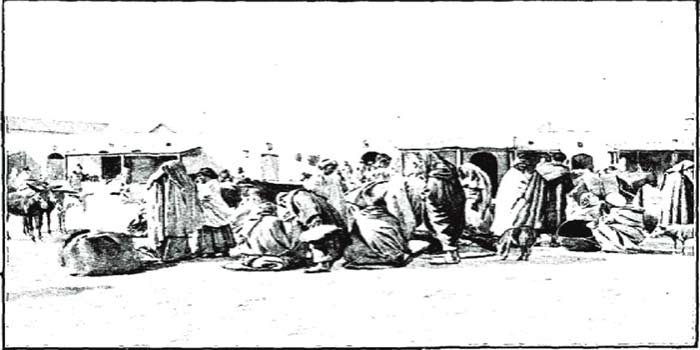
On 31 October 1900, Montet landed in Tangier. To get to Marrakech, for security reasons, he did not take the classic route through Fez followed by European legations and official travelers, but traveled along the Atlantic coast, which led him to cross the Doukkala lands from 6 to 12 December 1900, including Mazagan where he stayed for 2 days. His journey through the Doukkala zone took place as follows: 6 December 1900: departure from Casablanca towards Marrakech; 7 December: arrival in Azemmour; 9 December: departure from Azemmour and arrival in Mazagan; 10 December: departure from Mazagan; 11 December: Souk Tlat Sidi Bennour; 12 December: Jebel Lakhdar and Guerrandou. Returning from Marrakech and Mogador, Montet would cross the province again from 5 to 7 January 1901 (Oualidia, ruins of Tit, and Mazagan), but he makes no description of it in the narration of his trip.
Two written traces crowned this trip. First, his study entitled: "The religious brotherhoods of Moroccan Islam: their religious, political, and social role", published in 1902 in the "Revue de l'histoire des religions" and in 1925 in book form. And the account of his trip to the Cherifian Empire published by the magazine "le Tour du monde (Journal of travels and travelers)" in 1903; divided into 8 episodes, it bears the title: "Trip to Morocco".
Montet does not in any way veil his colonialist ideas about Morocco. Thus, throughout his narrative, he denounces "the abuses of the Cherifian government (which) are so glaring and its tyranny so unbearable, that complaints and protests break out everywhere, complaints and protests to which Europe should lend an ear; for if there is a country where the intervention of the great European powers is imposed as an absolute necessity, it is Morocco"; before attesting in one of the conclusions of his prose: "I believe that, if there is a country to which the destinies of Morocco should be entrusted, it is France. The proximity of Algeria, the remarkable transformation through which Algeria has passed under the French regime and genius, and finally the very close relations, from an ethnographic, physical, linguistic, and religious point of view, between Western Algeria (Oran province) and Morocco, are all reasons of very great weight that militate in favor of the thesis that I affirm (establishment of a French protectorate in Morocco)."
Two written traces crowned this trip. First, his study entitled: "The religious brotherhoods of Moroccan Islam: their religious, political, and social role", published in 1902 in the "Revue de l'histoire des religions" and in 1925 in book form. And the account of his trip to the Cherifian Empire published by the magazine "le Tour du monde (Journal of travels and travelers)" in 1903; divided into 8 episodes, it bears the title: "Trip to Morocco".
Montet does not in any way veil his colonialist ideas about Morocco. Thus, throughout his narrative, he denounces "the abuses of the Cherifian government (which) are so glaring and its tyranny so unbearable, that complaints and protests break out everywhere, complaints and protests to which Europe should lend an ear; for if there is a country where the intervention of the great European powers is imposed as an absolute necessity, it is Morocco"; before attesting in one of the conclusions of his prose: "I believe that, if there is a country to which the destinies of Morocco should be entrusted, it is France. The proximity of Algeria, the remarkable transformation through which Algeria has passed under the French regime and genius, and finally the very close relations, from an ethnographic, physical, linguistic, and religious point of view, between Western Algeria (Oran province) and Morocco, are all reasons of very great weight that militate in favor of the thesis that I affirm (establishment of a French protectorate in Morocco)."
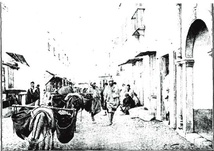
Mazagan in 1900
Montet therefore arrived in Mazagan on 9 December 1900, coming from Azemmour, and left the next day. He was hosted by the French consul in the city, Joseph Brudo, who had "prepared rooms in his hospitable home and did not (want) at any price for us to sleep in a tent". The latter, writes Joseph Goulven in "The Establishment of the first Europeans in Mazagan during the 19th century", was sent by "the Altaras House (...) in 1856 (...) to Morocco for the recovery of some of its outstanding debts in Mogador. After he had fulfilled the object of his mission, Joseph Brudo immediately established himself on his own account (1857) and chose Mazagan as his habitual residence; he acquired, early on, a predominant place among the merchants of the city. It is to this influence, which came to him from his great qualities, that he owed being chosen, in 1866, as consular agent of France in Mazagan". "He even pushed his zeal," adds the former head of the Civil Services Office of Morocco who worked at the El Jadida municipality between 1915 and 1920, "to the point of creating, around 1890-1891, a French postal service in Morocco and receiving, at his own expense, all the missions that the French government sent to Morocco. The Brudo house was reputed to be the house of France in Mazagan: the Tissots, Ordegas, Erckmanns, Schlumbergers, Burckarts, Douttés, etc., etc., were received there with open arms."
At his table, Brudo serves his guests a "superb chebel (shad) caught in the Oum Errbia, it is one of the first caught in this season, and which, as such, should have been sent to the sultan; it is therefore a royal dish that we are putting under our teeth".
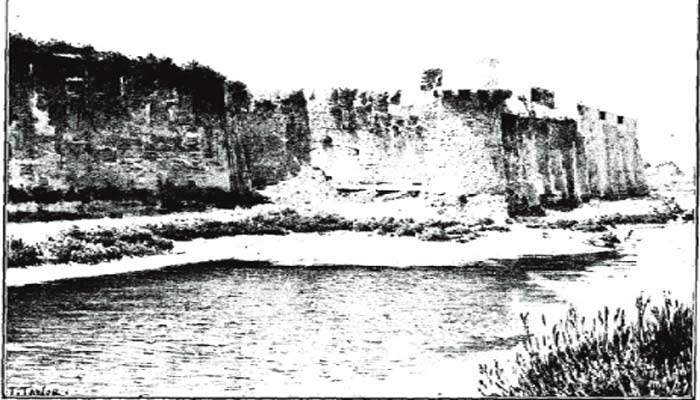
According to Montet, Mazagan is an "important commercial city, of fifteen to twenty thousand inhabitants, (...) which has preserved its superb Portuguese fortifications in perfect condition. A small port, where only barges can enter, is attached to the customs; as for the ships, they anchor offshore, far from the underwater rocks that defend the approach to the city."
And the caid of the city sent the guest of Mazagan a sheep as "mouna". The next day, he went to his home. He is "an old man with an austere appearance; while offering us tea, he takes care not to let go of his rosary, which he counts while chatting. He affects great simplicity, and, I have been told, he only goes out mounted on a donkey, like poor people". According to the representative of the Makhzen, the Doukkala province had ninety thousand tents, or about three hundred thousand inhabitants.
Montet therefore arrived in Mazagan on 9 December 1900, coming from Azemmour, and left the next day. He was hosted by the French consul in the city, Joseph Brudo, who had "prepared rooms in his hospitable home and did not (want) at any price for us to sleep in a tent". The latter, writes Joseph Goulven in "The Establishment of the first Europeans in Mazagan during the 19th century", was sent by "the Altaras House (...) in 1856 (...) to Morocco for the recovery of some of its outstanding debts in Mogador. After he had fulfilled the object of his mission, Joseph Brudo immediately established himself on his own account (1857) and chose Mazagan as his habitual residence; he acquired, early on, a predominant place among the merchants of the city. It is to this influence, which came to him from his great qualities, that he owed being chosen, in 1866, as consular agent of France in Mazagan". "He even pushed his zeal," adds the former head of the Civil Services Office of Morocco who worked at the El Jadida municipality between 1915 and 1920, "to the point of creating, around 1890-1891, a French postal service in Morocco and receiving, at his own expense, all the missions that the French government sent to Morocco. The Brudo house was reputed to be the house of France in Mazagan: the Tissots, Ordegas, Erckmanns, Schlumbergers, Burckarts, Douttés, etc., etc., were received there with open arms."
At his table, Brudo serves his guests a "superb chebel (shad) caught in the Oum Errbia, it is one of the first caught in this season, and which, as such, should have been sent to the sultan; it is therefore a royal dish that we are putting under our teeth".
According to Montet, Mazagan is an "important commercial city, of fifteen to twenty thousand inhabitants, (...) which has preserved its superb Portuguese fortifications in perfect condition. A small port, where only barges can enter, is attached to the customs; as for the ships, they anchor offshore, far from the underwater rocks that defend the approach to the city."
And the caid of the city sent the guest of Mazagan a sheep as "mouna". The next day, he went to his home. He is "an old man with an austere appearance; while offering us tea, he takes care not to let go of his rosary, which he counts while chatting. He affects great simplicity, and, I have been told, he only goes out mounted on a donkey, like poor people". According to the representative of the Makhzen, the Doukkala province had ninety thousand tents, or about three hundred thousand inhabitants.
"Tea," writes Montet in another passage of his story, "loosens the tongue of a Moroccan". Therefore, around the "three mandatory glasses of green mint tea, saturated with sugar" offered by the caid, the latter "expresses himself in very vivid terms about the lamentable state of Morocco, the abuses of the administration, and the tyranny of the Makhzen. It is he who, a few years earlier, said to a French officer: Come then to Morocco, you French!". And the theologian draws from these remarks the conclusion that supports his intimate conviction: "The more I come into contact with Moroccans, the more I am convinced (...) of the desire highly expressed by many Moroccans in all social spheres for a protectorate, and especially a French protectorate".
In another chapter of his story, Montet recounts, while he is invited to the home of a rich merchant in Rabat, the unfolding of the tea ceremony in the Moroccan fashion, a description that deserves to be reported: "A slave brings a tray, teapot and samovar, of European origin, white cups and small colored glasses, of the same origin, sugar, green tea, and fresh mint. Mint is the only authentically Moroccan product and the favorite drink of the people of Maghreb El-Aksa. The master of the house prepares the tea himself. (...) When the infusion (of mint) is finished, he fills, not the cups, but the glasses alone, which are offered by the master of the house himself. (...) The reader will have noticed that we drank tea in colored glasses, and that we did not use the white cups. Every time we were invited to have tea at a Moroccan's home, it was like this. Here is the explanation for this fact. In Morocco, where arsenic poisonings are frequent, white porcelain cups are used for this purpose of homicide, where the arsenical powder goes unnoticed. The use of colored glasses is intended to prevent an attack of this kind, and it is an act of frankness and politeness towards the guest to present him with tea in a cup, which guarantees him by its color, so to speak, his life."
After praising "the inexhaustible kindness of (his) hosts and friends (met in Mazagan) in the European colony and among the Muslims", Montet testifies that the city is "of all the cities on the coast open to Europeans, the one where they enjoy the greatest security"; and this "in some even where Morocco has been very agitated and where the authority of the sultan was very shaken, (...) calm has always reigned over Mazagan, and the Europeans have not had to fear the violence of which, elsewhere, they would have infallibly been the victims, if they had not prudently retreated to this stronghold. Its Portuguese walls seem to be a symbol of the safety that the European colony enjoys under their protection".
"This exceptional peace and tranquility, he asserts, which are the precious privilege of Mazagan" are demonstrated by several facts, of which he recalls two. "The first is the habit that Europeans have taken, for several years, to build, outside the walls, shops, warehouses, and even residential houses"; and to conclude: "Security must really be very great and one must feel in Mazagan sheltered from raids and looting, to do what nowhere else, in Morocco, with the exception of Tangier (and Larache), (...) one dares to attempt."
In another chapter of his story, Montet recounts, while he is invited to the home of a rich merchant in Rabat, the unfolding of the tea ceremony in the Moroccan fashion, a description that deserves to be reported: "A slave brings a tray, teapot and samovar, of European origin, white cups and small colored glasses, of the same origin, sugar, green tea, and fresh mint. Mint is the only authentically Moroccan product and the favorite drink of the people of Maghreb El-Aksa. The master of the house prepares the tea himself. (...) When the infusion (of mint) is finished, he fills, not the cups, but the glasses alone, which are offered by the master of the house himself. (...) The reader will have noticed that we drank tea in colored glasses, and that we did not use the white cups. Every time we were invited to have tea at a Moroccan's home, it was like this. Here is the explanation for this fact. In Morocco, where arsenic poisonings are frequent, white porcelain cups are used for this purpose of homicide, where the arsenical powder goes unnoticed. The use of colored glasses is intended to prevent an attack of this kind, and it is an act of frankness and politeness towards the guest to present him with tea in a cup, which guarantees him by its color, so to speak, his life."
After praising "the inexhaustible kindness of (his) hosts and friends (met in Mazagan) in the European colony and among the Muslims", Montet testifies that the city is "of all the cities on the coast open to Europeans, the one where they enjoy the greatest security"; and this "in some even where Morocco has been very agitated and where the authority of the sultan was very shaken, (...) calm has always reigned over Mazagan, and the Europeans have not had to fear the violence of which, elsewhere, they would have infallibly been the victims, if they had not prudently retreated to this stronghold. Its Portuguese walls seem to be a symbol of the safety that the European colony enjoys under their protection".
"This exceptional peace and tranquility, he asserts, which are the precious privilege of Mazagan" are demonstrated by several facts, of which he recalls two. "The first is the habit that Europeans have taken, for several years, to build, outside the walls, shops, warehouses, and even residential houses"; and to conclude: "Security must really be very great and one must feel in Mazagan sheltered from raids and looting, to do what nowhere else, in Morocco, with the exception of Tangier (and Larache), (...) one dares to attempt."
The second trait reported by the author is "the existence (...) of a private post, whose history confirms the good reputation of this peaceful city." It is, obviously, the postal service between Mazagan and Marrakech, founded by Joseph Brudo, which had its own stamps and whose Rekkas (couriers) connected the two cities in three days in general, sometimes even two, by relaying each other, while "hurried travelers, and who do not carry numerous bags with them, can make the trip in five days."
Charity and begging
Montet also praises the charity of the Mazaganais in particular and Moroccans in general, reporting two anecdotal facts. A French traveler arrives one evening, very tired and with an empty stomach, in a foundouk in the city. Beggars ask him what he would like to eat. Bread and butter, he replies. And one of them goes to beg for the food in the city and brings it to him. Second anecdote: a beggar stationed in front of one of the gates of Mazagan was soliciting a sum equal to the price of a donkey. After several days spent shouting in vain, a rich personage of the city was touched by his complaints and granted him the sum necessary for the purchase of the donkey, about twenty pesetas. And since then, no one saw the beggar in front of the city gate anymore.
Concerning begging, Montet qualifies it as being "one of the plagues of Morocco; it is due in part (...) to the general misery produced by the tyranny of the sultan". And to affirm that the fact relating to the beggar soliciting the price of a donkey that he cited, shows "to what extent the Moroccan in comfort is charitable, and can be exploited by professional beggars".
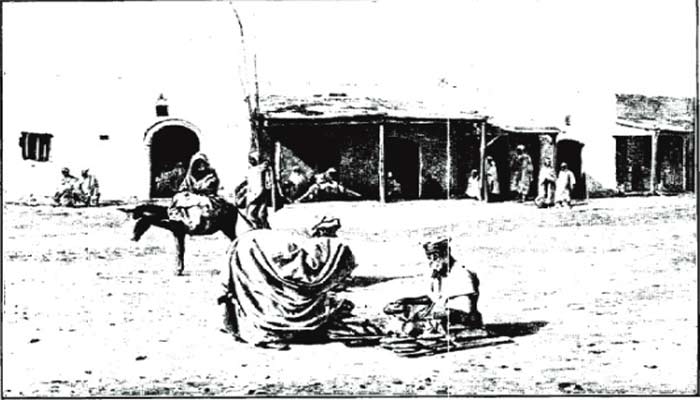
In Mazagan, the market is held outside the walls, explains Montet. He stops there in front of the shop of what he calls an "indigenous doctor", a modest tent. Our doctor questions his patients, gives them the appropriate remedy (herbs and seeds), to which he adds a magic formula written by him on a piece of paper and recommends that they absorb both the remedy and the paper. However, Montet acknowledges that indigenous doctors know how to apply various modes of dressings, treat fractures, and know the therapeutic use of certain plants and some mineral waters.
When Montet prepares to leave Mazagan, the "austere and miserly caid" of the city wants to honor him by having him accompanied, him and his travel companions, by one of his soldiers. Thus, he sends them "a ragged mkhâzni of repulsive filth; the poor devil is mounted on a horse that has not been groomed for a long time, and whose flanks are covered with a thick layer of manure".
Charity and begging
Montet also praises the charity of the Mazaganais in particular and Moroccans in general, reporting two anecdotal facts. A French traveler arrives one evening, very tired and with an empty stomach, in a foundouk in the city. Beggars ask him what he would like to eat. Bread and butter, he replies. And one of them goes to beg for the food in the city and brings it to him. Second anecdote: a beggar stationed in front of one of the gates of Mazagan was soliciting a sum equal to the price of a donkey. After several days spent shouting in vain, a rich personage of the city was touched by his complaints and granted him the sum necessary for the purchase of the donkey, about twenty pesetas. And since then, no one saw the beggar in front of the city gate anymore.
Concerning begging, Montet qualifies it as being "one of the plagues of Morocco; it is due in part (...) to the general misery produced by the tyranny of the sultan". And to affirm that the fact relating to the beggar soliciting the price of a donkey that he cited, shows "to what extent the Moroccan in comfort is charitable, and can be exploited by professional beggars".
In Mazagan, the market is held outside the walls, explains Montet. He stops there in front of the shop of what he calls an "indigenous doctor", a modest tent. Our doctor questions his patients, gives them the appropriate remedy (herbs and seeds), to which he adds a magic formula written by him on a piece of paper and recommends that they absorb both the remedy and the paper. However, Montet acknowledges that indigenous doctors know how to apply various modes of dressings, treat fractures, and know the therapeutic use of certain plants and some mineral waters.
When Montet prepares to leave Mazagan, the "austere and miserly caid" of the city wants to honor him by having him accompanied, him and his travel companions, by one of his soldiers. Thus, he sends them "a ragged mkhâzni of repulsive filth; the poor devil is mounted on a horse that has not been groomed for a long time, and whose flanks are covered with a thick layer of manure".

"The man and the beast," he remarks, "are of such a repulsive appearance and smell so bad, that (his) people themselves, who are hardly difficult, but who are clean, are nauseated by it." Thus, and after a few minutes of walking, the Frenchman heading towards Marrakech hastened "to send back to his master this unworthy traveling companion".
By Saïd Ahid
*) A summary of this article was presented during the XIIth Colloquium "Morocco-Portugal: History and heritage in sharing", entitled "Mazagan world heritage 20 years later: achievements and expectations" and organized, on 27 December 2024 in El Jadida, by the Centre for Studies and Research on Moroccan-Lusitanian Heritage in collaboration with other institutions.
By Saïd Ahid
*) A summary of this article was presented during the XIIth Colloquium "Morocco-Portugal: History and heritage in sharing", entitled "Mazagan world heritage 20 years later: achievements and expectations" and organized, on 27 December 2024 in El Jadida, by the Centre for Studies and Research on Moroccan-Lusitanian Heritage in collaboration with other institutions.
