

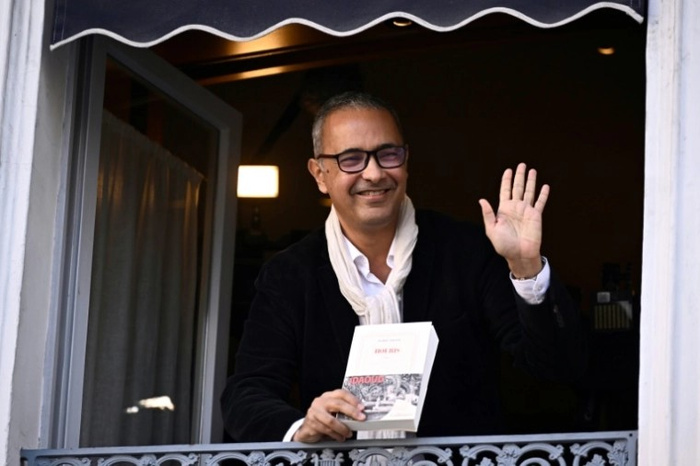
For this summons, also revealed by Mediapart on Friday, a first procedural hearing is scheduled for the afternoon of May 7 at the Paris Judicial Court, AFP learned from a source close to the case.
According to this source, the summons was served on Thursday to the writer, during a book signing near Bordeaux, and to Gallimard.
Contacted by AFP, Gallimard did not wish to comment.
"Houris", which in the Muslim faith refers to the young women promised in paradise, is a dark novel set partly in Oran about the fate of Aube, a young woman who has been mute since an Islamist slit her throat on December 31, 1999.
Ms. Arbane had stated in mid-November on the Algerian channel One TV that the character of Aube was modelled on her story, as she is a survivor of an attempted throat-slitting perpetrated in 2000 by jihadists and has since worn a cannula (to breathe and speak, Ed.). Kamel Daoud had known her as a patient of his wife Aicha Dehdouh, a psychiatrist, between 2015 and 2023.
Supported by numerous attestations, Ms. Arbane is requesting 200,000 euros in damages in her summons, as well as publicity for any potential conviction, because a "fortuitous nature" of the resemblance is "totally unthinkable".
The plaintiff did not wish for her story to become public and "never gave her consent for her narrative to be used by Mr. Daoud", the summons insists, "despite the three requests" alleged, between 2021 and this autumn.
On the contrary, Saâda Arbane was "determined that in no way should this narrative, which is very singular, intimate, and unique, be used by anyone", especially since it could lead to criminal prosecution in Algeria.
The summons cites an interview with the writer in September in L'Obs, which asked him if his book was inspired by a real woman. The author of "The Meursault Investigation", winner of the 2015 Goncourt for a first novel, had replied: "Yes, I knew a woman with a cannula (...). She was the real metaphorisation of this story".
The document also cites two medical specialists in France and Algeria who attest to the unprecedented and unique nature of Ms. Arbane's injury.
Finally, the document lists several dozen passages from "Houris" regarding the heroine "Aube's" family, the attack she suffered, her scars, or her tattoos. They are considered close to Ms. Arbane's life and therefore as evidence of the alleged "plundering".
"This procedure, in the judicial history of privacy violations under the guise of fiction, is absolutely exceptional", affirmed to AFP Mr. William Bourdon and Lily Ravon, lawyers for Ms. Arbane.
"It is so by the scale of the borrowings, by the repeated bad faith, and even more so the cynicism of Kamel Daoud, and by the very serious damages suffered", according to the counsel.
"Mr. Daoud presents himself as an engaged writer, but in any case, he has detached himself, by writing this book, from all ethics, from respect for women's rights, and from the respect he owed to a person he knew, Ms. Saâda Arbane", they also believe.
The Franco-Algerian writer was already targeted by a complaint from Ms. Arbane in his country of origin.
He had stated in mid-December on France Inter that "everyone knows (this) story in Algeria, and especially in Oran. It is a public story".
"The fact that she recognises herself in a novel that does not cite her, that does not tell her life, that does not tell the details of her life, I am sorry", the writer had continued.
His publisher Gallimard had denounced the "violent defamatory campaigns orchestrated (against the writer) by certain media close to a regime whose nature is known to all".
"Houris" cannot be published in Algeria, as it falls under a law prohibiting any work on the "Black Decade" between 1992 and 2002, which left at least 200,000 dead, according to official figures.
Mr. Daoud had also approved the idea that the plaintiff was being "manipulated by the regime" of which he is a critic.