

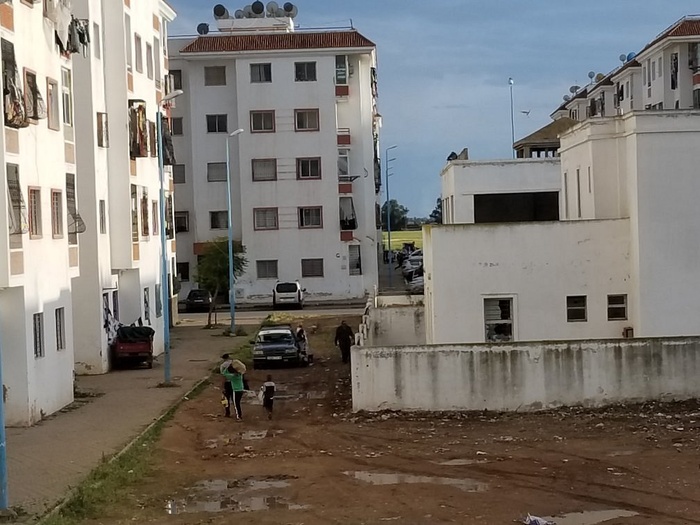
In the heart of Deroua, an illegal dump spreads over several hectares of land. For more than thirty years, this informal landfill has been piling up, degrading the living environment of the inhabitants, polluting the environment, and poisoning the air, water, and soil. These are thousands of cubic meters of garbage dumped without control, without sorting or precaution, generating devastating consequences on the health of the population.
"We can no longer live with this monster in front of our houses," laments Manar, 34, a mother of three children, living in the Al Massira neighborhood, not far from the dump. "Every morning, as soon as I open my windows, a pestilential odor gets into all the rooms. My children and I are constantly coughing. My 7-year-old son has asthma, the doctor tells me it's the fumes from the dump."
Her modest house is located just a few dozen meters from the first mounds of garbage. Behind the concrete wall supposed to delimit the site, the dump takes on worrying proportions. Tires, plastic bottles, rubble, market scraps, and carcasses of dead cats... Everything piles up pell-mell, forming real hills of waste.
Abdelaziz, 65, was born in the neighborhood and has seen this site grow over the years. "It was first a few pieces of rubble... then it was entire trucks of garbage that were dumped. Over time, the dump turned into an illegal dump. No one took the responsibility to develop or close it."
The inhabitants interviewed say that fires sometimes break out there, spreading thick clouds of black smoke over the city. "This smoke catches in the throat, it irritates the eyes. At night, some even lock themselves in their houses by sealing all the openings," explains Khadija, a merchant from the nearby Souk. "We live with this danger constantly, and it is the children and the weakest who suffer the most."
The consequences on health are alarming: chronic cough, rising cases of asthma, skin conditions, headaches... "My youngest daughter's doctor has seen the number of cases linked to the dump skyrocket in a few years," testifies Manar, and it is logical because the dump releases toxic gases and leachates that infiltrate the soil and contaminate the groundwater used by some inhabitants. It is a health catastrophe that is ignored until the harm is generalized.
However, Deroua has all the cards in hand, with the master plan of the Casablanca-Settat region, to tackle this scourge. It is a matter of finding the political will and allocating sufficient technical and financial resources. The illegal dump is not inevitable. With more responsible waste management policies, with the participation of citizens, the case of Deroua can find a way out. This is what the inhabitants hope for, what their health and dignity demand.
Houda BELABD
The authorities call for collective responsibility
Faced with this worrying situation, the local authorities claim to have taken the measure of the problem. The municipality, in coordination with the prefecture services, is currently working on the development of a site rehabilitation plan and the gradual transfer of waste to a controlled landfill. Awareness campaigns for the inhabitants have also been launched, encouraging them not to throw garbage on vacant lots or feed the existing black spot. Because if institutions are required to organize the collection and treatment of waste, a large part of illegal deposits also comes from repeated uncivil acts. The authorities thus insist on the need for collective involvement, believing that without a change in daily behavior, no sustainable solution will be possible.