

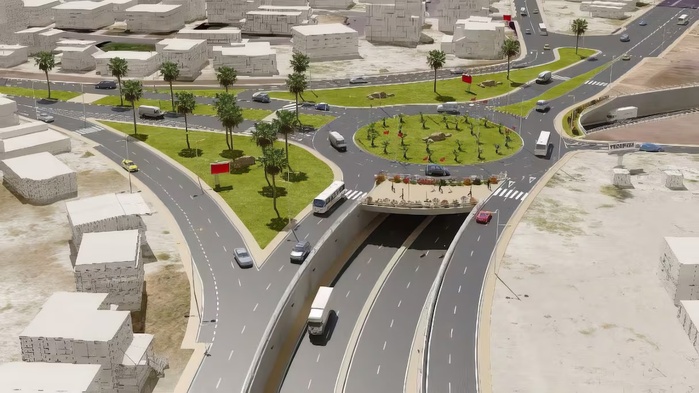
The Casablanca–Dar Bouazza–Benabid–Sidi Rahal Chataï road has officially acquired expressway status over nearly 32 kilometres. This section, which runs along the Atlantic and serves several residential and seaside hubs, constitutes, in this month of June, an essential link in the regional road network, both for daily commutes and seasonal tourism.
"Integrated into the national expressway extension programme, this infrastructure is the result of a significant development effort led by the Casablanca–Settat region," we learn via the Casablanca City Council. Indeed, the route has been widened to 2×2, or even 2×3 lanes in places, with the addition of underpasses, interchanges, and anti-flooding devices.
"The transformation of the road into an expressway is supported by parallel works on the regional roads RR320 and RR322, intended to streamline connections with the Casablanca agglomeration. Last May, the construction sites reached 10% and 30% progress respectively. These improvements are accompanied by reinforced signage, pavements, and service areas," our source continues.
In other words, starting this summer, the expressway becomes a mandatory route for temporary residents and tourists heading to the beaches of Dar Bouazza, Oued Merzeg, or Sidi Rahal. While detailed traffic data has not been published, estimates suggest peaks exceeding 100,000 vehicles per day near Casablanca, particularly at weekends.
The widening of the carriageways and the removal of certain intersections allow for better fluidity. Moreover, regular users highlight a reduction in travel time and a more serene driving experience, thanks to night lighting and the physical separation of traffic flows. However, several drivers report low tolerance for incidents: in the event of a breakdown or collision, the lanes can quickly become saturated.
The development is part of an overall vision supported by local authorities. The region has signed several co-financing agreements, notably for a 5 billion dirham envelope intended for the modernisation of coastal and peri-urban roads by 2027.
Furthermore, the Casablanca south-west bypass, currently being finalised, is set to connect the El Jadida motorway to Dar Bouazza to alleviate traffic towards the beaches. Other projects are underway or under study: the regional road 315 connecting Casablanca to Médiouna, raised and secured against flooding, as well as the future continental motorway between Rabat and Casablanca, planned as an alternative to the existing coastal axis.
Users are talking about it...
Testimonials collected on the ground confirm the interest of this route for the inhabitants. Karim, a resident of Dar Bouazza, notes: "In summer, we sometimes took an hour to cover a few kilometres. Today, we save nearly 15 minutes per trip."
For her part, Fatima, a resident of Sidi Rahal, insists on safety: "We feel more comfortable at night. The improvements have really changed the game." As for Youssef, a taxi driver serving the beaches south of the Metropolis, he tempers: "The new lanes are practical, but there is still a lack of regulation devices in case of an accident."
Houda BELABD
A framework for the mobility of tomorrow
The development of the Casablanca–Sidi Rahal expressway responds to a dual logic: to absorb the rapid urban growth of the south-west peripheries of Casablanca and to strengthen the tourist attractiveness of the coast. The region, being in line with the mobility objectives linked to the 2025 Africa Cup of Nations and the 2030 World Cup, is banking on a structural modernisation of its road network.
There is no shortage of challenges: maintaining the quality of the carriageways, managing traffic flows, securing secondary access points, and coordinating with urbanisation projects. But as it stands, this infrastructure represents an important lever to support the territorial dynamics of the region.