

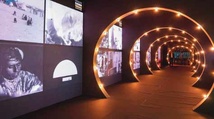
The Minister of Youth, Culture and Communication, Mohamed Mehdi Bensaid, presided over the official inauguration ceremony of the Moroccan Cinematheque on Saturday at the headquarters of the Moroccan Cinematographic Centre in Rabat.
Following the example of international cinematheques, this new structure aims to offer a space dedicated to the conservation, documentation and restoration of the national cinematographic heritage, as well as the promotion of Moroccan and international cinematographic works.
In this regard, Mr. Bensaid affirmed that the Moroccan Cinematheque will work towards establishing strategic partnerships capable of restoring Moroccan cinematographic and documentary works.
In a statement to the press, the Minister stressed that this establishment aims to strengthen Morocco's position in the global cinematographic landscape, noting that young Moroccans "aspire to know the history of national cinema, which makes the Cinematheque an essential space for preserving this cultural heritage and bringing it closer to new generations".
He added that the Cinematheque will benefit from the necessary support to achieve its objectives in terms of conservation, restoration and enhancement of the national cinematographic heritage, through the provision of the necessary means and resources to enable it to carry out its mission optimally.
Speaking on this occasion, the director of the Moroccan Cinematheque, Narjiss Nejjar, indicated that the mission of the Cinematheque is based on three fundamental pillars, namely "conservation, transmission and inspiration", with a precious collection of films representing various eras and cinematographic schools.
Ms. Nejjar announced that the Cinematheque will organise, starting in April, a 100-day "cinematographic marathon", during which 100 films representing a century of Moroccan, Arab, African and international cinema will be screened.
She expressed the hope that the Moroccan Cinematheque would become a beacon of cultural and artistic influence.
The inauguration ceremony was enhanced by the presence of André Azoulay, Advisor to His Majesty the King, as well as eminent personalities from the world of art and culture.
Culture broth
Colloquium
A scientific colloquium on the contributions of academician Salem Chaker will be held on 18 and 19 February in Rabat, under the theme "A legacy of words and knowledge", at the initiative of the National Library of the Kingdom of Morocco.
This meeting is organised in tribute to Professor Salem Chaker, an eminent specialist and academician in Amazigh linguistics, who generously donated his personal library to the National Library of the Kingdom of Morocco, a statement said.
This event will highlight the academic contributions and the research career of this former professor at the National Institute of Oriental Languages and Civilisations in Paris (INALCO) and then at the University of Aix-Marseille, who notably directed the "Berber Encyclopedia".
The programme for this meeting includes an inaugural session dedicated to the collections of Salem Chaker, donated to the National Library, as well as a study day chaired by Abdellah Bounfour of INALCO.
The second session, entitled "Anthropology and diachronic linguistics" will be held under the chairmanship of Meftaha Ameur of the Sidi Mohamed Ben Abdellah University of Fez, with the participation of Hélène Claudot-Hawad (CNRS, Aix-en-Provence), as well as Abdellah Bounfour and Malika Assam (University of Aix-Marseille).
The third session on "Descriptive linguistics and diachronic linguistics" will be chaired by Hélène Claudot-Hawad, with interventions by Meftaha Ameur, Abdellah Boumalk (Royal Institute of Amazigh Culture, Rabat) and Kamel Nait-Zerrad (INALCO, Paris).
This colloquium will close with a fourth and final session on the theme "History and diachronic linguistics", led by Jorge Pintado, with contributions from Ahmed M’charek (University of Tunis), Abdellah Fili (Chouaïb Doukkali University, El Jadida) and Mansour Ghaki (University of Tunis).