

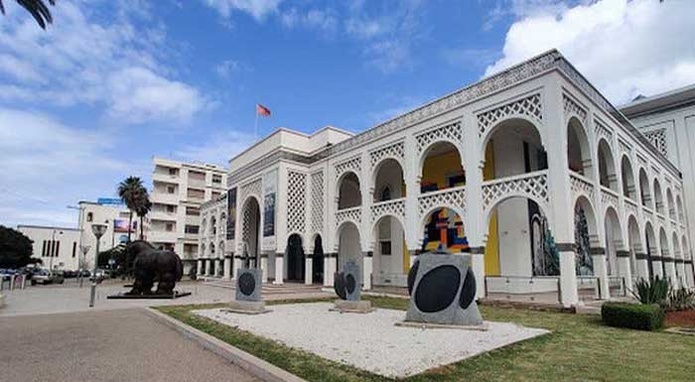
The prestigious American daily newspaper, The Washington Post, dedicated an article in its Saturday edition to the city of Rabat, a “historic seaside jewel” experiencing a museum “renaissance”.
In this article by Graham Cornwell, a historian specializing in the Middle East and North Africa, the newspaper indicates that Rabat has benefited from the investment momentum triggered in this sector within the Kingdom over recent years.
In this context, the specialist from George Washington University notes that Morocco has invested in its museum infrastructure, rehabilitating historic buildings to repurpose them for showcasing new collections across the country.
Within this architectural panorama of Morocco's capital, the Mohammed VI Museum of Modern and Contemporary Art stands out as a rare jewel, he indicates. This building was the spearhead of this “national” momentum in favor of museums.
The inauguration of this institution in 2014 attracted contemporary Moroccan and international artists and has led to exhibitions “ranging from Moroccan postcolonial art to works by expatriate Cuban painters”.
The Washington Post also cites the Bank Al-Maghrib Museum, “housed in an architectural masterpiece of a building that integrates Moroccan aesthetic flourishes into modern European design”.
This museum recounts millennia of Moroccan history through old coins and some of the best Moroccan paintings of the past century, the article's author notes.
Added to this mosaic is the National Museum of Photography, located in the picturesque L'Océan district, the daily adds, recalling that this space has just hosted an exhibition of “innovative” photographers from across Africa.
Among the works that are the pride of the capital, the publication also cites the Mohammed VI Tower, the tallest in Africa, the Grand Theatre of Rabat, and the historic site of Chellah.
In this article, embellished with beautiful photos illustrating facets of the cultural and social life of the capital, the author also invites visitors to appreciate the tranquility that reigns in the alleys of the Medina of Rabat.
Collective exhibition
The opening of the collective visual art exhibition bringing together artists from the Ribat Al Fath Association for Sustainable Development took place on Saturday at the Mohamed Benali Rbati space in Rabat, as part of the 6th edition of the "Florilège Culturel" Festival.
This event aims to enrich the artistic and cultural landscape of the "City of Light" by highlighting fine arts and strengthening their presence in the city's cultural and artistic activities.
In a statement to MAP, the president of the cultural committee of the Ribat Al Fath Association, Abdelkamel Dinia, indicated that this collective exhibition, marked by the participation of about 30 artists, both men and women, aims to support Moroccan painters by offering them the opportunity to exhibit their works in this prestigious space.
The exhibition includes works by artists from various art schools, mainly graduates of Moroccan schools, as well as self-taught artists gifted with innate talent, including skilled portraitists, he added.
This artistic event is distinguished by strong participation from young people and women, exhibiting works dealing with the subject of artificial intelligence (AI), a topical issue, he noted.
In a similar statement, self-taught artist Omar Chennai highlighted the importance of "preserving the heritage that embodies the past and the present", affirming that his paintings are inspired by authentic Moroccan architecture such as Kasbahs and markets.
Visual artist Amina Costo noted that she participates in this exhibition every year with her paintings belonging to the intuitive art movement, emphasizing that she transitioned from carpet weaving to visual art.
For his part, Moroccan calligrapher and artist Naïm Idrissi specified that the works he presents in this collective exhibition highlight the beauty of Arabic calligraphy and its artistic and aesthetic value.
The 6th "Florilège Culturel" Festival (December 3-20), placed under the High Patronage of HM King Mohammed VI, offers a varied program including conferences, poetry readings, and art exhibitions.
